

Tetanus
Clostridium tetani infection
Also known as: Lockjaw
In short
Tetanus is a rare but life-threatening bacterial infection in dogs and cats. Caused by toxins from Clostridium tetani bacteria entering a wound, it leads to severe muscle stiffness, lockjaw, and spasms. Learn about the signs, diagnosis, and intensive care required for recovery.
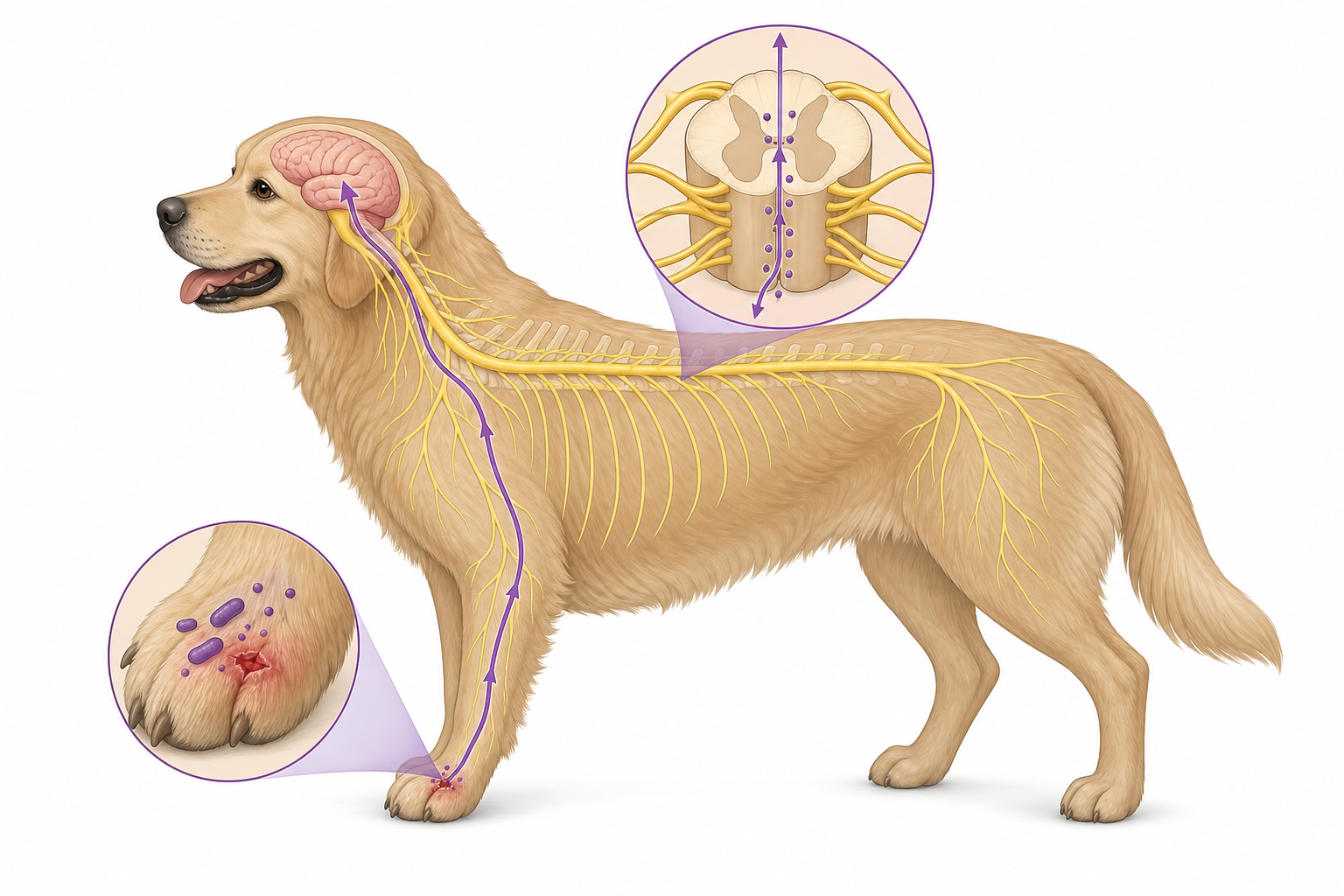
TL;DR. Tetanus is a severe, life-threatening neurological condition caused by bacterial toxins entering a wound, resulting in extreme muscle stiffness, lockjaw, and potentially fatal breathing complications.
Tetanus toxin travels backwards through the nerves to block inhibitory signals in the central nervous system.
What is it?
Tetanus is an uncommon but highly serious disease that affects the nervous system of dogs and cats. It is characterized by the sustained contraction of muscles without relaxation, leading to extreme stiffness. The condition is caused by a powerful toxin called tetanospasmin, which is produced by the bacterium Clostridium tetani. This bacterium is anaerobic, meaning it thrives in environments that lack oxygen, such as deep, enclosed wounds.
When Clostridium tetani bacteria contaminate a wound, they multiply and release tetanospasmin. This toxin binds irreversibly to the nerve terminals in the body. It then travels along the nerves to the central nervous system, where it blocks the release of inhibitory neurotransmitters (the chemical messengers that tell muscles to relax). Without these inhibitory signals, the motor nerves fire continuously, forcing the muscles into a state of constant, painful contraction.
While humans and horses are highly sensitive to tetanus, dogs and cats are fortunately more resistant to the toxin. However, when an infection does take hold in a dog or cat, it can progress rapidly and become a life-threatening emergency. Understanding the signs and seeking immediate veterinary care is vital for your pet's survival.
Causes & risk factors
Tetanus is not contagious; a pet cannot catch it from another animal. Instead, it is acquired from the environment. Clostridium tetani bacteria exist in soil, dust, and manure as highly resilient spores. These spores are incredibly hardy, as noted in a leading veterinary internal medicine reference:
"The spores are resistant to boiling water and an autoclave temperature of 120°C for up to 20 minutes. However, the vegetative phase of this bacterium is susceptible to chemical and physical inactivation. Organisms can be isolated from the feces of dogs, cats, and humans, but presence of the organism does not indicate infection because not all strains possess the plasmid."
The primary risk factor for developing tetanus is wound contamination. Common triggers include:
- Deep puncture wounds (such as stepping on a nail or receiving a bite wound)
- Surgical site contamination
- Severe lacerations or scrapes
- Foreign bodies embedded in the skin or paws
Because the bacteria thrive in oxygen-deprived environments, deep, narrow puncture wounds that heal over quickly on the surface provide the perfect breeding ground for the spores to germinate, multiply, and release their deadly toxin. There are no known breed predispositions for tetanus in either dogs or cats.
Signs to watch for
The symptoms of tetanus can develop anywhere from a few days to several weeks after the initial wound occurred. The signs may start localized to the area near the wound but often progress to affect the entire body.
Cardinal Signs
- Trismus (Lockjaw): Severe spasms of the jaw muscles that prevent the pet from opening its mouth.
- Risus Sardonicus: A characteristic facial grimace where the forehead skin is deeply wrinkled, the ears are pulled stiffly upright and close together, and the lips are pulled back.
Common Signs
- Stiff gait: A rigid, awkward walk, often progressing to a "sawhorse stance" where all four legs are splayed out stiffly.
- Elevated tail: The tail is held stiffly straight out or upward.
- Reflex muscle spasms: Sudden, violent muscle contractions triggered by minor sensory stimuli like sound, light, or touch.
- Recumbency: Inability to stand, leaving the pet lying rigidly on its side.
- Dysphagia: Difficulty swallowing, which can lead to drooling and an inability to eat.
- Protrusion of the third eyelid: The inner eyelid membrane sweeps across the eye.
- Enophthalmos: Sunken appearance of the eyes.
- Opisthotonos: A severe posture where the neck is arched backward and the limbs are rigidly extended.

Risus sardonicus is a cardinal sign of tetanus, characterized by a wrinkled forehead and stiffly erect ears.
Occasional Signs
- Constipation and urinary retention: The muscles controlling the bladder and bowels become too stiff to function properly.
- Respiratory paralysis: The muscles responsible for breathing become paralyzed, which is the primary cause of death.
- Autonomic dysfunction: Instability in the involuntary nervous system, causing wild fluctuations in heart rate, blood pressure, and body temperature.
As a leading veterinary critical care textbook notes:
"Involvement of the head can lead to spasms of the masticatory and pharyngeal muscles, causing trismus (lockjaw) and dysphagia. This can be exacerbated functionally by increased salivation, increased bronchial secretions, and increased respiratory rate resulting from involvement of the parasympathetic and somatic cranial nerve nuclei."
How vets diagnose it
Diagnosing tetanus is primarily presumptive, meaning your vet will make a diagnosis based on the pet's clinical signs and a history of a recent wound. Because the toxin binds quickly to the nerves, waiting for laboratory confirmation before starting treatment is dangerous.
To support the diagnosis and rule out other conditions, your vet may perform several tests:
- Measurement of serum antibodies to tetanospasmin: This is the gold standard diagnostic test, though results are rarely available quickly enough to guide initial emergency treatment.
- Gram stain and anaerobic culture of the wound: Your vet may take a swab of the suspected wound to look for the Clostridium tetani bacteria. However, failing to find the bacteria does not rule out tetanus, as the wound may have already healed or the bacterial numbers may be low.
- Serum creatine kinase (CK) measurement: This blood test measures muscle damage. Pets with tetanus often have highly elevated CK levels due to continuous, violent muscle contractions.
- Electromyography (EMG): This test evaluates the electrical activity of the muscles, which can confirm continuous motor unit activity.
- Radiography (X-rays): Chest and abdominal X-rays may be taken to look for secondary complications, such as aspiration pneumonia (caused by swallowing difficulties) or a foreign body in a wound.
Treatment options
Tetanus requires immediate, aggressive, and often prolonged veterinary treatment. Therapy is aimed at neutralizing the remaining toxin, eliminating the bacteria, controlling muscle spasms, and providing intensive supportive care.
First-Line Therapies
- Tetanus Antitoxin (Immunoserum): This injection contains antibodies that bind to and neutralize any circulating toxin that has not yet attached to the nerves. It cannot reverse the effects of toxin that is already bound. Because the antitoxin is derived from horse serum, it carries a risk of severe allergic reactions (anaphylaxis). Your vet will have emergency medications like epinephrine, glucocorticoids, and antihistamines (such as diphenhydramine) ready. A single dose is usually sufficient, as therapeutic levels persist for about 14 days.
- Antibiotics: To kill the vegetative bacteria and stop further toxin production, your vet will administer antibiotics. First-line choices include Metronidazole or Penicillin G.
- Muscle Relaxants and Sedatives: Diazepam (a benzodiazepine) is commonly used to reduce muscle rigidity, control spasms, and keep the pet calm.
Second-Line Therapies
If first-line antibiotics are not tolerated or unavailable, alternative antibiotics may be used, including:
Supportive Care
Supportive care is the cornerstone of tetanus recovery. Because sensory stimuli (like bright lights, sudden noises, or touch) can trigger severe, painful muscle spasms, hospitalized pets must be kept in a dark, quiet, heavily padded room.
If the pet cannot swallow, a feeding tube may be placed. Intravenous fluids are administered to maintain hydration, and urinary catheters may be required if the pet cannot urinate on its own. Physical therapy is initiated once the spasms begin to subside to prevent permanent muscle contracture.

A quiet, dark environment is essential during recovery to prevent sensory stimuli from triggering painful muscle spasms.
Prognosis
The prognosis for tetanus varies significantly depending on the severity of the disease.
- In Dogs: The overall mortality rate ranges from 18% to 50%. This is heavily dependent on the "severity class" of the disease. Dogs with Class I or II tetanus (localized stiffness or mild generalized stiffness where they can still walk and eat) have a 100% survival rate with prompt treatment. However, dogs with Class III or IV tetanus (recumbent, experiencing severe spasms, or suffering from autonomic nervous system instability) have a lower survival rate of approximately 58%.
- In Cats: Cats generally recover well from localized tetanus, though residual neurological or muscular deficits can persist for several months.
Recovery from tetanus is a very slow process. As a leading veterinary textbook explains:
"Neuronal binding of toxin is thought to be irreversible. Recovery requires the growth of new nerve terminals, which explains the long duration of tetanus."
It can take several weeks to months of dedicated nursing care for a pet to regain full mobility and normal muscle function.
Prevention
Unlike humans and horses, dogs and cats do not receive routine tetanus vaccinations. Because of their natural resistance to the toxin, the risk of the vaccine outweighs the risk of contracting the disease.
Prevention relies entirely on proper wound management:
- Clean all wounds immediately: Wash any cuts, scrapes, or bites thoroughly with clean water and mild soap.
- Seek prompt veterinary care: Any deep puncture wound, animal bite, or wound contaminated with dirt or soil should be evaluated by a veterinarian. Your vet may prescribe preventative antibiotics and thoroughly flush the wound to prevent anaerobic conditions from developing.
- Monitor healing: Keep a close eye on any healing wounds for signs of infection, swelling, or discharge, and contact your vet if you notice any changes.
When to call your vet
Tetanus is a veterinary emergency. If your pet has a history of a recent wound and begins showing any of the following signs, contact your veterinarian or an emergency animal hospital immediately:
- Stiffness in the limbs or a "sawhorse" stance
- Inability to open the mouth or difficulty swallowing
- A persistent facial grimace (wrinkled forehead, pulled-back lips)
- The third eyelid covering part of the eye
- Sudden, violent muscle spasms, especially in response to sound or touch
- Difficulty breathing or rapid, shallow breathing
Sources
- Small Animal Critical Care Medicine, 2nd Edition, pages 498-500.
- Textbook of Veterinary Internal Medicine, 5th Edition, pages 1130-1131.
My highlights & notes
Signs & symptoms
How it is diagnosed
- Measurement of serum antibodies to tetanospasminGold standard
- Anaerobic culture of wound
- Electromyography
- Gram stain of wound smear
- Presumptive diagnosis based on clinical signs and history of a recent wound
- Radiography
- Serum creatine kinase measurement
Treatment approaches
Treatment must be prescribed by a licensed veterinarian based on your pet. Specific drug doses are intentionally not shown here.
Frequently asked questions
What is Tetanus?
Tetanus is a rare but life-threatening bacterial infection in dogs and cats. Caused by toxins from Clostridium tetani bacteria entering a wound, it leads to severe muscle stiffness, lockjaw, and spasms. Learn about the signs, diagnosis, and intensive care required for recovery.
What are the symptoms of Tetanus?
risus sardonicus、trismus、Trouble swallowing (dysphagia)、Recumbency、Stiff gait、elevated tail、enophthalmos、erect ears
How is Tetanus diagnosed?
Measurement of serum antibodies to tetanospasmin、Anaerobic culture of wound、Electromyography、Gram stain of wound smear、Presumptive diagnosis based on clinical signs and history of a recent wound、Radiography
How is Tetanus treated?
Treatment must be prescribed by a licensed veterinarian based on your pet. Specific drug doses are intentionally not shown here.
Sources
- Small Animal Critical Care Medicine, 2nd Edition (VetBooks.ir) · p. 499
- Small Animal Critical Care Medicine, 2nd Edition (VetBooks.ir) · p. 498
- Internal Medicine 5th · p. 1131
- Small Animal Critical Care Medicine, 2nd Edition (VetBooks.ir) · p. 498
- Small Animal Critical Care Medicine, 2nd Edition (VetBooks.ir) · p. 500
- Internal Medicine 5th · p. 1130
This article is for general education and is not a substitute for professional veterinary advice. If your pet is unwell, please consult a veterinarian.
Worried about your pet?
Peqaboo’s AI helps you track symptoms, understand lab reports, and know when to see a vet.
Get the Peqaboo app