

Tetanus
Clostridium tetani infection
Aussi appelé: Lockjaw
En bref
Tetanus is a rare but life-threatening bacterial infection in dogs and cats. Caused by toxins from Clostridium tetani bacteria entering a wound, it leads to severe muscle stiffness, lockjaw, and spasms. Learn about the signs, diagnosis, and intensive care required for recovery.
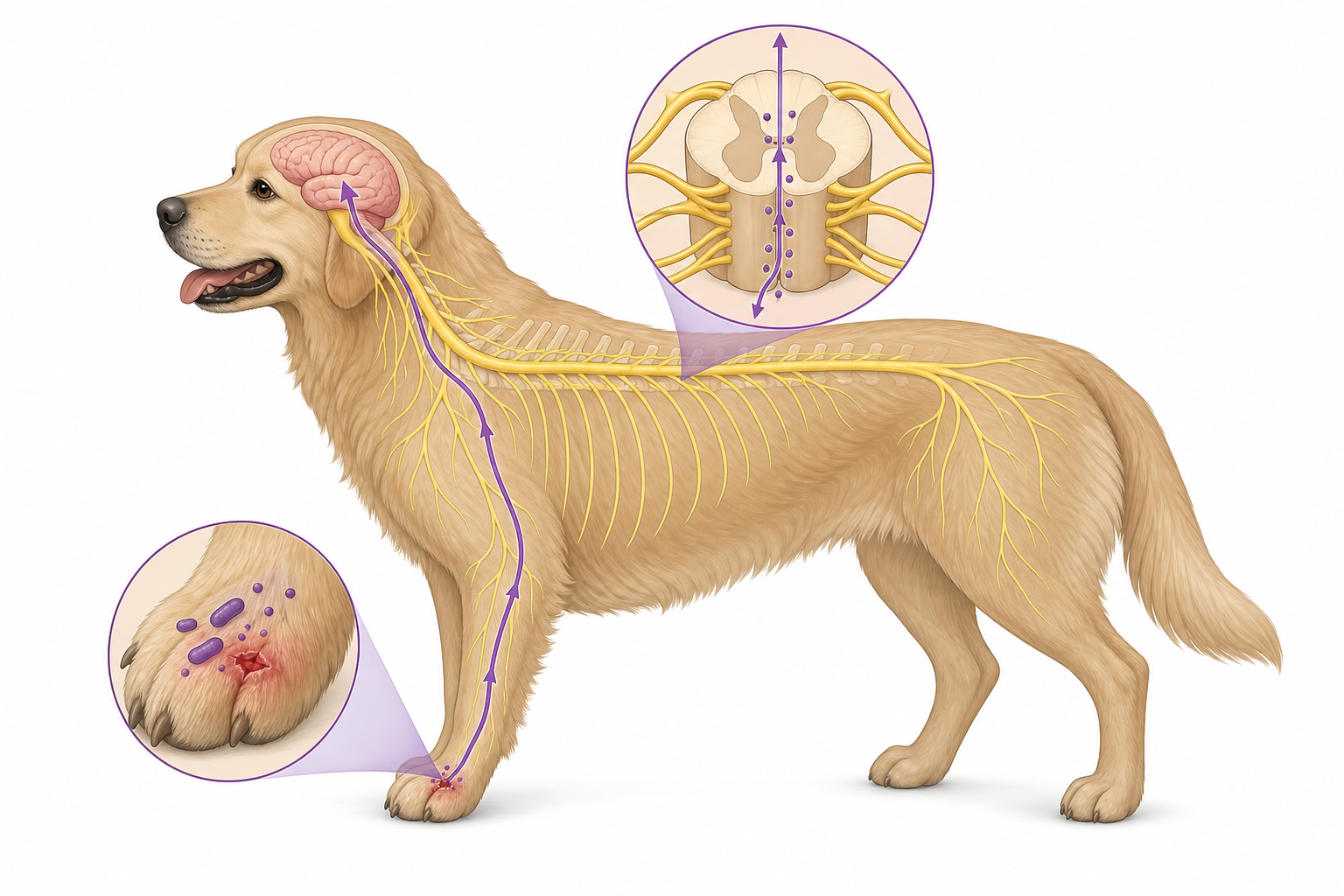
TL;DR. Le tétanos est une urgence neurologique grave due à des toxines bactériennes dans une plaie: rigidité musculaire extrême, trismus et risque de paralysie respiratoire.
La toxine tétanique chemine le long des nerfs et bloque les signaux inhibiteurs du SNC.
Qu'est-ce que c'est ?
Le tétanos est dû au tétanospasmine produit par Clostridium tetani, bactérie anaérobie des plaies profondes. La toxine se fixe irréversiblement aux terminaisons nerveuses, gagne le SNC et bloque les neurotransmetteurs inhibiteurs. Les nerfs moteurs déchargent en continu; les muscles restent en contraction douloureuse. Chien et chat sont plus résistants que l'humain ou le cheval, mais les cas cliniques sont des urgences.
Causes et facteurs de risque
Non contagieux. Spores dans sol, poussière et fumier:
"The spores are resistant to boiling water and an autoclave temperature of 120°C for up to 20 minutes. However, the vegetative phase of this bacterium is susceptible to chemical and physical inactivation. Organisms can be isolated from the feces of dogs, cats, and humans, but presence of the organism does not indicate infection because not all strains possess the plasmid."
Déclencheurs: plaies perforantes, morsures, sites chirurgicaux contaminés, corps étrangers. Pas de prédisposition de race.
Signes à surveiller
Cardinaux: trismus; risus sardonicus (front ridé, oreilles raides, lèvres tirées).
Fréquents: démarche raide/posture en chevalet, queue raide, spasmes réflexes aux stimuli, décubitus, dysphagie, 3e paupière, énophtalmie, opisthotonos.
Occasionnels: constipation, rétention urinaire, paralysie respiratoire, dysfonction autonome.

Le risus sardonicus est un signe cardinal du tétanos.
"Involvement of the head can lead to spasms of the masticatory and pharyngeal muscles, causing trismus (lockjaw) and dysphagia. This can be exacerbated functionally by increased salivation, increased bronchial secretions, and increased respiratory rate resulting from involvement of the parasympathetic and somatic cranial nerve nuclei."
Comment les vétérinaires diagnostiquent
Surtout clinique (signes + histoire de plaie). Appui: anticorps sériques anti-tétanospasmine (gold, lent), Gram/culture anaérobie, CK, EMG, radiographies si complications.
Options de traitement
- Antitoxine tétanique: neutralise la toxine circulante (pas celle déjà liée); risque d'anaphylaxie.
- Antibiotiques: métronidazole ou pénicilline G; alternatives clindamycine, doxycycline, tétracycline.
- Relaxants/sédatifs: diazépam.
- Support: pièce sombre, calme, rembourrée; sonde alimentaire, fluides i.v., sonde urinaire si besoin.

Un environnement calme et sombre limite les spasmes déclenchés par les stimuli.
Pronostic
Chien: mortalité ~18–50 %; classes I–II souvent 100 % de survie, III–IV ~58 %. Chat: local souvent bon, déficits possibles pendant des mois.
"Neuronal binding of toxin is thought to be irreversible. Recovery requires the growth of new nerve terminals, which explains the long duration of tetanus."
Prévention
Pas de vaccination de routine chez chien/chat. Nettoyer toute plaie; plaies profondes/sales: avis vétérinaire.
Quand appeler le vétérinaire
Urgence si rigidité, trismus, grimace, 3e paupière, spasmes au bruit/toucher ou détresse respiratoire après plaie.
Sources
- Small Animal Critical Care Medicine, 2nd Edition, pages 498-500.
- Textbook of Veterinary Internal Medicine, 5th Edition, pages 1130-1131.
My highlights & notes
Signes et symptômes
Comment c’est diagnostiqué
- Measurement of serum antibodies to tetanospasminRéférence
- Anaerobic culture of wound
- Electromyography
- Gram stain of wound smear
- Presumptive diagnosis based on clinical signs and history of a recent wound
- Radiography
- Serum creatine kinase measurement
Approches de traitement
Le traitement doit être prescrit par un vétérinaire agréé selon votre animal. Les doses précises ne sont volontairement pas affichées.
Questions fréquentes
What is Tetanus?
Tetanus is a rare but life-threatening bacterial infection in dogs and cats. Caused by toxins from Clostridium tetani bacteria entering a wound, it leads to severe muscle stiffness, lockjaw, and spasms. Learn about the signs, diagnosis, and intensive care required for recovery.
What are the symptoms of Tetanus?
risus sardonicus、trismus、Trouble swallowing (dysphagia)、Recumbency、Stiff gait、elevated tail、enophthalmos、erect ears
How is Tetanus diagnosed?
Measurement of serum antibodies to tetanospasmin、Anaerobic culture of wound、Electromyography、Gram stain of wound smear、Presumptive diagnosis based on clinical signs and history of a recent wound、Radiography
How is Tetanus treated?
Le traitement doit être prescrit par un vétérinaire agréé selon votre animal. Les doses précises ne sont volontairement pas affichées.
Sources
- Small Animal Critical Care Medicine, 2nd Edition (VetBooks.ir) · p. 499
- Small Animal Critical Care Medicine, 2nd Edition (VetBooks.ir) · p. 498
- Internal Medicine 5th · p. 1131
- Small Animal Critical Care Medicine, 2nd Edition (VetBooks.ir) · p. 498
- Small Animal Critical Care Medicine, 2nd Edition (VetBooks.ir) · p. 500
- Internal Medicine 5th · p. 1130
Cet article est informatif et ne remplace pas un avis vétérinaire. Si votre animal est malade, consultez un vétérinaire.
Inquiet pour votre animal ?
L’IA Peqaboo aide à suivre les symptômes, comprendre les analyses et savoir quand consulter.
Télécharger l’app Peqaboo