

Tetanus
Clostridium tetani infection
También conocido como: Lockjaw
En resumen
Tetanus is a rare but life-threatening bacterial infection in dogs and cats. Caused by toxins from Clostridium tetani bacteria entering a wound, it leads to severe muscle stiffness, lockjaw, and spasms. Learn about the signs, diagnosis, and intensive care required for recovery.
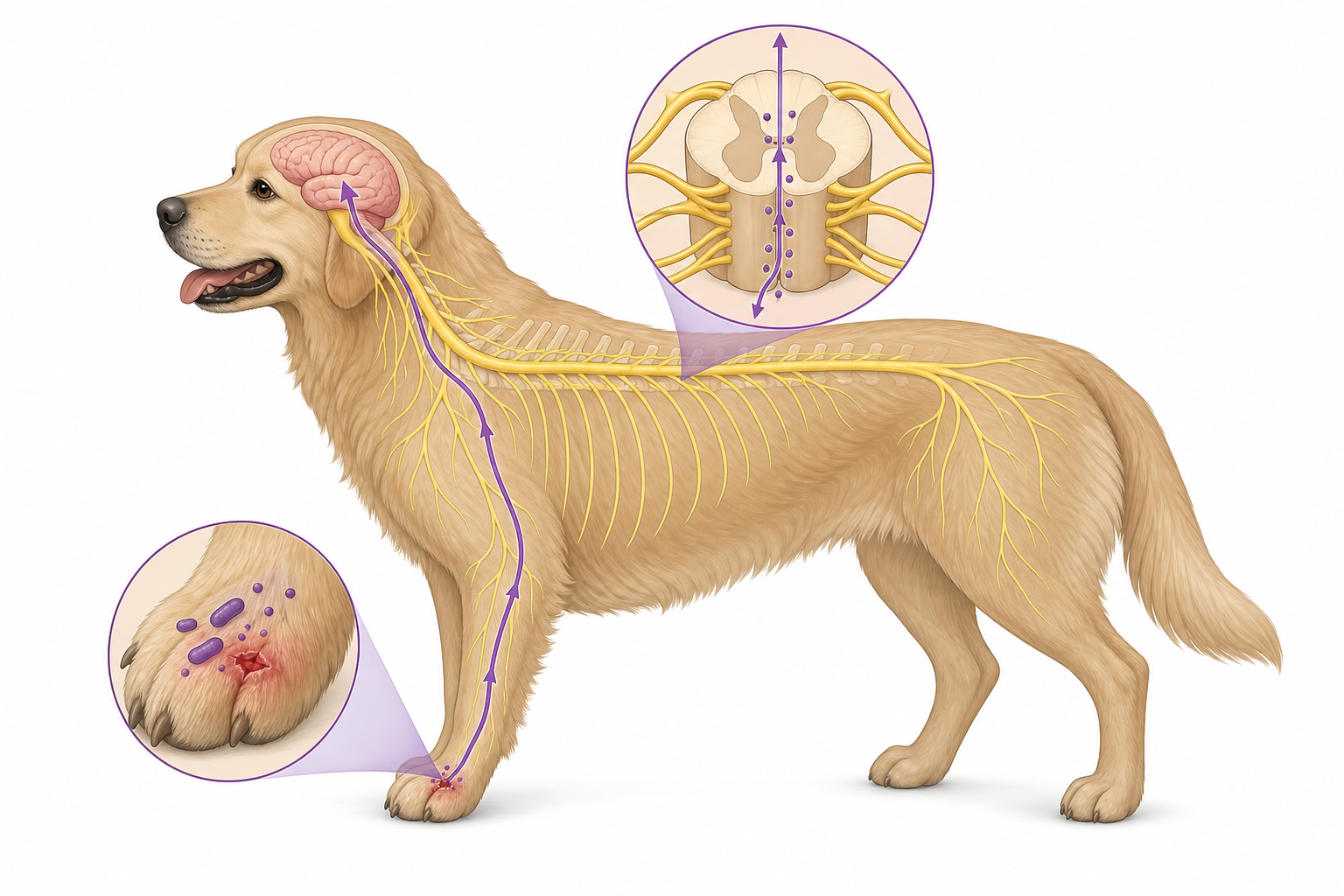
TL;DR. El tétanos es una emergencia neurológica grave por toxinas bacterianas en una herida: rigidez muscular extrema, trismo y riesgo de parálisis respiratoria.
La toxina tetánica viaja por los nervios y bloquea las señales inhibitorias del SNC.
¿Qué es?
El tétanos lo produce la tetanospasmina de Clostridium tetani, bacteria anaerobia de heridas profundas. La toxina se une de forma irreversible a las terminales nerviosas, llega al SNC y bloquea los neurotransmisores inhibitorios. Los nervios motores descargan sin freno; los músculos quedan en contracción dolorosa. Perro y gato son más resistentes que el humano o el caballo, pero los casos clínicos son emergencias.
Causas y factores de riesgo
No es contagioso. Esporas en suelo, polvo y estiércol:
"The spores are resistant to boiling water and an autoclave temperature of 120°C for up to 20 minutes. However, the vegetative phase of this bacterium is susceptible to chemical and physical inactivation. Organisms can be isolated from the feces of dogs, cats, and humans, but presence of the organism does not indicate infection because not all strains possess the plasmid."
Desencadenantes: heridas punzantes, mordidas, sitios quirúrgicos contaminados, cuerpos extraños. Sin predisposición racial.
Signos a vigilar
Cardinales: trismo; risus sardonicus (frente arrugada, orejas rígidas, labios retraídos).
Frecuentes: marcha rígida/postura de caballete, cola rígida, espasmos reflejos a estímulos, decúbito, disfagia, 3er párpado, enoftalmos, opistótonos.
Ocasionales: estreñimiento, retención urinaria, parálisis respiratoria, disfunción autonómica.

El risus sardonicus es un signo cardinal del tétanos.
"Involvement of the head can lead to spasms of the masticatory and pharyngeal muscles, causing trismus (lockjaw) and dysphagia. This can be exacerbated functionally by increased salivation, increased bronchial secretions, and increased respiratory rate resulting from involvement of the parasympathetic and somatic cranial nerve nuclei."
Cómo lo diagnostican los veterinarios
Principalmente clínico (signos + historia de herida). Apoyo: anticuerpos séricos anti-tetanospasmina (gold, lento), tinción de Gram/cultivo anaerobio, CK, EMG, radiografías si hay complicaciones.
Opciones de tratamiento
- Antitoxina tetánica: neutraliza toxina circulante (no la ya unida); riesgo de anafilaxia.
- Antibióticos: metronidazol o penicilina G; alternativas clindamicina, doxiciclina, tetraciclina.
- Relajantes/sedantes: diazepam.
- Soporte: sala oscura, silenciosa y acolchonada; sonda de alimentación, fluidos i.v., sonda urinaria si hace falta.

Un entorno quieto y oscuro reduce los espasmos disparados por estímulos.
Pronóstico
Perro: mortalidad ~18–50 %; clases I–II a menudo 100 % de supervivencia, III–IV ~58 %. Gato: local a menudo bueno; déficits pueden durar meses.
"Neuronal binding of toxin is thought to be irreversible. Recovery requires the growth of new nerve terminals, which explains the long duration of tetanus."
Prevención
Sin vacuna rutinaria en perro/gato. Limpiar heridas de inmediato; heridas profundas/sucias: valoración veterinaria.
Cuándo llamar al veterinario
Emergencia si hay rigidez, trismo, mueca facial, 3er párpado, espasmos al ruido/tacto o dificultad respiratoria tras una herida.
Fuentes
- Small Animal Critical Care Medicine, 2nd Edition, pages 498-500.
- Textbook of Veterinary Internal Medicine, 5th Edition, pages 1130-1131.
My highlights & notes
Signos y síntomas
Cómo se diagnostica
- Measurement of serum antibodies to tetanospasminEstándar de referencia
- Anaerobic culture of wound
- Electromyography
- Gram stain of wound smear
- Presumptive diagnosis based on clinical signs and history of a recent wound
- Radiography
- Serum creatine kinase measurement
Enfoques de tratamiento
El tratamiento debe recetarlo un veterinario colegiado según tu mascota. Las dosis concretas no se muestran a propósito.
Preguntas frecuentes
What is Tetanus?
Tetanus is a rare but life-threatening bacterial infection in dogs and cats. Caused by toxins from Clostridium tetani bacteria entering a wound, it leads to severe muscle stiffness, lockjaw, and spasms. Learn about the signs, diagnosis, and intensive care required for recovery.
What are the symptoms of Tetanus?
risus sardonicus、trismus、Trouble swallowing (dysphagia)、Recumbency、Stiff gait、elevated tail、enophthalmos、erect ears
How is Tetanus diagnosed?
Measurement of serum antibodies to tetanospasmin、Anaerobic culture of wound、Electromyography、Gram stain of wound smear、Presumptive diagnosis based on clinical signs and history of a recent wound、Radiography
How is Tetanus treated?
El tratamiento debe recetarlo un veterinario colegiado según tu mascota. Las dosis concretas no se muestran a propósito.
Fuentes
- Small Animal Critical Care Medicine, 2nd Edition (VetBooks.ir) · p. 499
- Small Animal Critical Care Medicine, 2nd Edition (VetBooks.ir) · p. 498
- Internal Medicine 5th · p. 1131
- Small Animal Critical Care Medicine, 2nd Edition (VetBooks.ir) · p. 498
- Small Animal Critical Care Medicine, 2nd Edition (VetBooks.ir) · p. 500
- Internal Medicine 5th · p. 1130
Este artículo es educación general y no sustituye el consejo veterinario profesional. Si tu mascota está mal, consulta a un veterinario.
¿Preocupado por tu mascota?
La IA de Peqaboo te ayuda a registrar síntomas, entender analíticas y saber cuándo acudir al veterinario.
Descargar la app Peqaboo