

Tetanus
Clostridium tetani infection
Ook bekend als: Lockjaw
Kort samengevat
Tetanus is a rare but life-threatening bacterial infection in dogs and cats. Caused by toxins from Clostridium tetani bacteria entering a wound, it leads to severe muscle stiffness, lockjaw, and spasms. Learn about the signs, diagnosis, and intensive care required for recovery.
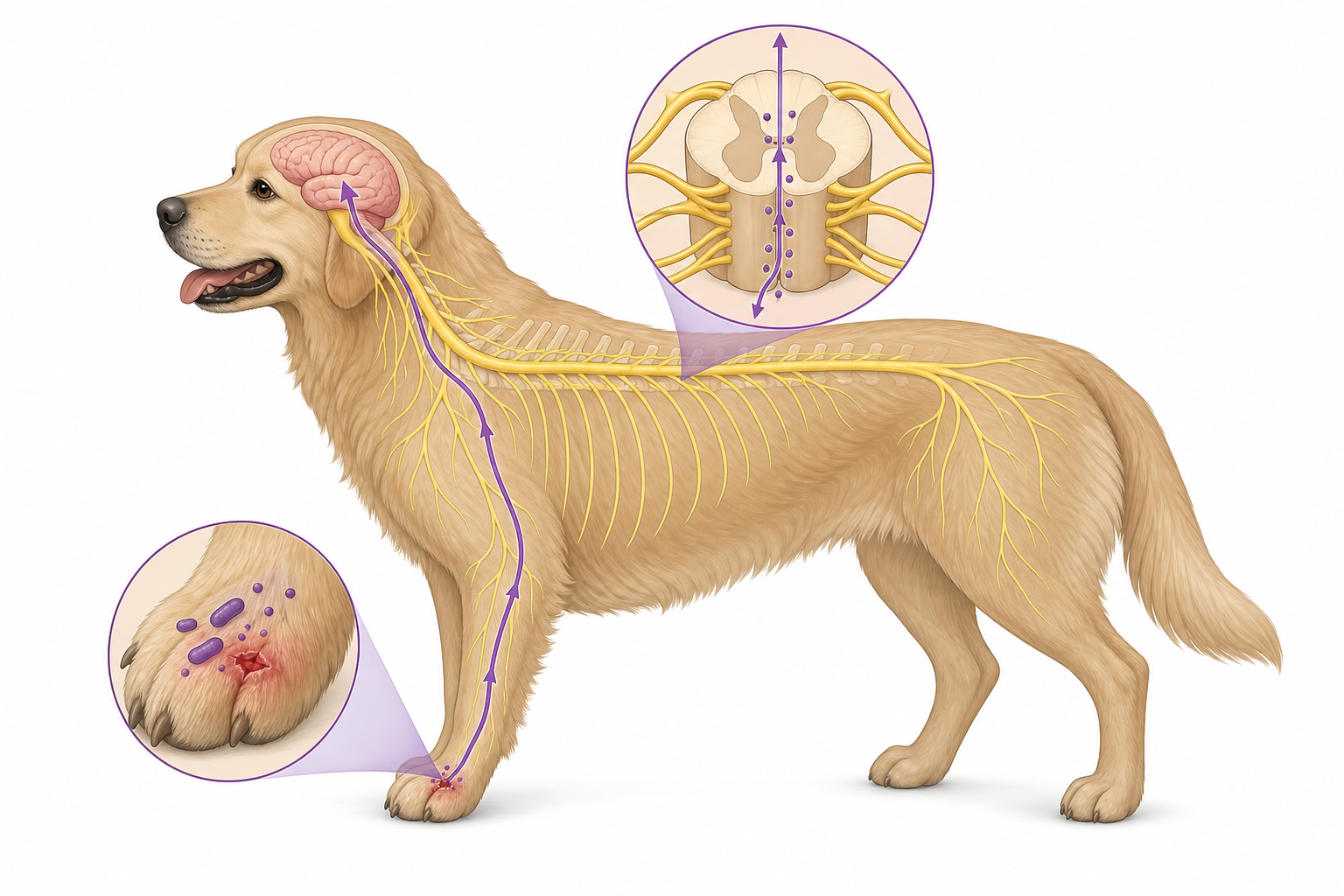
TL;DR. Tetanus is een ernstige, levensbedreigende neurologische aandoening door bacteriële toxinen in een wond: extreme spierstijfheid, kaakklem en risico op ademhalingsverlamming.
Tetanustoxine reist langs de zenuwen en blokkeert remmende signalen in het CZS.
Wat is het?
Tetanus ontstaat door tetanospasmine van Clostridium tetani, een anaeroob bacterie in diepe wonden. Het toxine bindt onomkeerbaar aan zenuwuiteinden, reist naar het CZS en blokkeert remmende neurotransmitters. Motorische zenuwen vuren ongehinderd; spieren blijven pijnlijk aangespannen. Hond en kat zijn resistenter dan mens en paard, maar klinische gevallen zijn spoedgevallen.
Oorzaken en risicofactoren
Niet besmettelijk. Sporen in grond, stof en mest:
"The spores are resistant to boiling water and an autoclave temperature of 120°C for up to 20 minutes. However, the vegetative phase of this bacterium is susceptible to chemical and physical inactivation. Organisms can be isolated from the feces of dogs, cats, and humans, but presence of the organism does not indicate infection because not all strains possess the plasmid."
Triggers: diepe steekwonden, beten, besmette operatiewonden, vreemde voorwerpen. Geen raspredispositie.
Signalen om op te letten
Kardinaal: trismus; risus sardonicus (gerimpeld voorhoofd, stijve oren, teruggetrokken lippen).
Vaak: stijve gang/zaagbokhouding, stijve staart, reflexspasmen op prikkels, liggen, dysfagie, derde ooglid, enophthalmus, opisthotonus.
Soms: obstipatie, urineretentie, ademhalingsverlamming, autonome dysfunctie.

Risus sardonicus is een kardinaal teken van tetanus.
"Involvement of the head can lead to spasms of the masticatory and pharyngeal muscles, causing trismus (lockjaw) and dysphagia. This can be exacerbated functionally by increased salivation, increased bronchial secretions, and increased respiratory rate resulting from involvement of the parasympathetic and somatic cranial nerve nuclei."
Hoe dierenartsen diagnosticeren
Vooral klinisch (tekenen + wondgeschiedenis). Steun: serumantistoffen tegen tetanospasmine (goud, traag), Gram/anaerobe kweek, CK, EMG, röntgen bij complicaties.
Behandelopties
- Tetanusantitoxine: neutraliseert circulerend toxine (niet al gebonden); anafylaxierisico.
- Antibiotica: metronidazol of penicilline G; alternatieven clindamycine, doxycycline, tetracycline.
- Spierontspanners/sedativa: diazepam.
- Support: donkere, stille, gepolsterde ruimte; voedingssonde, i.v.-vloeistoffen, urinekatheter indien nodig.

Een stille, donkere omgeving beperkt door prikkels uitgelokte spasmen.
Prognose
Hond: mortaliteit ~18–50 %; klasse I–II vaak 100 % overleving, III–IV ~58 %. Kat: lokaal vaak goed; restverschijnselen kunnen maanden duren.
"Neuronal binding of toxin is thought to be irreversible. Recovery requires the growth of new nerve terminals, which explains the long duration of tetanus."
Preventie
Geen routinevaccinatie bij hond/kat. Wonden meteen reinigen; diepe/vuile wonden: dierenarts.
Wanneer de dierenarts bellen
Spoed bij stijfheid, kaakklem, grimas, derde ooglid, spasmen op geluid/aanraking of ademnood na een wond.
Bronnen
- Small Animal Critical Care Medicine, 2nd Edition, pages 498-500.
- Textbook of Veterinary Internal Medicine, 5th Edition, pages 1130-1131.
My highlights & notes
Tekenen & symptomen
Hoe het wordt gediagnosticeerd
- Measurement of serum antibodies to tetanospasminGouden standaard
- Anaerobic culture of wound
- Electromyography
- Gram stain of wound smear
- Presumptive diagnosis based on clinical signs and history of a recent wound
- Radiography
- Serum creatine kinase measurement
Behandelbenaderingen
Behandeling moet worden voorgeschreven door een bevoegde dierenarts. Specifieke doses worden expres niet getoond.
Veelgestelde vragen
What is Tetanus?
Tetanus is a rare but life-threatening bacterial infection in dogs and cats. Caused by toxins from Clostridium tetani bacteria entering a wound, it leads to severe muscle stiffness, lockjaw, and spasms. Learn about the signs, diagnosis, and intensive care required for recovery.
What are the symptoms of Tetanus?
risus sardonicus、trismus、Trouble swallowing (dysphagia)、Recumbency、Stiff gait、elevated tail、enophthalmos、erect ears
How is Tetanus diagnosed?
Measurement of serum antibodies to tetanospasmin、Anaerobic culture of wound、Electromyography、Gram stain of wound smear、Presumptive diagnosis based on clinical signs and history of a recent wound、Radiography
How is Tetanus treated?
Behandeling moet worden voorgeschreven door een bevoegde dierenarts. Specifieke doses worden expres niet getoond.
Bronnen
- Small Animal Critical Care Medicine, 2nd Edition (VetBooks.ir) · p. 499
- Small Animal Critical Care Medicine, 2nd Edition (VetBooks.ir) · p. 498
- Internal Medicine 5th · p. 1131
- Small Animal Critical Care Medicine, 2nd Edition (VetBooks.ir) · p. 498
- Small Animal Critical Care Medicine, 2nd Edition (VetBooks.ir) · p. 500
- Internal Medicine 5th · p. 1130
Dit artikel is algemene educatie en geen vervanging voor professioneel veterinair advies. Bij ziekte: raadpleeg een dierenarts.
Zorgen over je huisdier?
Peqaboo’s AI helpt symptomen te volgen, labuitslagen te begrijpen en te weten wanneer je naar de dierenarts moet.
Download de Peqaboo-app