

Tetanus
Clostridium tetani infection
Auch bekannt als: Lockjaw
Kurz gesagt
Tetanus is a rare but life-threatening bacterial infection in dogs and cats. Caused by toxins from Clostridium tetani bacteria entering a wound, it leads to severe muscle stiffness, lockjaw, and spasms. Learn about the signs, diagnosis, and intensive care required for recovery.
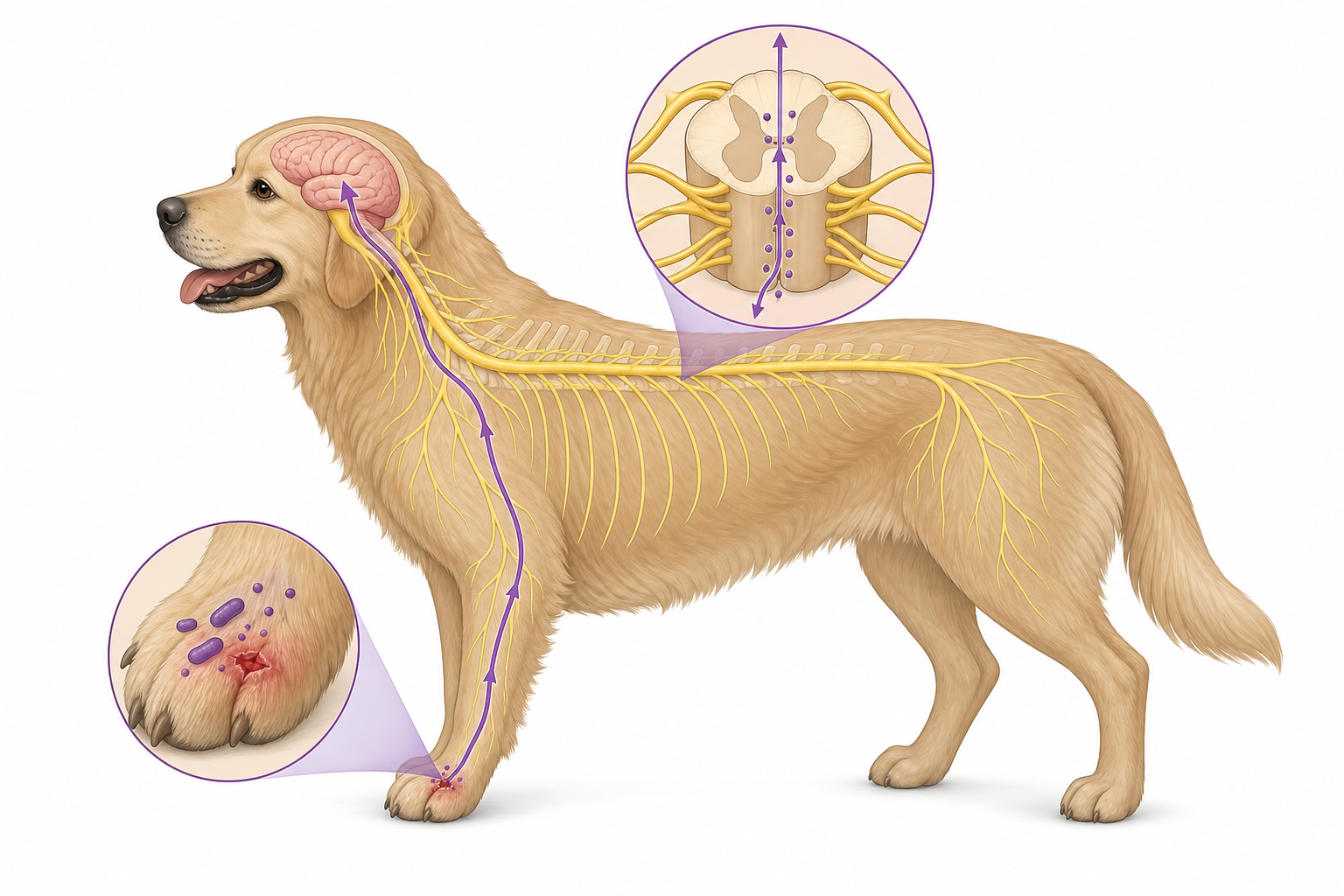
TL;DR. Tetanus ist eine schwere, lebensbedrohliche neurologische Erkrankung durch bakterielle Toxine in einer Wunde: extreme Muskelsteifheit, Kieferklemme und drohende Atemlähmung.
Tetanustoxin wandert retrograd entlang der Nerven und blockiert hemmende Signale im ZNS.
Was ist das?
Tetanus entsteht durch Tetanospasmin aus Clostridium tetani, einem anaeroben Bakterium in tiefen, sauerstoffarmen Wunden. Das Toxin bindet irreversibel an Nervenenden, wandert zum ZNS und blockiert hemmende Neurotransmitter. Motorische Nerven feuern ungebremst; Muskeln bleiben in schmerzhafter Dauerkontraktion. Hund und Katze sind resistenter als Mensch und Pferd, aber klinische Fälle sind Notfälle.
Ursachen und Risikofaktoren
Nicht ansteckend. Sporen in Erde, Staub und Mist:
"The spores are resistant to boiling water and an autoclave temperature of 120°C for up to 20 minutes. However, the vegetative phase of this bacterium is susceptible to chemical and physical inactivation. Organisms can be isolated from the feces of dogs, cats, and humans, but presence of the organism does not indicate infection because not all strains possess the plasmid."
Auslöser: tiefe Stichwunden, Bisse, kontaminierte OP-Wunden, Fremdkörper. Keine Rasseprädisposition.
Anzeichen, auf die man achten sollte
Kardinal: Trismus (Kieferklemme); Risus sardonicus (gerunzelte Stirn, steife Ohren, zurückgezogene Lippen).
Häufig: steifer Gang/Sägebockstellung, steifer Schwanz, reflektorische Spasmen bei Reizen, Liegen, Dysphagie, dritte Augenlidmembran, Enophthalmus, Opisthotonus.
Gelegentlich: Obstipation, Harnverhalt, Atemlähmung, autonome Dysfunktion.

Risus sardonicus ist ein kardinales Tetanuszeichen.
"Involvement of the head can lead to spasms of the masticatory and pharyngeal muscles, causing trismus (lockjaw) and dysphagia. This can be exacerbated functionally by increased salivation, increased bronchial secretions, and increased respiratory rate resulting from involvement of the parasympathetic and somatic cranial nerve nuclei."
Wie Tierärzte diagnostizieren
Vorwiegend klinisch (Zeichen + Wundanamnese). Unterstützend: Serumantikörper gegen Tetanospasmin (Gold, aber langsam), Gramfärbung/Anaerobkultur der Wunde, CK, EMG, Röntgen bei Komplikationen.
Behandlungsoptionen
- Tetanus-Antitoxin: neutralisiert zirkulierendes Toxin (nicht bereits gebundenes); Anaphylaxie-Risiko.
- Antibiotika: Metronidazol oder Penicillin G; Alternativen Clindamycin, Doxycyclin, Tetracyclin.
- Muskelrelaxanzien/Sedativa: Diazepam.
- Support: dunkler, ruhiger, gepolsterter Raum; ggf. Ernährungssonde, i.v. Flüssigkeiten, Katheter.

Ruhige, dunkle Umgebung verhindert reizgetriggerte Spasmen.
Prognose
Hund: Mortalität etwa 18–50 %; Klasse I–II oft 100 % Überleben, III–IV etwa 58 %. Katze: lokal meist gut, Defizite können monatelang bleiben.
"Neuronal binding of toxin is thought to be irreversible. Recovery requires the growth of new nerve terminals, which explains the long duration of tetanus."
Vorbeugung
Keine Routineimpfung bei Hund/Katze. Wunden sofort reinigen; tiefe/schmutzige Wunden tierärztlich versorgen und beobachten.
Wann den Tierarzt rufen
Notfall bei Steifheit, Kieferklemme, Grimasse, dritter Augenlidmembran, reizgetriggerten Spasmen oder Atemnot nach Wunde.
Quellen
- Small Animal Critical Care Medicine, 2nd Edition, pages 498-500.
- Textbook of Veterinary Internal Medicine, 5th Edition, pages 1130-1131.
My highlights & notes
Anzeichen & Symptome
Diagnose
- Measurement of serum antibodies to tetanospasminGoldstandard
- Anaerobic culture of wound
- Electromyography
- Gram stain of wound smear
- Presumptive diagnosis based on clinical signs and history of a recent wound
- Radiography
- Serum creatine kinase measurement
Behandlungsansätze
Behandlungen müssen von einem approbierten Tierarzt verordnet werden. Konkrete Dosierungen werden absichtlich nicht angezeigt.
Häufige Fragen
What is Tetanus?
Tetanus is a rare but life-threatening bacterial infection in dogs and cats. Caused by toxins from Clostridium tetani bacteria entering a wound, it leads to severe muscle stiffness, lockjaw, and spasms. Learn about the signs, diagnosis, and intensive care required for recovery.
What are the symptoms of Tetanus?
risus sardonicus、trismus、Trouble swallowing (dysphagia)、Recumbency、Stiff gait、elevated tail、enophthalmos、erect ears
How is Tetanus diagnosed?
Measurement of serum antibodies to tetanospasmin、Anaerobic culture of wound、Electromyography、Gram stain of wound smear、Presumptive diagnosis based on clinical signs and history of a recent wound、Radiography
How is Tetanus treated?
Behandlungen müssen von einem approbierten Tierarzt verordnet werden. Konkrete Dosierungen werden absichtlich nicht angezeigt.
Quellen
- Small Animal Critical Care Medicine, 2nd Edition (VetBooks.ir) · p. 499
- Small Animal Critical Care Medicine, 2nd Edition (VetBooks.ir) · p. 498
- Internal Medicine 5th · p. 1131
- Small Animal Critical Care Medicine, 2nd Edition (VetBooks.ir) · p. 498
- Small Animal Critical Care Medicine, 2nd Edition (VetBooks.ir) · p. 500
- Internal Medicine 5th · p. 1130
Dieser Artikel dient der allgemeinen Information und ersetzt keinen tierärztlichen Rat. Bei Krankheit bitte einen Tierarzt aufsuchen.
Sorgen um Ihr Tier?
Peqaboos KI hilft Symptome zu tracken, Laborberichte zu verstehen und zu wissen, wann der Tierarzt nötig ist.
Peqaboo-App laden