

Tetanus
Clostridium tetani infection
Også kendt som: Lockjaw
Kort sagt
Tetanus is a rare but life-threatening bacterial infection in dogs and cats. Caused by toxins from Clostridium tetani bacteria entering a wound, it leads to severe muscle stiffness, lockjaw, and spasms. Learn about the signs, diagnosis, and intensive care required for recovery.
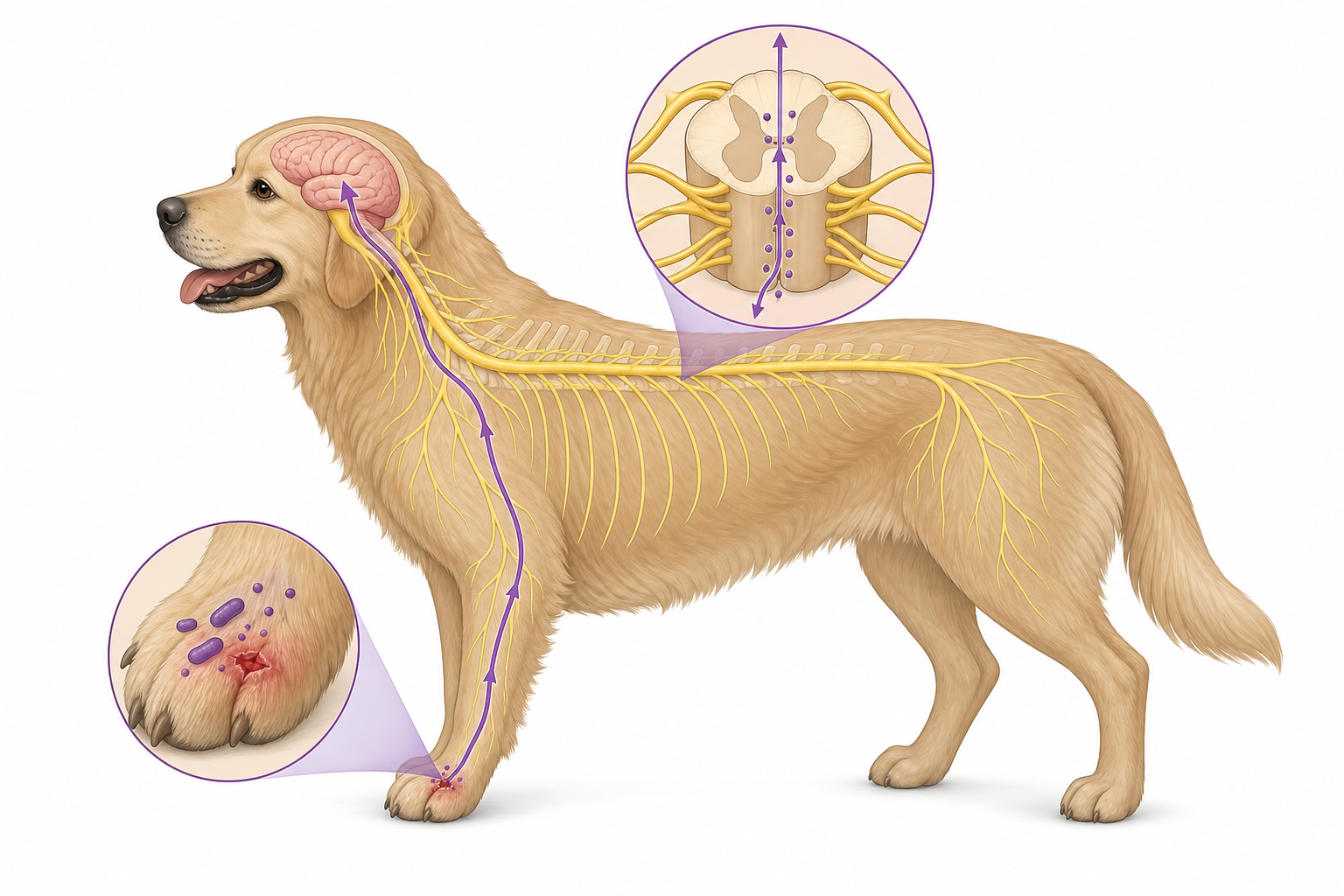
TL;DR. Stivkrampe er en alvorlig, livstruende neurologisk akut tilstand forårsaget af bakterietoksiner i et sår: ekstrem muskelstivhed, kæbelåsning og risiko for respirationsparalyse.
Tetanustoksin vandrer langs nerverne og blokerer hæmmende signaler i CNS.
Hvad er det?
Stivkrampe skyldes tetanospasmin fra Clostridium tetani, en anaerob bakterie i dybe sår. Toksiner binder irreversibelt til nerveender, når CNS og blokerer hæmmende neurotransmittere. Motoriske nerver fyrer uhindret; musklerne forbliver i smertefuld kontraktion. Hund og kat er mere resistente end menneske og hest, men kliniske tilfælde er akutte.
Årsager og risikofaktorer
Ikke smitsomt. Sporer i jord, støv og gødning:
"The spores are resistant to boiling water and an autoclave temperature of 120°C for up to 20 minutes. However, the vegetative phase of this bacterium is susceptible to chemical and physical inactivation. Organisms can be isolated from the feces of dogs, cats, and humans, but presence of the organism does not indicate infection because not all strains possess the plasmid."
Udløsere: dybe stiksår, bid, kontaminerede operationssår, fremmedlegemer. Ingen raceprædisposition.
Tegn at holde øje med
Kardinal: trismus; risus sardonicus (rynket pande, stive ører, tilbagetrukne læber).
Almindelige: stiv gang/savbuk-stilling, stiv hale, refleksspasmer ved stimuli, liggende, dysfagi, tredje øjenlåg, enoftalmus, opistotonus.
Lejlighedsvise: forstoppelse, urinretention, respirationsparalyse, autonom dysfunktion.

Risus sardonicus er et kardinaltegn ved stivkrampe.
"Involvement of the head can lead to spasms of the masticatory and pharyngeal muscles, causing trismus (lockjaw) and dysphagia. This can be exacerbated functionally by increased salivation, increased bronchial secretions, and increased respiratory rate resulting from involvement of the parasympathetic and somatic cranial nerve nuclei."
Hvordan dyrlæger diagnosticerer
Primært klinisk (tegn + sårhistorik). Støtte: serumantistoffer mod tetanospasmin (guld, langsomt), Gram/anaerob dyrkning, CK, EMG, røntgen ved komplikationer.
Behandlingsmuligheder
- Tetanusantitoksin: neutraliserer cirkulerende toksin (ikke allerede bundet); anafylaksirisiko.
- Antibiotika: metronidazol eller penicillin G; alternativer clindamycin, doxycyclin, tetracyclin.
- Muskelafslappende/sedativa: diazepam.
- Støtte: mørkt, stille, polstret rum; ernæringssonde, i.v.-væsker, urinkateter efter behov.

Et roligt, mørkt miljø begrænser stimulusudløste spasmer.
Prognose
Hund: mortalitet ~18–50 %; klasse I–II ofte 100 % overlevelse, III–IV ~58 %. Kat: lokal ofte god; restsymptomer kan vare i måneder.
"Neuronal binding of toxin is thought to be irreversible. Recovery requires the growth of new nerve terminals, which explains the long duration of tetanus."
Forebyggelse
Ingen rutinevaccination hos hund/kat. Rengør sår med det samme; dybe/beskidte sår: dyrlægevurdering.
Hvornår skal man ringe til dyrlægen
Akut ved stivhed, kæbelåsning, grimasse, tredje øjenlåg, spasmer ved lyd/berøring eller åndenød efter sår.
Kilder
- Small Animal Critical Care Medicine, 2nd Edition, pages 498-500.
- Textbook of Veterinary Internal Medicine, 5th Edition, pages 1130-1131.
My highlights & notes
Tegn og symptomer
Hvordan det diagnosticeres
- Measurement of serum antibodies to tetanospasminGuldstandard
- Anaerobic culture of wound
- Electromyography
- Gram stain of wound smear
- Presumptive diagnosis based on clinical signs and history of a recent wound
- Radiography
- Serum creatine kinase measurement
Behandlingsmetoder
Behandling skal ordineres af en autoriseret dyrlæge. Specifikke doser vises bevidst ikke.
Ofte stillede spørgsmål
What is Tetanus?
Tetanus is a rare but life-threatening bacterial infection in dogs and cats. Caused by toxins from Clostridium tetani bacteria entering a wound, it leads to severe muscle stiffness, lockjaw, and spasms. Learn about the signs, diagnosis, and intensive care required for recovery.
What are the symptoms of Tetanus?
risus sardonicus、trismus、Trouble swallowing (dysphagia)、Recumbency、Stiff gait、elevated tail、enophthalmos、erect ears
How is Tetanus diagnosed?
Measurement of serum antibodies to tetanospasmin、Anaerobic culture of wound、Electromyography、Gram stain of wound smear、Presumptive diagnosis based on clinical signs and history of a recent wound、Radiography
How is Tetanus treated?
Behandling skal ordineres af en autoriseret dyrlæge. Specifikke doser vises bevidst ikke.
Kilder
- Small Animal Critical Care Medicine, 2nd Edition (VetBooks.ir) · p. 499
- Small Animal Critical Care Medicine, 2nd Edition (VetBooks.ir) · p. 498
- Internal Medicine 5th · p. 1131
- Small Animal Critical Care Medicine, 2nd Edition (VetBooks.ir) · p. 498
- Small Animal Critical Care Medicine, 2nd Edition (VetBooks.ir) · p. 500
- Internal Medicine 5th · p. 1130
Artiklen er generel oplysning og erstatter ikke dyrlægeråd. Hvis dyret er sygt, kontakt en dyrlæge.
Bekymret for dit dyr?
Peqaboos AI hjælper dig med at følge symptomer, forstå labsvar og vide, hvornår du skal se dyrlægen.
Hent Peqaboo-appen