

Fibrosarcoma
Fibrosarcoma
Also known as: FSA, injection site sarcoma, ISS, vaccine-associated sarcoma
In short
Fibrosarcoma is an uncommon but highly invasive cancer of the connective tissue in dogs and cats. Learn how to recognize the signs, understand the diagnostic process, and explore treatment options like surgery, chemotherapy, and radiation.
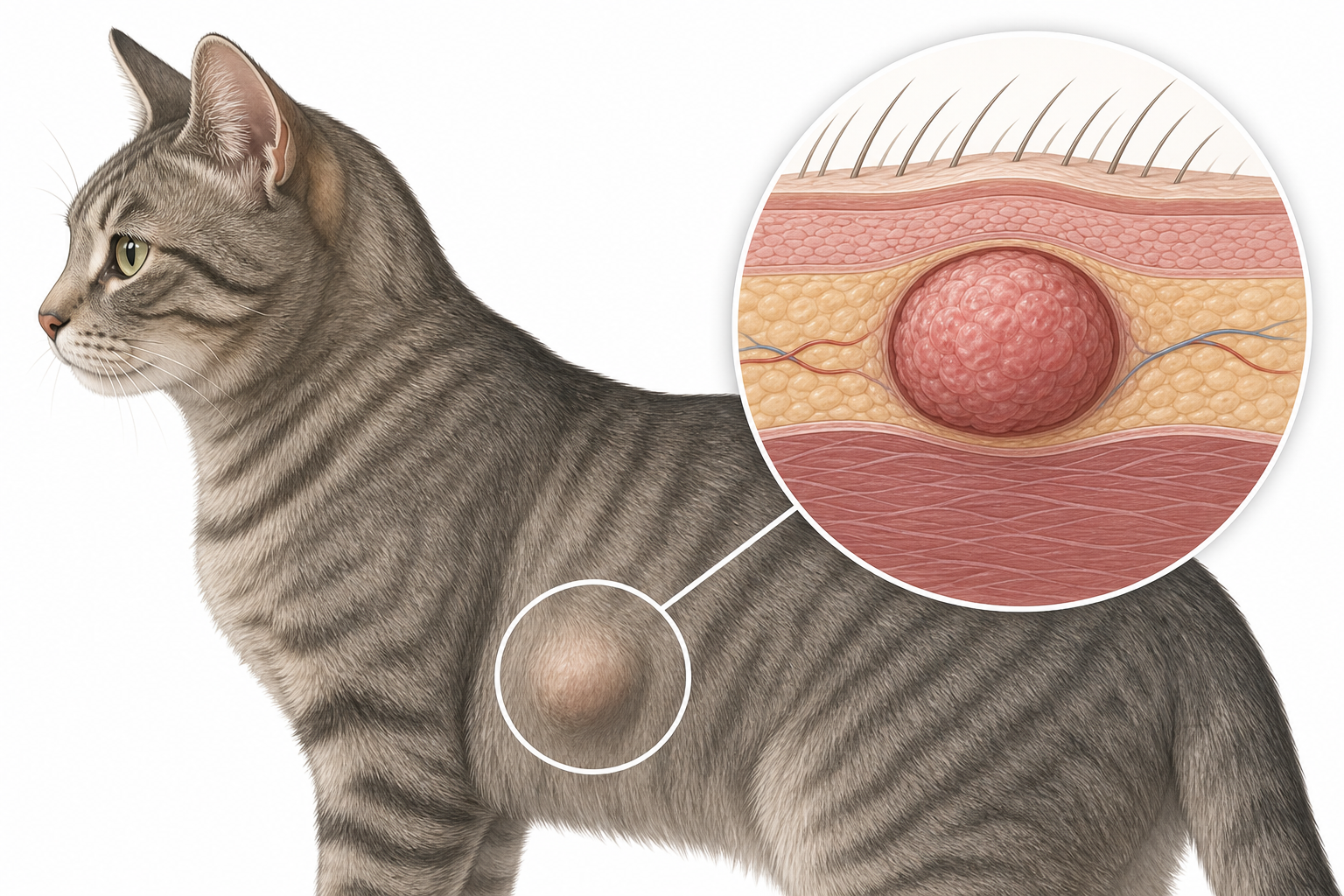
TL;DR. Fibrosarcoma is an aggressive, invasive cancer of the connective tissue in dogs and cats that requires prompt veterinary attention, often presenting as a firm lump under the skin.
Fibrosarcomas often present as firm, irregular lumps beneath the skin.
What is it?
Fibrosarcoma is a malignant tumor that arises from fibroblasts, which are the specialized cells responsible for producing collagen and maintaining the structural framework of the body's connective tissues. Because connective tissue is found throughout the body, these tumors can develop almost anywhere, though they most commonly form in the deep layers of the skin or in the tissues just beneath it (the subcutaneous space).
In dogs, fibrosarcomas typically occur spontaneously, meaning they develop without a clear, identifiable external trigger. In cats, the disease is more complex. Feline fibrosarcomas can occur spontaneously, but they can also be induced by the feline sarcoma virus (FeSV) or arise as a vaccine-induced (injection-site) sarcoma. Regardless of the underlying cause, these tumors are characterized by their highly invasive nature. They tend to send microscopic, finger-like projections into the surrounding healthy tissue, making them difficult to remove completely without wide, aggressive surgical margins.
Understanding this disease is critical for pet owners because early detection is the single most important factor in achieving a successful outcome. While these tumors are classified as uncommon, their aggressive local behavior means that delaying treatment can quickly limit a pet's therapeutic options.
Causes & risk factors
While many cases of fibrosarcoma are spontaneous and have no single known cause, several distinct risk factors and triggers have been identified in veterinary medicine:
- Feline Sarcoma Virus (FeSV): In cats, this virus can directly cause the development of fibrosarcomas. FeSV-associated tumors are unique because they are typically multicentric, meaning they appear in multiple locations across the body simultaneously.
- Injection-Site Sarcomas (ISS): Also known as vaccine-associated sarcomas, these tumors can develop in cats at sites where they previously received injections, such as vaccines, antibiotics, or long-acting steroids. Chronic local inflammation at the injection site is believed to trigger the malignant transformation of local fibroblasts in genetically susceptible cats.
- Breed Predispositions: In dogs, certain breeds show a higher incidence of this tumor. These include Golden Retrievers, Doberman Pinschers, Labrador Retrievers, German Shepherd Dogs, and Boxers. Spontaneous fibrosarcomas are most frequently diagnosed in middle-aged to older dogs and cats.
Signs to watch for
The clinical signs of fibrosarcoma vary depending on where the tumor is located on the body. Because these tumors most commonly affect the skin and subcutaneous tissues, the primary signs are visible or feelable changes on your pet's body.
- Subcutaneous mass (Cardinal): A firm, irregular, or nodular lump beneath the skin. It may feel fixed to the underlying tissue rather than sliding freely under your fingers.
- Skin ulceration (Common): As the tumor grows, it can outgrow its blood supply or stretch the overlying skin to the point of breaking, resulting in open, non-healing sores.
- Alopecia (Common): Hair loss directly over the area of the lump.
- Anorexia (Occasional): Loss of appetite, which is particularly common if the tumor is located in the mouth or is causing systemic pain.
- Halitosis (Occasional): Severe bad breath, typically associated with oral fibrosarcomas.
- Dysphagia (Occasional): Difficulty swallowing or chewing.
- Oral bleeding (Occasional): Unexplained bleeding from the mouth.
- Facial deformity (Occasional): Swelling or asymmetry of the face or jaw.
- Nasal discharge (Occasional): Chronic fluid or pus draining from the nose, occurring when tumors invade the nasal passages.
- Sneezing (Occasional): Persistent, unexplained sneezing.

Overlying skin may become hairless (alopecic) and ulcerated as the tumor grows.
How vets diagnose it
Diagnosing a fibrosarcoma begins with a thorough physical examination, but definitive identification requires laboratory analysis. Because these tumors can mimic benign lumps, like lipomas (fatty tumors) or cysts, your vet will perform several diagnostic steps:
-
Fine-Needle Aspiration (FNA): Your vet will insert a thin needle into the mass to collect cells for microscopic evaluation. While FNA is a helpful screening tool, it is not always definitive for fibrosarcomas. As noted in a prominent veterinary internal medicine textbook:
"Although FNA findings may provide a definitive answer, more often a surgical biopsy is necessary because sarcomas do not consistently exfoliate cells..."
-
Biopsy and Histopathology [GOLD STANDARD]: A surgical biopsy is the gold standard for diagnosing fibrosarcoma. Your vet will remove a small piece of the tumor (an incisional biopsy) or, in some cases, the entire mass (an excisional biopsy) and send it to a veterinary pathologist. Under the microscope, the pathologist will look for characteristic features of malignant fibroblasts. A standard veterinary cytology reference describes these cells:
"...fibroblasts are large spindle cells that exhibit oval nuclei, reticular chromatin, and one or more prominent, large nucleoli."
-
Staging and Imaging: If a fibrosarcoma is confirmed, your vet will recommend staging to see if the cancer has spread. This typically includes thoracic radiography (chest X-rays) to check the lungs, as well as advanced imaging like a CT scan or MRI. Advanced imaging is highly recommended prior to surgery because it allows the veterinary surgeon to see the true boundaries of the tumor beneath the skin, which are almost always much larger than what can be felt by hand.
Treatment options
Treating fibrosarcoma requires an aggressive, multi-modal approach to target both the visible tumor and the microscopic cells invading the surrounding tissues.
Surgery
Surgical removal is the primary and most effective treatment for fibrosarcoma. Because these tumors are highly invasive, the surgeon must achieve "wide and deep margins." This means removing not just the visible lump, but also a large buffer zone of healthy-looking tissue around and beneath the tumor (often 3 to 5 centimeters of margin in cats with injection-site sarcomas). If the tumor is on a limb, amputation may be recommended to ensure complete removal.
Radiation Therapy
If the tumor cannot be completely removed with clean surgical margins, or if it is located in an area where wide margins are impossible (such as the face or spine), radiation therapy is often used. Radiation is typically performed after surgery to kill any microscopic cancer cells left behind, helping to delay or prevent local recurrence.
Chemotherapy
Chemotherapy may be recommended for high-grade tumors, cases where surgery is not possible, or when there is a high risk of the cancer spreading (metastasizing) to other organs. Common chemotherapy agents used for fibrosarcoma include:
- Cyclophosphamide: An alkylating agent that works by damaging the DNA of rapidly dividing cancer cells.
- Carboplatin: A platinum-based alkylating agent that interferes with cancer cell replication.
- Doxorubicin: An anthracycline antineoplastic antibiotic that blocks the enzymes cancer cells need to divide.
Prognosis
The prognosis for pets with fibrosarcoma is highly variable and depends heavily on how early the tumor is detected and how aggressively it can be treated.
For highly invasive, recurrent, or metastatic cases, the prognosis is guarded to poor. Because these tumors are highly prone to local recurrence, incomplete surgical removal often leads to the tumor growing back rapidly, sometimes within weeks or months. However, fibrosarcoma can be cured with early, wide surgical excision. If the tumor is caught when it is small and is removed with completely clean margins, many pets go on to live long, healthy lives.
Prevention
Spontaneous fibrosarcomas in dogs and cats cannot be prevented, as there are no known lifestyle changes or genetic screenings that can avert their development.
For feline injection-site sarcomas, prevention focuses on minimizing unnecessary inflammation. Veterinary guidelines recommend tailoring vaccine protocols to your individual cat's lifestyle so they only receive necessary vaccines. Additionally, veterinarians follow standardized injection protocols, administering specific vaccines in designated areas low on the limbs rather than between the shoulder blades. This practice ensures that if a tumor does develop, it can be successfully treated with limb amputation.
For all pets, the best preventative measure is vigilant monitoring. Use the "3, 2, 1 Rule" established by veterinary oncologists to monitor any lump that develops after an injection:
"...worry if the mass persists for more than 3 months after vaccination, is larger than 2 cm in diameter, or grows 1 month after the injection."
When to call your vet
You should contact your veterinarian if you notice any new lump or bump on your pet's body, especially if it is firm, growing rapidly, or associated with a previous injection site.
Schedule an emergency veterinary visit if your pet exhibits any of the following signs:
- Difficulty breathing or rapid, labored breathing
- Active bleeding from the mouth or nose
- Sudden inability to swallow or severe distress when attempting to eat
- A rapid, severe decline in energy, alertness, or willingness to move
For specific breeds
If you own a Golden Retriever, Doberman Pinscher, Labrador Retriever, German Shepherd Dog, or Boxer, you should be especially vigilant. Incorporate a thorough skin check into your weekly grooming routine. Run your hands firmly but gently over your dog's entire body, feeling for any deep, firm lumps beneath the skin. If you detect any abnormalities, do not adopt a "wait and see" approach; schedule an evaluation with your veterinarian immediately.
Sources
- Small Animal Dermatology: A Color Atlas and Therapeutic Guide, pages 461-462.
- Small Animal Internal Medicine, 5th Edition, page 1229.
- Cowell and Tyler's Diagnostic Cytology and Hematology of the Dog and Cat, 5th Edition, page 154.
My highlights & notes
Signs & symptoms
Breeds at higher risk
How it is diagnosed
- Biopsy and histopathologyGold standard
- CT or MRI
- Fine-needle aspiration
- Thoracic radiography
Treatment approaches
Treatment must be prescribed by a licensed veterinarian based on your pet. Specific drug doses are intentionally not shown here.
Frequently asked questions
What is Fibrosarcoma?
Fibrosarcoma is an uncommon but highly invasive cancer of the connective tissue in dogs and cats. Learn how to recognize the signs, understand the diagnostic process, and explore treatment options like surgery, chemotherapy, and radiation.
What are the symptoms of Fibrosarcoma?
Subcutaneous mass、Hair loss、Skin ulceration、Loss of appetite、Trouble swallowing (dysphagia)、Facial deformity、Bad breath、Nasal discharge
How is Fibrosarcoma diagnosed?
Biopsy and histopathology、CT or MRI、Fine-needle aspiration、Thoracic radiography
How is Fibrosarcoma treated?
Treatment must be prescribed by a licensed veterinarian based on your pet. Specific drug doses are intentionally not shown here.
Sources
- 2016 oncology guidelines
- 皮膚病 教科書點子書 Small-Animal-Dermatology-A-Color-Atlas-and-Therapeutic-Guide · p. 461
- 皮膚病 教科書點子書 Small-Animal-Dermatology-A-Color-Atlas-and-Therapeutic-Guide · p. 462
- Internal Medicine 5th · p. 1229
- Cowell and Tyler s Diagnostic Cytology and Hematology of the Dog and Cat, 5th Edition (VetBooks.ir) · p. 154
This article is for general education and is not a substitute for professional veterinary advice. If your pet is unwell, please consult a veterinarian.
Worried about your pet?
Peqaboo’s AI helps you track symptoms, understand lab reports, and know when to see a vet.
Get the Peqaboo app