

Hemangiosarcoma
Auch bekannt als: HSA, Canine hemangiosarcoma
Kurz gesagt
Hemangiosarcoma is a highly aggressive, malignant cancer of the blood vessels that commonly affects the spleen, heart, or skin in dogs and cats. Recognizing the signs of internal bleeding and understanding your diagnostic and treatment options can help you make informed decisions for your pet.
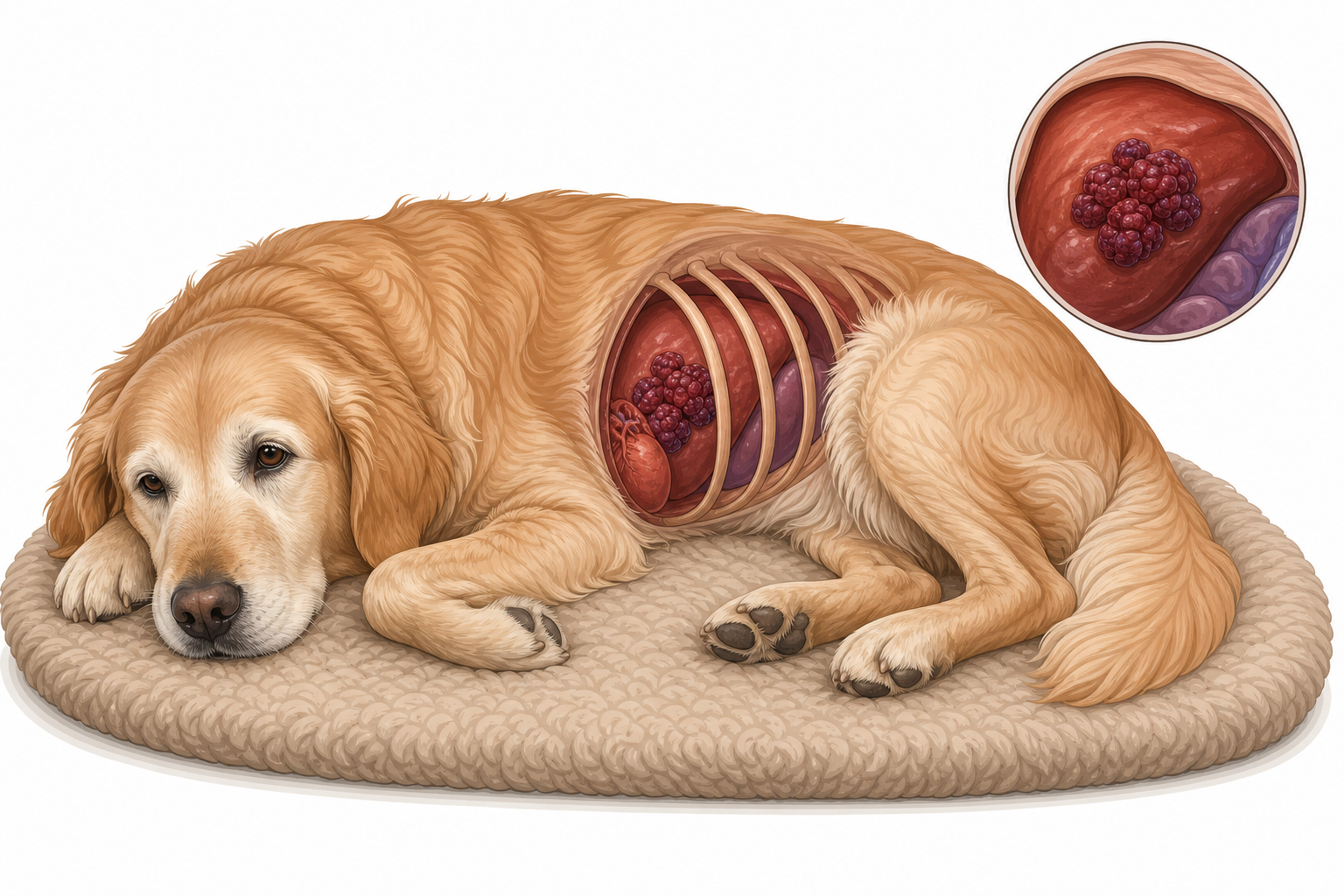
TL;DR. Aggressiver Blutgefäßkrebs v. a. beim Hund: innere Blutungen, plötzliche Schwäche, oft Notfall. Früh metastasierend.
Häufig erst Lethargie oder Schwäche, dann akute Krise.
Was ist das?
Hochmaligner Tumor der Endothelzellen (Gefäßinnenhaut). Kann theoretisch überall entstehen; bevorzugt Organe mit reicher Blutversorgung. Fehlgebildete, fragile Gefäße bluten leicht. Milz am häufigsten; auch rechtes Atrium, subkutan, Leber.
"Approximately 50% of the tumors originate in the spleen, 25% in the right atrium, 13% in subcutaneous tissue, 5% in the liver, 5% in the liver-spleen-right atrium, and 1% to 2% simultaneously in other organs (i. e. , kidney, urinary bladder, bone, tongue, prostate)."
Hunde am häufigsten, Katzen möglich. Metastasen oft sehr früh, bevor äußere Zeichen sichtbar sind.
Ursachen und Risikofaktoren
Ursache der inneren Form unklar; multifaktoriell, Genetik zentral. Kein Beleg für Futter, Lifestyle oder Impfungen.
Kutane Form: UV-Licht bei hellen, kurzhaarigen Hunden.
"Solar damage may be involved in the development of tumors on the ventral glabrous skin in short-coated, lightly pigmented dogs (especially Whippets, Italian Greyhounds, Beagles, Great Danes, and English bulldogs), and on the head and ears"
Meist mittelalte bis ältere Tiere.
Anzeichen
Kardinal
- Anämie: blasse, graue oder weiße Schleimhäute
Häufig
- Schwäche, Lethargie; spontane Blutungen; Hämabdomen (pot-bellied); akuter Kollaps; Thrombozytopenie
Gelegentlich
- Herztamponade; ventrikuläre Arrhythmien; Bauchumfang; Alopezie oder Ulzera (kutan)

Blasse oder weiße Schleimhäute sind ein Warnsignal für schwere Anämie und innere Blutung.
Klassisch: wellenförmige Schwäche (Kollaps, kurze Erholung, erneute Ruptur).
Diagnose
- CBC/Blutausstrich: Anämie, Fragmentozyten, Akanthozyten, oft Thrombozytopenie/DIC-Muster
"Most dogs with HSAs (83%) evaluated at the author's clinic are anemic; more than one half had RBC fragmentation and acanthocytosis. The pretreatment hemostasis profiles are normal in less than 20% of the dogs; most dogs (75%) have thrombocytopenia. Approximately one half of the hemostasis profiles meet three or more criteria for diagnosis of DIC."
- Abdomen-Ultraschall: Massen an Milz/Leber, freie Flüssigkeit
- 3-Ebenen-Thorax-Röntgen: Lungenmetastasen
- Echokardiografie: rechtes Atrium, Perikarderguss
- Histopathologie (Biopsie): Goldstandard; FNA oft nicht aussagekräftig wegen Blutverdünnung
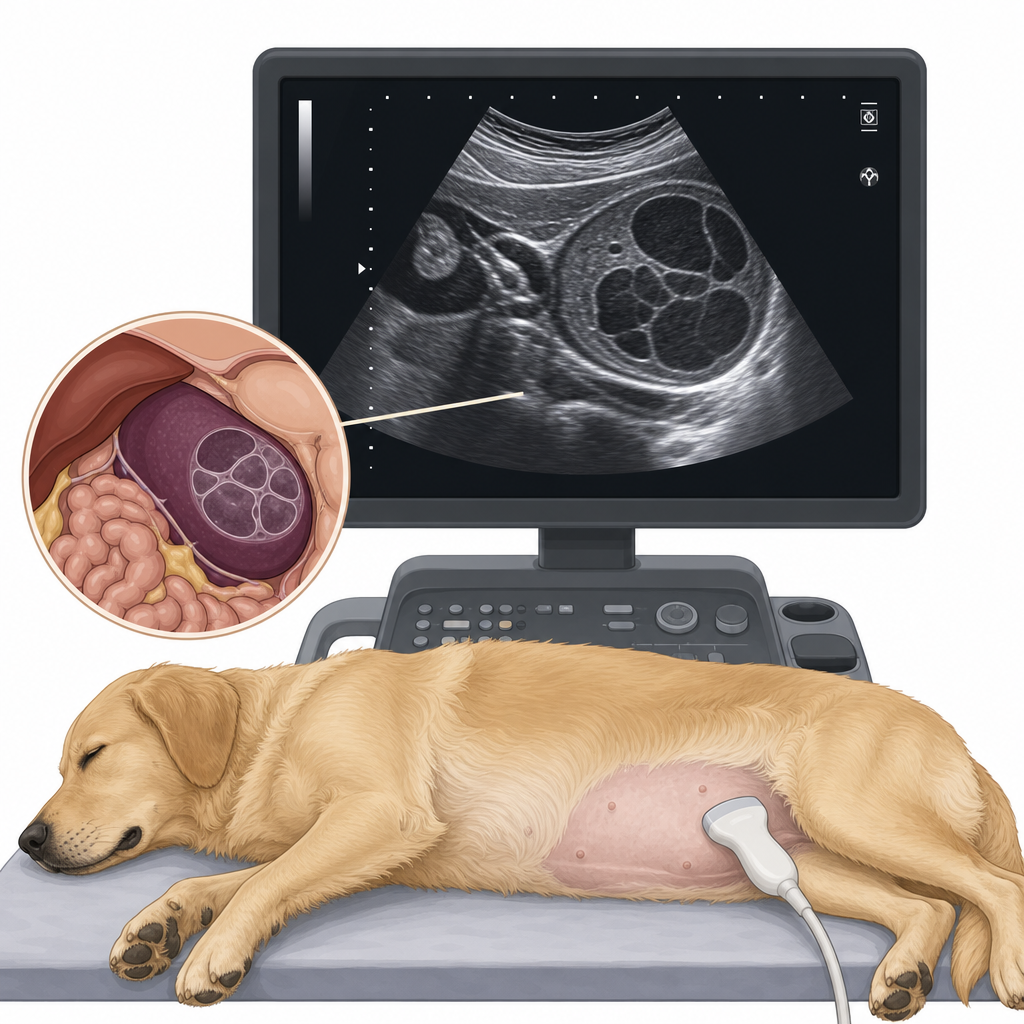
Ultraschall zeigt Massen an Milz oder Leber.
Behandlung
Stabilisieren, Blutung kontrollieren, Metastasen bremsen: OP plus Chemotherapie.
Chirurgie
Splenektomie oder Exzision kutaner Tumoren; allein bei inneren Formen selten heilend (Mikrometastasen).
Chemotherapie
Postoperativ empfohlen: Doxorubicin, Cyclophosphamide, Vincristine. Die meisten Hunde vertragen die Therapie gut.
Supportiv
Infusionen, Transfusionen, Schmerz- und Arrhythmie-Therapie.
Prognose
Ohne Therapie oft 20-60 Tage. OP plus Chemotherapie etwa 140-202 Tage. Kutane, früh exzidierte Formen günstiger. Katzen: Daten begrenzt, Verlauf aggressiv.
Vorbeugung
Innere Form nicht verhinderbar. Kutan: Sonne meiden (10:00-16:00), pet-sichere Sonnencreme, UV-Shirts. Bei prädisponierten Senioren ggf. regelmäßige Abdomen-Ultraschall-Screenings.
Wann den Tierarzt rufen
Notfall: plötzlicher Kollaps; extrem blasse Schleimhäute; schwere Atemnot; akuter Bauchumfang; extreme Lethargie; unerklärliche Blutergüsse oder Nasenbluten.
Für bestimmte Rassen
Abdomenform: German Shepherd Dogs, Golden Retrievers, and Labrador Retrievers.
"Abdominal hemangiosarcoma is principally found in older dogs, especially German Shepherd Dogs and Golden Retrievers."
Weitere: English Cocker Spaniels, English Setters, Afghan Hounds, Siberian Huskies, Irish Setters, and Great Danes. Greyhounds: oft intramuskulär in der Hintergliedmaße.
"Greyhounds with intramuscular HSA typically present with a swollen and bruised rear limb; the tumor is frequently in the biceps femoris or quadriceps."
Kutan: Whippets, Italian Greyhounds, Beagles, Great Danes, and English Bulldogs.
Quellen
- Small Animal Internal Medicine, 5th Edition, pages 529, 1220.
- Small Animal Dermatology: A Color Atlas and Therapeutic Guide, page 466.
My highlights & notes
Anzeichen & Symptome
Rassen mit höherem Risiko
Diagnose
- Histopathology / BiopsyGoldstandard
- 3-View Chest Radiographs
- Abdominal Ultrasound (AUS)
- Blood smear
- Echocardiography
- Fine-needle aspiration (FNA) / Cytology
- Hemostasis profile
Behandlungsansätze
Behandlungen müssen von einem approbierten Tierarzt verordnet werden. Konkrete Dosierungen werden absichtlich nicht angezeigt.
Häufige Fragen
What is Hemangiosarcoma?
Hemangiosarcoma is a highly aggressive, malignant cancer of the blood vessels that commonly affects the spleen, heart, or skin in dogs and cats. Recognizing the signs of internal bleeding and understanding your diagnostic and treatment options can help you make informed decisions for your pet.
What are the symptoms of Hemangiosarcoma?
Anaemia (pale gums)、Acute collapse、Hemoabdomen、Spontaneous bleeding、Low platelets、Weakness (low energy, no strength)、Bloated belly、Hair loss
How is Hemangiosarcoma diagnosed?
Histopathology / Biopsy、3-View Chest Radiographs、Abdominal Ultrasound (AUS)、Blood smear、Echocardiography、Fine-needle aspiration (FNA) / Cytology
How is Hemangiosarcoma treated?
Behandlungen müssen von einem approbierten Tierarzt verordnet werden. Konkrete Dosierungen werden absichtlich nicht angezeigt.
Quellen
- Internal Medicine 5th · p. 1220
- Internal Medicine 5th · p. 1220
- 皮膚病 教科書點子書 Small-Animal-Dermatology-A-Color-Atlas-and-Therapeutic-Guide · p. 466
- Internal Medicine 5th · p. 529
- Internal Medicine 5th · p. 1220
Dieser Artikel dient der allgemeinen Information und ersetzt keinen tierärztlichen Rat. Bei Krankheit bitte einen Tierarzt aufsuchen.
Sorgen um Ihr Tier?
Peqaboos KI hilft Symptome zu tracken, Laborberichte zu verstehen und zu wissen, wann der Tierarzt nötig ist.
Peqaboo-App laden