

Prostatic Hyperplasia
Benign prostatic hyperplasia
Även känd som: Benign Prostatic Hyperplasia, BPH, Cystic Benign Prostatic Hyperplasia, CBPH
Kort sagt
Benign prostatic hyperplasia (BPH) is a common, non-cancerous enlargement of the prostate gland that affects intact male dogs as they age. Driven by normal hormonal changes, BPH can cause straining to defecate, bloody urine, or discharge. Fortunately, it is highly treatable and completely curable through surgical castration, while medical options exist for breeding dogs.
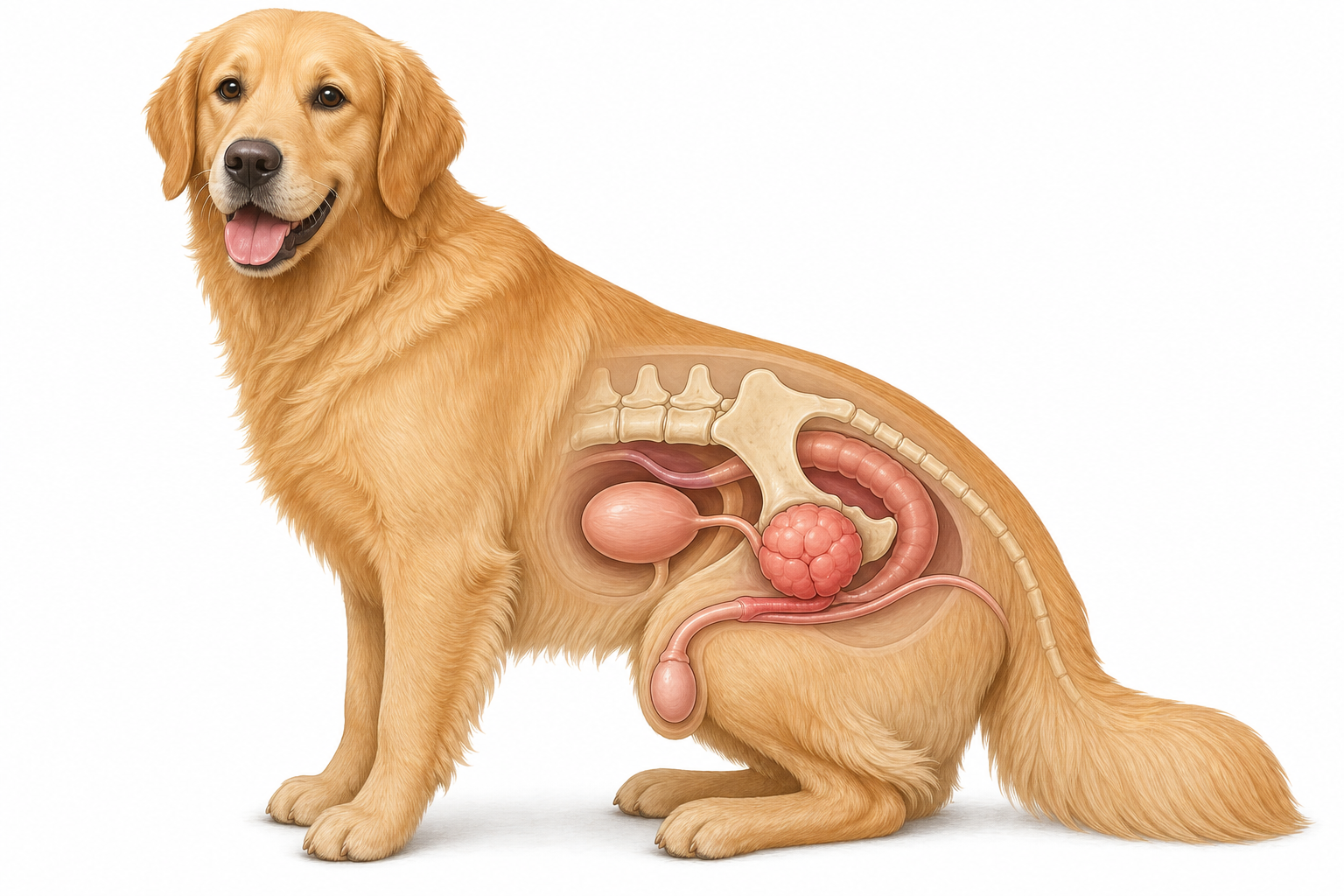
TL;DR. Icke-cancerös förstoring hos intakta hanar; krystning, blod eller flytning; behandlas väl med kastration eller läkemedel.
Prostatans relation till blåsa och rektum.
Vad är det?
Spontan icke-malign förstoring. DHT: hyperplasi/hypertrofi; cystor möjliga. Kompression av urinrör/rektum.
Orsaker och riskfaktorer
Hormonal åldrande från ~2 år. Ingen dokumenterad raspredisposition.
Tecken att bevaka
- Tenesmus
- Hematuri
- Dysuri/pollakisuri
- Prepucial flytning
- Bandformad avföring (ibland)
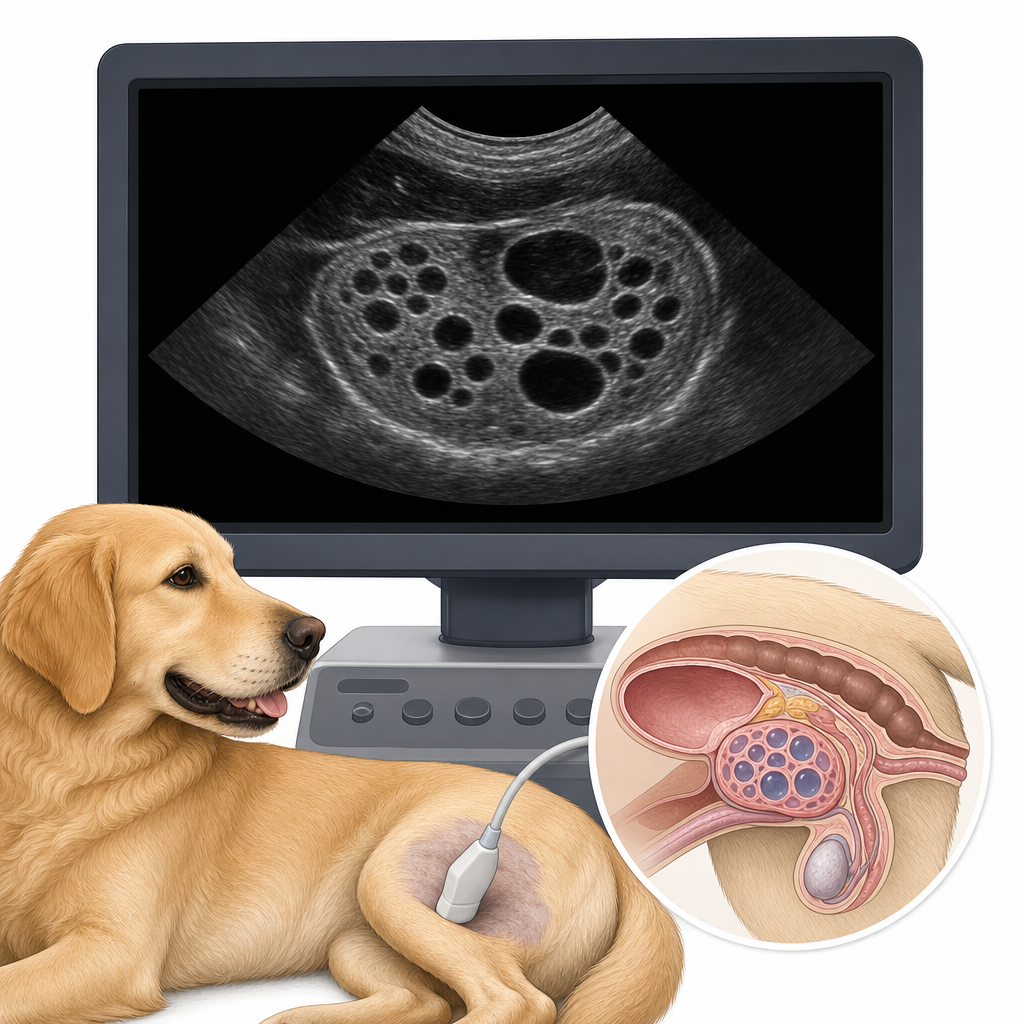
Ultraljud: struktur och cystor.
Hur veterinärer diagnostiserar
Rektalundersökning, bild, CPSE; biopsi vid tvekan.
Behandlingsalternativ
Kastration botande. Finasterid medicinsk förstalinje.
Prognos
Utmärkt under behandling.
Prevention
Kastration förebygger; rektalkontroller om intakt.
När ska veterinären kontaktas
Akut: kan inte kissa, svår smärta, feber, bakbenssvaghet.
Källor
- Cowell and Tyler's Diagnostic Cytology and Hematology of the Dog and Cat, 5th Edition, pages 424, 426.
- Textbook of Veterinary Internal Medicine, 5th Edition, page 992.
My highlights & notes
Tecken & symptom
Hur det diagnostiseras
- Histological examination of a prostatic biopsy specimenGuldstandard
- Canine prostate-specific arginine esterase (CPSE) blood measurement
- Digital rectal examination
- Fine-needle aspiration of the prostate
- Radiography
- Ultrasonography
Behandlingsmetoder
Behandling måste ordineras av legitimerad veterinär. Specifika doser visas medvetet inte.
Vanliga frågor
What is Prostatic Hyperplasia?
Benign prostatic hyperplasia (BPH) is a common, non-cancerous enlargement of the prostate gland that affects intact male dogs as they age. Driven by normal hormonal changes, BPH can cause straining to defecate, bloody urine, or discharge. Fortunately, it is highly treatable and completely curable through surgical castration, while medical options exist for breeding dogs.
What are the symptoms of Prostatic Hyperplasia?
Blood in urine、Straining to poop、Painful or difficult urination、Pollakiuria、preputial discharge、urethral discharge、decreased fertility、loss of libido
How is Prostatic Hyperplasia diagnosed?
Histological examination of a prostatic biopsy specimen、Canine prostate-specific arginine esterase (CPSE) blood measurement、Digital rectal examination、Fine-needle aspiration of the prostate、Radiography、Ultrasonography
How is Prostatic Hyperplasia treated?
Behandling måste ordineras av legitimerad veterinär. Specifika doser visas medvetet inte.
Källor
- Cowell and Tyler s Diagnostic Cytology and Hematology of the Dog and Cat, 5th Edition (VetBooks.ir) · p. 424
- Internal Medicine 5th · p. 992
- Cowell and Tyler s Diagnostic Cytology and Hematology of the Dog and Cat, 5th Edition (VetBooks.ir) · p. 426
Artikeln är allmän information och ersätter inte veterinärråd. Om djuret mår dåligt, kontakta veterinär.
Orolig för ditt djur?
Peqaboos AI hjälper dig följa symptom, förstå labbsvar och veta när du ska träffa veterinär.
Ladda ner Peqaboo-appen