

Prostatic Hyperplasia
Benign prostatic hyperplasia
Auch bekannt als: Benign Prostatic Hyperplasia, BPH, Cystic Benign Prostatic Hyperplasia, CBPH
Kurz gesagt
Benign prostatic hyperplasia (BPH) is a common, non-cancerous enlargement of the prostate gland that affects intact male dogs as they age. Driven by normal hormonal changes, BPH can cause straining to defecate, bloody urine, or discharge. Fortunately, it is highly treatable and completely curable through surgical castration, while medical options exist for breeding dogs.
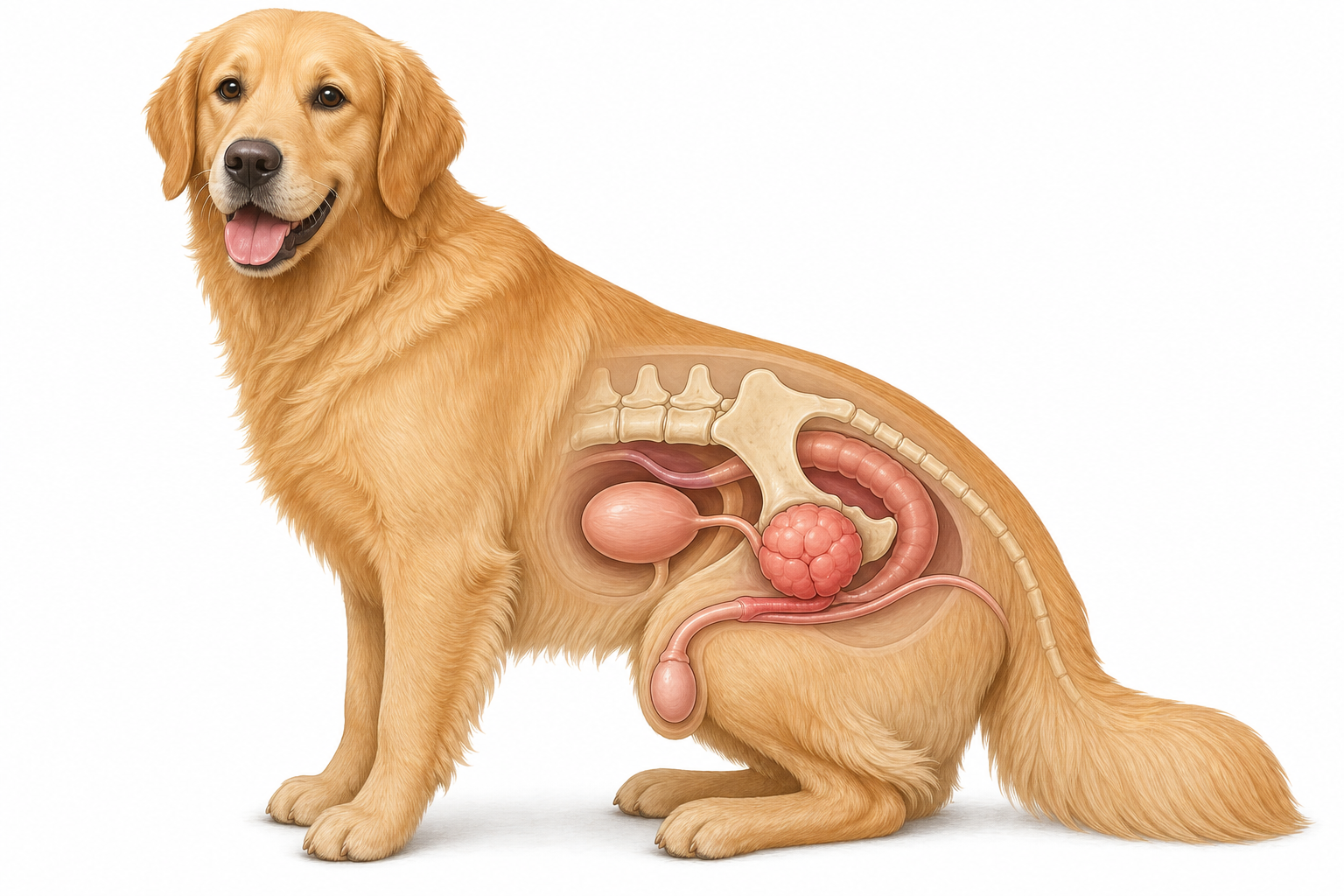
TL;DR. BPH ist eine nicht krebsartige Vergrößerung der Prostata bei intakten Rüden; führt zu Pressen beim Kotabsatz, Blut im Urin oder Ausfluss und ist gut behandelbar durch Kastration oder Medikamente.
Anatomische Lage der Prostata zu Blase und Rektum.
Was ist das?
Die benigne Prostatahyperplasie (BPH) ist eine spontane, nicht maligne Vergrößerung der Prostata bei nicht kastrierten Rüden. Die Prostata bildet Samenflüssigkeit und umschließt die Urethra unter dem Rektum. Dihydrotestosteron (DHT) treibt Hyperplasie und Hypertrophie; zystische Formen (CBPH) kommen vor. Die Vergrößerung komprimiert Urethra und Rektum und begünstigt Infekte oder schmerzhafte Zysten.
Ursachen und Risikofaktoren
Hormonell vermittelter Alterungsprozess intakter Rüden. Ab ca. 2 Jahren: DHT-Überproduktion und veränderte Östrogen-/Testosteron-Ratio. Keine rassespezifische Prädisposition dokumentiert. Kastrierte Rüden entwickeln keine BPH.
Anzeichen, auf die Sie achten sollten
- Tenesmus (häufig)
- Hämaturie
- Dysurie und Pollakisurie
- Präputial-/Urethralausfluss
- Bandförmiger Kot (gelegentlich); verminderte Fertilität/Libido; steifer Gang (selten)
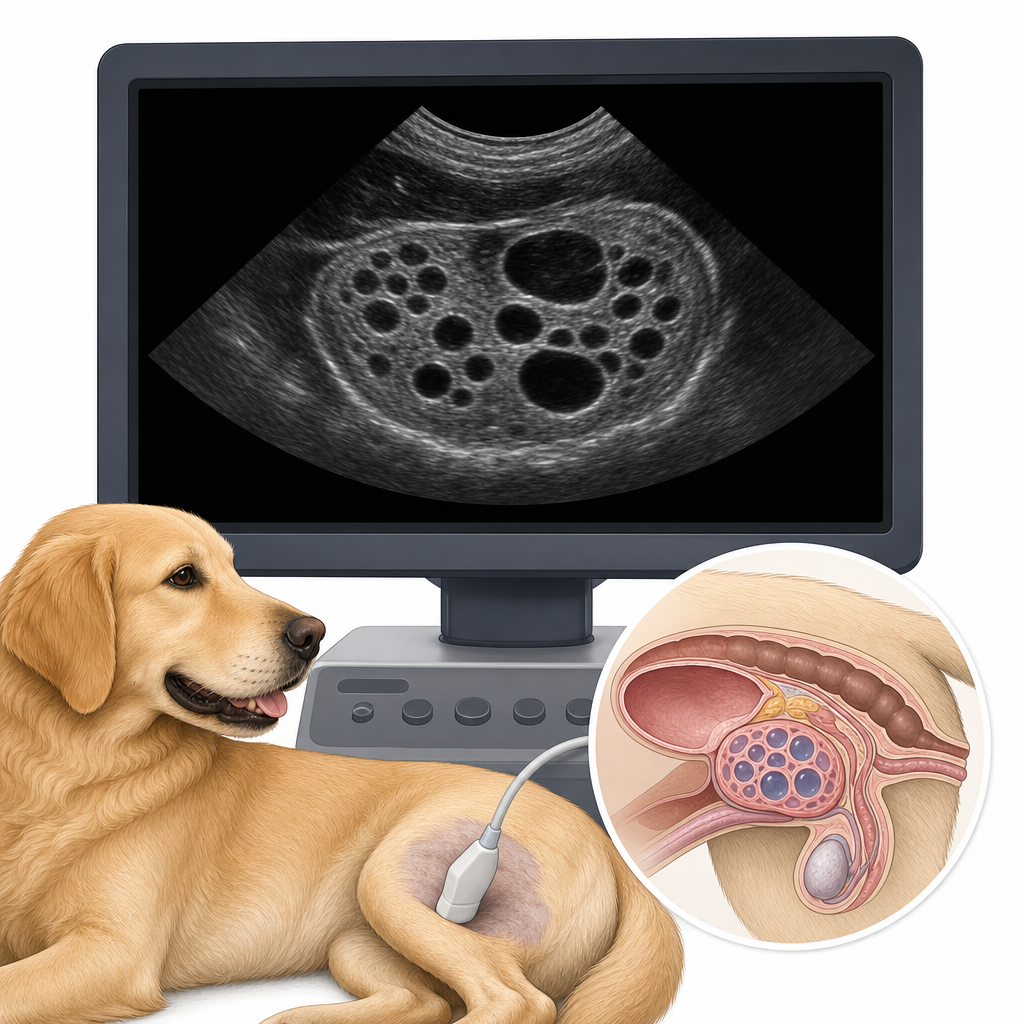
Ultraschall zeigt Strukturveränderungen und Zysten.
Wie Tierärzte diagnostizieren
Rektale Untersuchung, Röntgen und Abdomenultraschall. CPSE-Blutwert. FNA oder Biopsie bei Infekt- oder Tumorverdacht (Biopsie = Goldstandard).
Behandlungsoptionen
Chirurgische Kastration: kurativ.
Finasterid: First-Line-Medikation bei Zuchttieren oder OP-Risiko; langfristig.
Prognose
Sehr gut bei Kastration oder konsequenter Finasterid-Therapie. Unbehandelt: Risiko für Prostatitis, Zysten, Abszesse.
Vorbeugung
Kastration verhindert BPH. Bei Intact: regelmäßige rektale Untersuchung ab ca. 2 Jahren.
Wann den Tierarzt rufen
Termin bei Blut, Ausfluss oder leichtem Pressen.
Notfall: Harnverhalt; starke Schmerzen; Fieber/Apathie; plötzliche Hinterhandschwäche.
Quellen
- Cowell and Tyler's Diagnostic Cytology and Hematology of the Dog and Cat, 5th Edition, pages 424, 426.
- Textbook of Veterinary Internal Medicine, 5th Edition, page 992.
My highlights & notes
Anzeichen & Symptome
Diagnose
- Histological examination of a prostatic biopsy specimenGoldstandard
- Canine prostate-specific arginine esterase (CPSE) blood measurement
- Digital rectal examination
- Fine-needle aspiration of the prostate
- Radiography
- Ultrasonography
Behandlungsansätze
Behandlungen müssen von einem approbierten Tierarzt verordnet werden. Konkrete Dosierungen werden absichtlich nicht angezeigt.
Häufige Fragen
What is Prostatic Hyperplasia?
Benign prostatic hyperplasia (BPH) is a common, non-cancerous enlargement of the prostate gland that affects intact male dogs as they age. Driven by normal hormonal changes, BPH can cause straining to defecate, bloody urine, or discharge. Fortunately, it is highly treatable and completely curable through surgical castration, while medical options exist for breeding dogs.
What are the symptoms of Prostatic Hyperplasia?
Blood in urine、Straining to poop、Painful or difficult urination、Pollakiuria、preputial discharge、urethral discharge、decreased fertility、loss of libido
How is Prostatic Hyperplasia diagnosed?
Histological examination of a prostatic biopsy specimen、Canine prostate-specific arginine esterase (CPSE) blood measurement、Digital rectal examination、Fine-needle aspiration of the prostate、Radiography、Ultrasonography
How is Prostatic Hyperplasia treated?
Behandlungen müssen von einem approbierten Tierarzt verordnet werden. Konkrete Dosierungen werden absichtlich nicht angezeigt.
Quellen
- Cowell and Tyler s Diagnostic Cytology and Hematology of the Dog and Cat, 5th Edition (VetBooks.ir) · p. 424
- Internal Medicine 5th · p. 992
- Cowell and Tyler s Diagnostic Cytology and Hematology of the Dog and Cat, 5th Edition (VetBooks.ir) · p. 426
Dieser Artikel dient der allgemeinen Information und ersetzt keinen tierärztlichen Rat. Bei Krankheit bitte einen Tierarzt aufsuchen.
Sorgen um Ihr Tier?
Peqaboos KI hilft Symptome zu tracken, Laborberichte zu verstehen und zu wissen, wann der Tierarzt nötig ist.
Peqaboo-App laden