

Prostatic Hyperplasia
Benign prostatic hyperplasia
Also known as: Benign Prostatic Hyperplasia, BPH, Cystic Benign Prostatic Hyperplasia, CBPH
In short
Benign prostatic hyperplasia (BPH) is a common, non-cancerous enlargement of the prostate gland that affects intact male dogs as they age. Driven by normal hormonal changes, BPH can cause straining to defecate, bloody urine, or discharge. Fortunately, it is highly treatable and completely curable through surgical castration, while medical options exist for breeding dogs.
TL;DR. Benign prostatic hyperplasia (BPH) is a common, age-related enlargement of the prostate in intact male dogs that can cause straining to defecate, bloody urine, or discharge, but is highly treatable with castration or medication.
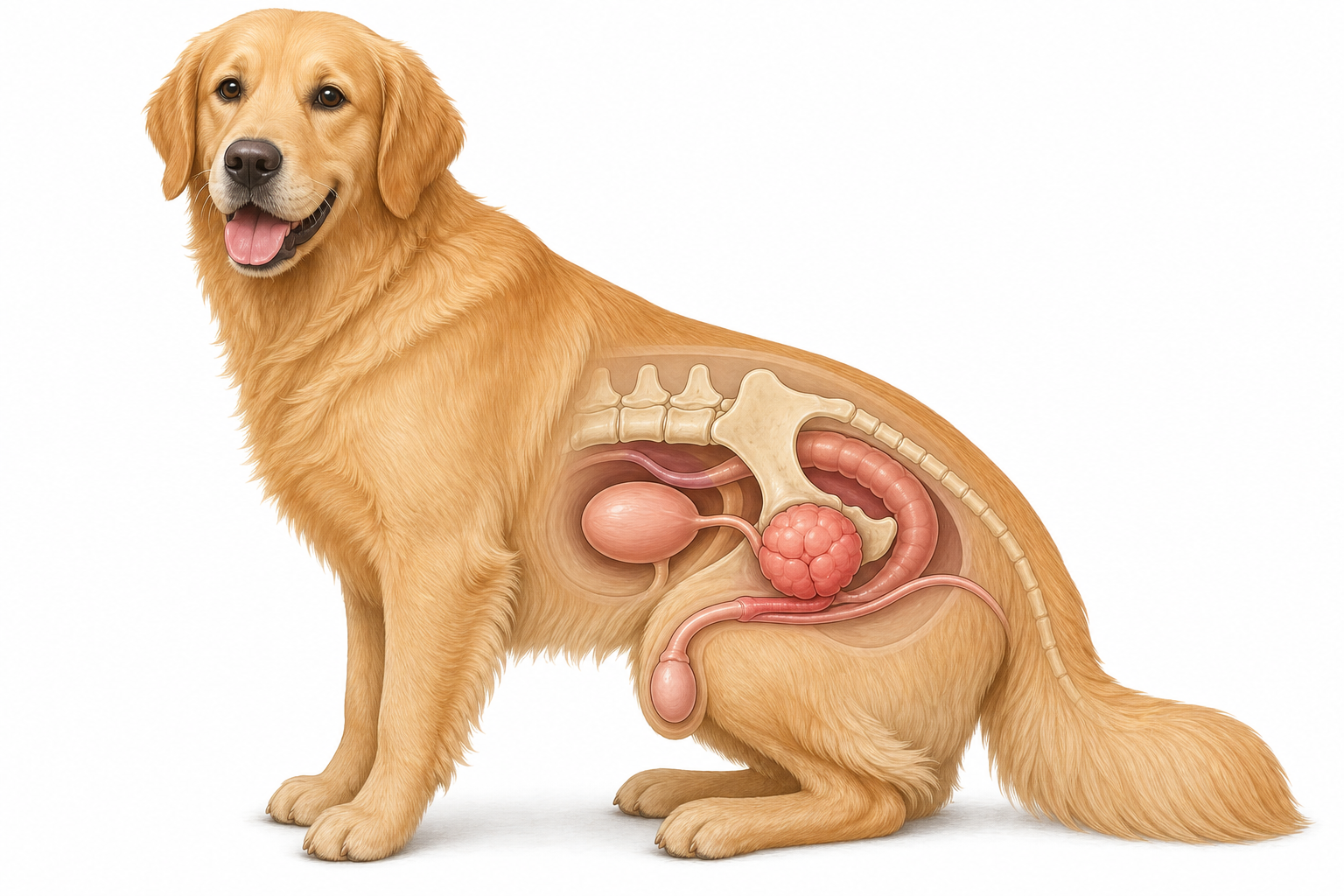
Anatomical relationship of the canine prostate to the bladder and rectum.
What is it?
Benign prostatic hyperplasia (BPH) is a common, spontaneous, and non-cancerous enlargement of the prostate gland in intact (unneutered) male dogs. The prostate is the only accessory sex gland in male dogs, and its primary function is to produce seminal fluid, which nourishes and transports sperm. Located within the pelvic cavity, the prostate sits directly below the rectum and completely surrounds the urethra—the tube that carries urine from the bladder out of the body.
As intact male dogs age, the prostate naturally undergoes structural changes. This process is primarily driven by the hormone dihydrotestosterone (DHT), a potent byproduct of testosterone. Over time, the prostate tissue experiences both hyperplasia (an increase in the number of normal cells) and hypertrophy (an increase in the size of individual cells). In some dogs, fluid-filled cavities can also develop within the tissue, a variation known as Cystic Benign Prostatic Hyperplasia (CBPH).
Because of the prostate's anatomical location, its enlargement can act like a clamp on the urethra and press upward against the rectum. This physical compression is responsible for the urinary and digestive symptoms associated with the condition. While BPH itself is benign and not cancerous, it is a progressive condition that can lead to significant discomfort and predispose dogs to secondary complications, such as infections or painful cysts, if left unmanaged.
Causes & risk factors
BPH is considered a normal part of the aging process for intact male dogs. It is a hormone-mediated condition that begins relatively early in a dog's life, even if clinical signs do not appear until years later. A leading veterinary diagnostic cytology reference explains the underlying hormonal mechanism:
"Beginning as early as age 2 years, an overproduction of the hormone dihydrotestosterone (DHT) is the primary mediator of BPH, ultimately leading to both hyperplasia and hypertrophy of the stromal and glandular components. An alteration of the ratio of 17β-estradiol to testosterone secreted by the testes is also involved."
As a dog ages, the testes continue to produce testosterone, which is converted to DHT within the prostate gland by an enzyme called 5-alpha-reductase. Additionally, the ratio of estrogen (17β-estradiol) to testosterone shifts as the dog grows older. This hormonal shift sensitizes the prostate tissue, making it more responsive to the growth-promoting effects of DHT.
There are no documented breed predispositions for BPH; any intact male dog of any breed can develop this condition as they age. The primary risk factors are simply being an intact male and advancing in age. Neutered dogs do not develop BPH because the removal of the testes eliminates the source of testosterone and DHT, preventing the hormonal stimulation required for the prostate to enlarge.
Signs to watch for
Many dogs with mild to moderate BPH do not show any outward signs of illness. However, as the prostate continues to grow, it begins to compress the surrounding organs, leading to noticeable clinical signs. These signs are detailed in a standard veterinary internal medicine reference:
"Regardless of etiology, clinical signs that suggest disease of the prostate include urinary abnormalities, such as hematuria, dysuria, and pollakiuria, preputial or urethral discharge, tenesmus, and ribbon or tapered stools. Animals may be presented for abnormalities in micturition, although it is less frequent. Intact animals may also exhibit decreased fertility or loss of libido."
Common Signs
- Tenesmus: Straining to defecate. This is one of the most frequent signs, occurring because the enlarged prostate pushes upward against the rectum, narrowing the passage for stool.
- Hematuria: Blood in the urine. The blood vessels within the enlarged prostate become fragile and can easily rupture, releasing blood into the urinary tract.
- Dysuria and Pollakiuria: Painful or difficult urination, and abnormally frequent urination. These occur when the swollen prostate compresses the urethra, making it difficult for the bladder to empty completely.
- Preputial or Urethral Discharge: A clear, pink, or bloody fluid dripping from the penis, which is often noticed independently of urination (for example, leaving spots on the dog's bedding).
Occasional Signs
- Ribbon-like or Tapered Stools: As the stool is forced past the compressed section of the rectum, it is flattened into a thin, ribbon-like shape.
- Decreased Fertility or Loss of Libido: The altered environment within the prostate can compromise the quality of the prostatic fluid, affecting sperm viability and breeding performance.
- Urinary Outflow Compromise: In some cases, the dog may experience significant difficulty initiating a urine stream.
Rare Signs
- Stilted Gait: In severe cases, the physical size of the prostate or the associated pelvic discomfort can cause a stiff, "stilted" movement in the hind limbs.
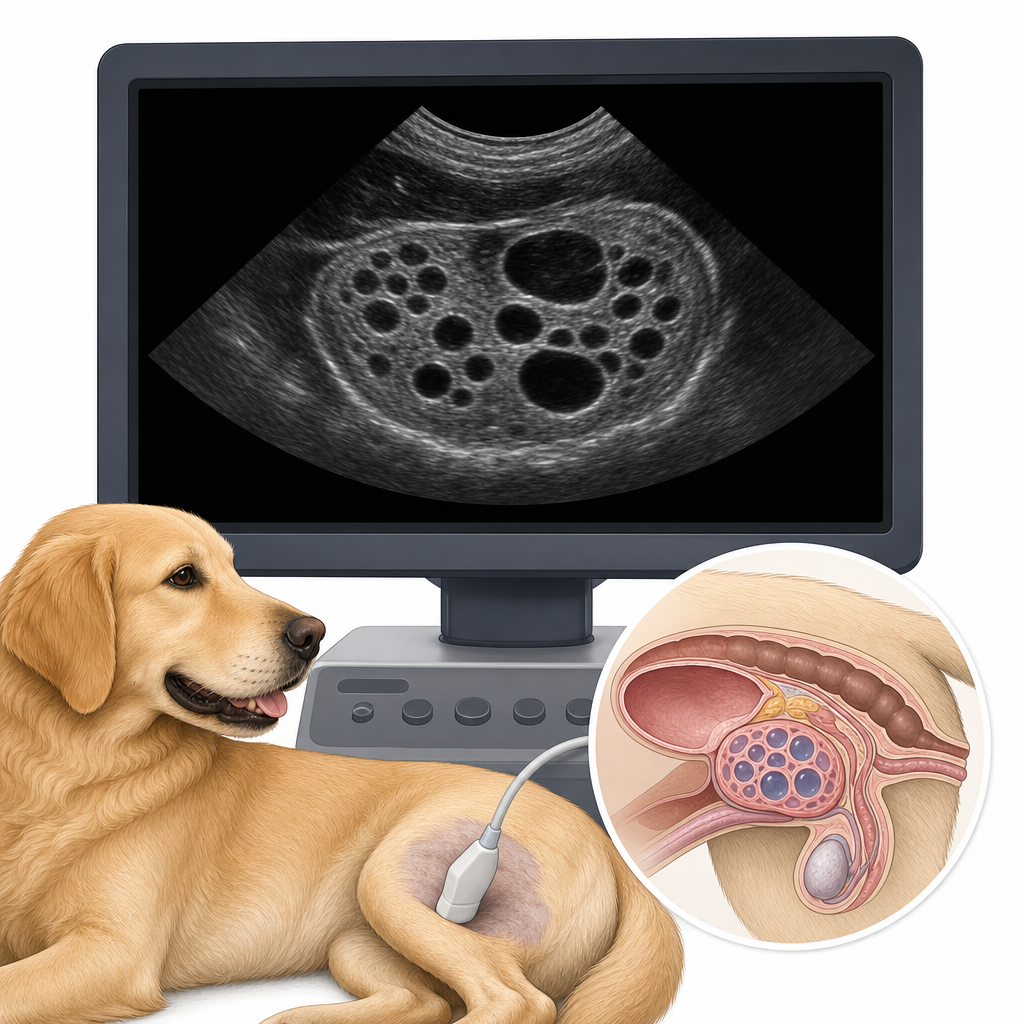
Ultrasound imaging helps vets visualize structural changes and fluid-filled cysts within the prostate.
How vets diagnose it
If your dog is showing signs of prostatic disease, your vet will perform a comprehensive diagnostic workup to confirm BPH and rule out other conditions, such as bacterial infections (prostatitis), prostatic abscesses, or prostatic cancer.
- Digital Rectal Examination (DRE): This is the most important initial screening tool. Your vet will insert a gloved, lubricated finger into your dog's rectum to feel the prostate gland. In dogs with BPH, the prostate is typically enlarged, smooth, symmetrical, and non-painful. If the gland is asymmetrical, lumpy, or highly painful, it suggests a different condition like an infection or cancer.
- Abdominal Radiography (X-rays): X-rays allow the vet to visualize the size and position of the prostate. An enlarged prostate may appear as a soft-tissue mass in the caudal abdomen, often displacing the bladder forward or pushing the rectum upward.
- Abdominal Ultrasonography: Ultrasound is highly valuable for assessing the internal structure of the prostate. It can identify whether the enlargement is uniform or if there are fluid-filled pockets, which are characteristic of Cystic Benign Prostatic Hyperplasia (CBPH).
- Canine Prostate-Specific Arginine Esterase (CPSE) Blood Measurement: This is a non-invasive blood test that measures a specific enzyme produced by the prostate. Elevated CPSE levels serve as a highly accurate biomarker for prostatic enlargement, helping to confirm a diagnosis of BPH.
- Fine-Needle Aspiration (FNA): If there is concern about infection or abnormal cell growth, your vet may use ultrasound guidance to insert a thin needle into the prostate to collect cells for microscopic evaluation (cytology).
- Histological Examination of a Prostatic Biopsy Specimen: This is the gold standard for diagnosing BPH. By obtaining a small tissue sample and examining it under a microscope, a pathologist can definitively confirm benign hyperplasia and rule out malignancy. However, because it is invasive, a biopsy is typically reserved for cases where other diagnostic tests are inconclusive.
Treatment options
Treatment for BPH is highly effective and tailored to whether the dog is a breeding animal or a family pet.
Surgical Castration (The Definitive Cure)
Surgical castration (neutering) is the treatment of choice and is considered curative for BPH. By removing the testes, the source of testosterone and DHT is eliminated. Without these hormones, the prostate gland undergoes rapid atrophy (shrinkage). Within days to weeks after surgery, the prostate will shrink significantly, and clinical signs like straining to defecate or bloody discharge will resolve. This is the most straightforward, permanent solution for dogs that are not intended for breeding.
Medical Management (Finasteride)
For valuable breeding dogs, or for dogs that are poor candidates for general anesthesia and surgery, medical management is an excellent alternative.
- Finasteride (5-alpha-reductase inhibitor): This is the first-line medical treatment for BPH. Finasteride works by blocking the enzyme 5-alpha-reductase, which prevents the conversion of testosterone into the more potent DHT. Because it selectively targets DHT, it allows the prostate gland to shrink while leaving circulating testosterone levels unaffected. This means the dog can maintain his libido and fertility, making it an ideal option for active stud dogs. Finasteride must be administered long-term; if the medication is discontinued, DHT levels will rise again, and the prostate will return to its enlarged state.
Prognosis
The prognosis for dogs with BPH is excellent. For dogs undergoing surgical castration, the condition is completely cured, and the prostate will remain small and inactive for the rest of the dog's life. For dogs managed medically with finasteride, the prognosis is also excellent, provided the medication is administered consistently as directed by your vet.
If BPH is left untreated, however, the prognosis can become more guarded. Chronic, unmanaged BPH predisposes the prostate to secondary bacterial infections (prostatitis), large fluid-filled cysts, or painful prostatic abscesses. These complications are much more difficult to treat, often requiring long-term antibiotic therapy, surgical drainage, and intensive supportive care.
Prevention
The only definitive way to prevent BPH is surgical castration. Neutering your dog before they reach maturity, or at any point in their adult life, will prevent the hormonal stimulation that causes the prostate to enlarge.
For intact male dogs, BPH is an inevitable consequence of aging. While it cannot be prevented if the dog remains intact, regular veterinary monitoring can help catch the condition early. If you own an intact male dog, ensure they receive regular digital rectal examinations during their annual veterinary checkups, starting around two years of age. Early detection allows for proactive management before uncomfortable clinical signs or secondary complications develop.
When to call your vet
You should schedule an appointment with your vet if you notice any changes in your dog's urination or defecation habits. Watch closely for blood in the urine, dripping fluid from the prepuce, or mild straining when your dog tries to pass stool.
Some prostatic complications require immediate veterinary attention. Seek emergency veterinary care immediately if your dog exhibits any of the following red flags:
- A complete inability to urinate (urinary obstruction)
- Severe distress, whining, or extreme pain when attempting to defecate or urinate
- Fever, extreme lethargy, or loss of appetite (which can indicate a severe prostatic infection or ruptured abscess)
- A sudden, severe weakness in the hind limbs or an inability to stand
Sources
- Cowell and Tyler's Diagnostic Cytology and Hematology of the Dog and Cat, 5th Edition, pages 424, 426.
- Textbook of Veterinary Internal Medicine, 5th Edition, page 992.
My highlights & notes
Signs & symptoms
How it is diagnosed
- Histological examination of a prostatic biopsy specimenGold standard
- Canine prostate-specific arginine esterase (CPSE) blood measurement
- Digital rectal examination
- Fine-needle aspiration of the prostate
- Radiography
- Ultrasonography
Treatment approaches
Treatment must be prescribed by a licensed veterinarian based on your pet. Specific drug doses are intentionally not shown here.
Frequently asked questions
What is Prostatic Hyperplasia?
Benign prostatic hyperplasia (BPH) is a common, non-cancerous enlargement of the prostate gland that affects intact male dogs as they age. Driven by normal hormonal changes, BPH can cause straining to defecate, bloody urine, or discharge. Fortunately, it is highly treatable and completely curable through surgical castration, while medical options exist for breeding dogs.
What are the symptoms of Prostatic Hyperplasia?
Blood in urine、Straining to poop、Painful or difficult urination、Pollakiuria、preputial discharge、urethral discharge、decreased fertility、loss of libido
How is Prostatic Hyperplasia diagnosed?
Histological examination of a prostatic biopsy specimen、Canine prostate-specific arginine esterase (CPSE) blood measurement、Digital rectal examination、Fine-needle aspiration of the prostate、Radiography、Ultrasonography
How is Prostatic Hyperplasia treated?
Treatment must be prescribed by a licensed veterinarian based on your pet. Specific drug doses are intentionally not shown here.
Sources
- Cowell and Tyler s Diagnostic Cytology and Hematology of the Dog and Cat, 5th Edition (VetBooks.ir) · p. 424
- Internal Medicine 5th · p. 992
- Cowell and Tyler s Diagnostic Cytology and Hematology of the Dog and Cat, 5th Edition (VetBooks.ir) · p. 426
This article is for general education and is not a substitute for professional veterinary advice. If your pet is unwell, please consult a veterinarian.
Worried about your pet?
Peqaboo’s AI helps you track symptoms, understand lab reports, and know when to see a vet.
Get the Peqaboo app