

Prostatic Hyperplasia
Benign prostatic hyperplasia
Også kendt som: Benign Prostatic Hyperplasia, BPH, Cystic Benign Prostatic Hyperplasia, CBPH
Kort sagt
Benign prostatic hyperplasia (BPH) is a common, non-cancerous enlargement of the prostate gland that affects intact male dogs as they age. Driven by normal hormonal changes, BPH can cause straining to defecate, bloody urine, or discharge. Fortunately, it is highly treatable and completely curable through surgical castration, while medical options exist for breeding dogs.
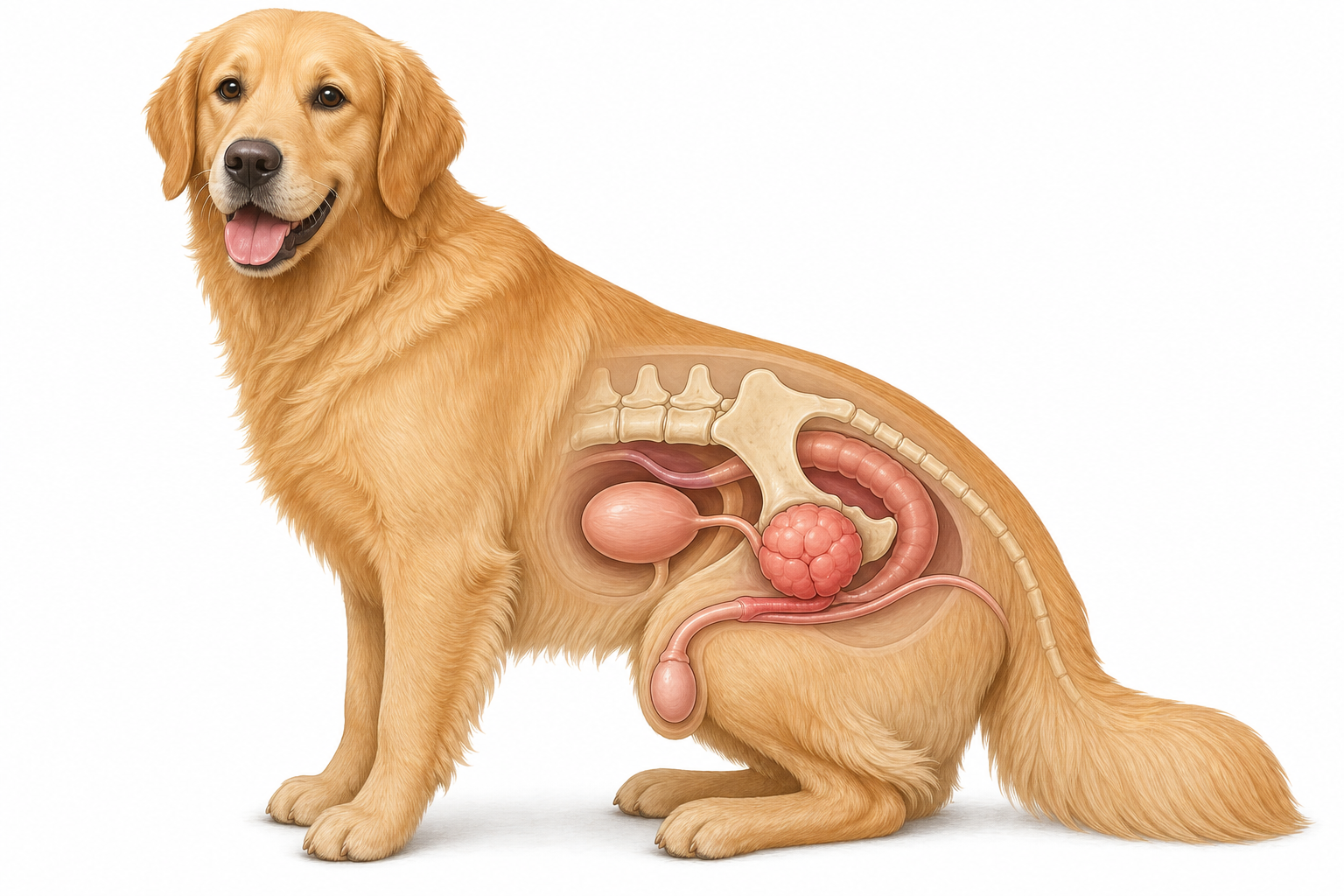
TL;DR. Ikke-kræftagtig forstørrelse hos intakte hanner; pres, blod eller flåd; behandles godt med kastration eller medicin.
Prostatas relation til blære og rektum.
Hvad er det?
Spontan ikke-malign forstørrelse. DHT: hyperplasi/hypertrofi; cyster mulige. Kompression af urinrør/rektum.
Årsager og risikofaktorer
Hormonal aldring fra ~2 år. Ingen dokumenteret raceprædisposition.
Tegn at holde øje med
- Tenesmus
- Hematuri
- Dysuri/pollakisuri
- Prepucial flåd
- Båndformet afføring (lejlighedsvis)
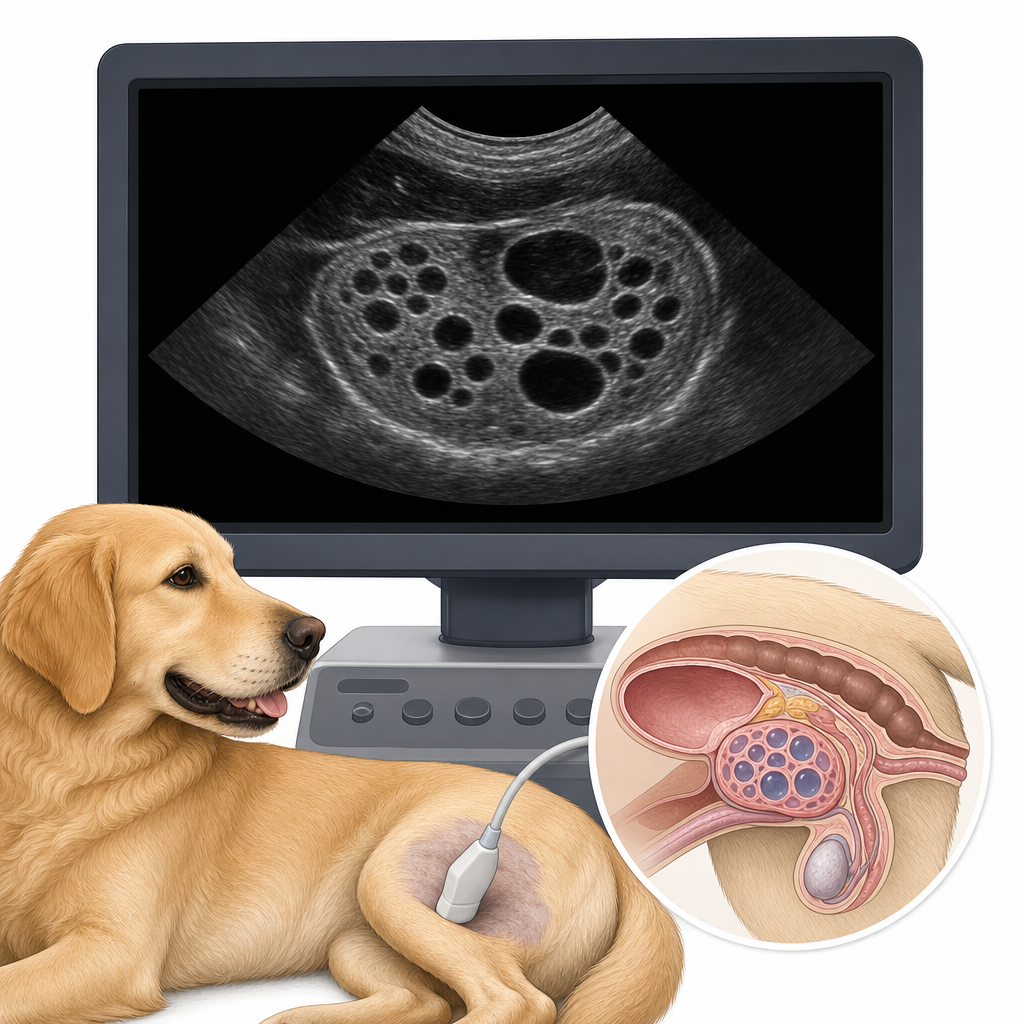
Ultralyd: struktur og cyster.
Hvordan dyrlæger diagnosticerer
Rektal undersøgelse, billeddiagnostik, CPSE; biopsi ved tvivl.
Behandlingsmuligheder
Kastration kurativ. Finasterid medicinsk førstevalg.
Prognose
Fremragende under behandling.
Forebyggelse
Kastration forebygger; rektale kontroller hvis intakt.
Hvornår ringe til dyrlægen
Akut: kan ikke urinere, stærke smerter, feber, bagbenssvaghed.
Kilder
- Cowell and Tyler's Diagnostic Cytology and Hematology of the Dog and Cat, 5th Edition, pages 424, 426.
- Textbook of Veterinary Internal Medicine, 5th Edition, page 992.
My highlights & notes
Tegn og symptomer
Hvordan det diagnosticeres
- Histological examination of a prostatic biopsy specimenGuldstandard
- Canine prostate-specific arginine esterase (CPSE) blood measurement
- Digital rectal examination
- Fine-needle aspiration of the prostate
- Radiography
- Ultrasonography
Behandlingsmetoder
Behandling skal ordineres af en autoriseret dyrlæge. Specifikke doser vises bevidst ikke.
Ofte stillede spørgsmål
What is Prostatic Hyperplasia?
Benign prostatic hyperplasia (BPH) is a common, non-cancerous enlargement of the prostate gland that affects intact male dogs as they age. Driven by normal hormonal changes, BPH can cause straining to defecate, bloody urine, or discharge. Fortunately, it is highly treatable and completely curable through surgical castration, while medical options exist for breeding dogs.
What are the symptoms of Prostatic Hyperplasia?
Blood in urine、Straining to poop、Painful or difficult urination、Pollakiuria、preputial discharge、urethral discharge、decreased fertility、loss of libido
How is Prostatic Hyperplasia diagnosed?
Histological examination of a prostatic biopsy specimen、Canine prostate-specific arginine esterase (CPSE) blood measurement、Digital rectal examination、Fine-needle aspiration of the prostate、Radiography、Ultrasonography
How is Prostatic Hyperplasia treated?
Behandling skal ordineres af en autoriseret dyrlæge. Specifikke doser vises bevidst ikke.
Kilder
- Cowell and Tyler s Diagnostic Cytology and Hematology of the Dog and Cat, 5th Edition (VetBooks.ir) · p. 424
- Internal Medicine 5th · p. 992
- Cowell and Tyler s Diagnostic Cytology and Hematology of the Dog and Cat, 5th Edition (VetBooks.ir) · p. 426
Artiklen er generel oplysning og erstatter ikke dyrlægeråd. Hvis dyret er sygt, kontakt en dyrlæge.
Bekymret for dit dyr?
Peqaboos AI hjælper dig med at følge symptomer, forstå labsvar og vide, hvornår du skal se dyrlægen.
Hent Peqaboo-appen