

Ventricular Septal Defect
Ventricular septal defect
Även känd som: VSD
Kort sagt
A ventricular septal defect (VSD) is an uncommon congenital heart condition where an abnormal hole exists in the wall separating the heart's lower chambers, which can range from a harmless, self-closing minor defect to a serious risk for heart failure.
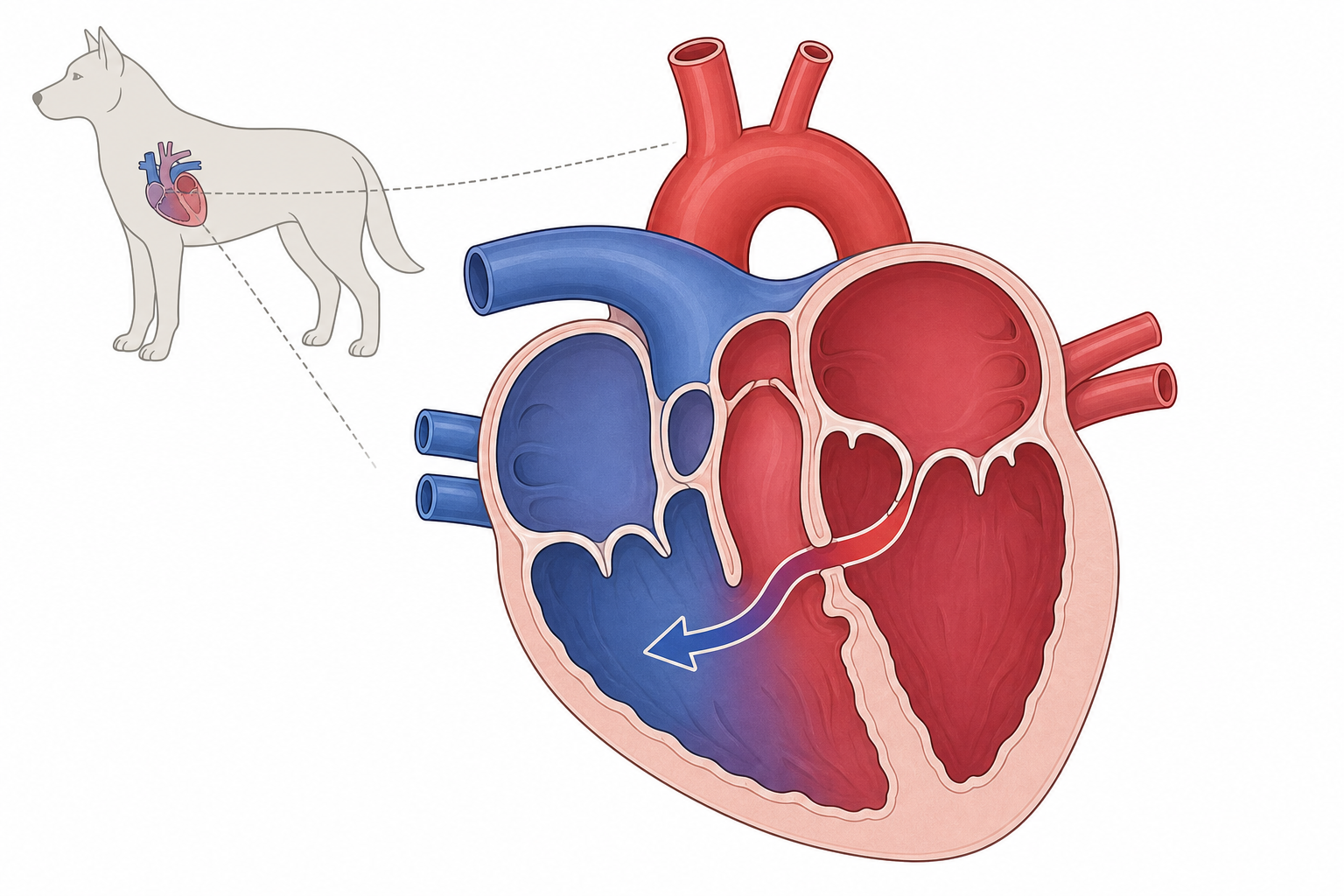
TL;DR. En ventrikelseptumdefekt är ett medfött hål i väggen mellan kamrarna; den kan vara mild eller innebära allvarlig risk för hjärtsvikt.
VSD tillåter shunt från vänster kammare (högt tryck) till höger.
Vad är det?
Medfödd hjärtmissbildning: hål i kammarseptum. Blod shuntas vänster-till-höger. Höger sida och lungor får för stor volym; vänstersidig överbelastning och kongestiv svikt möjliga.
Orsaker och riskfaktorer
Fosterutvecklingsfel med genetisk komponent. Ovanligt. Riskhundar: English Bulldog, English Springer Spaniel, Keeshond, West Highland White Terrier, Lakeland Terrier. Även hos katt.
Tecken
- Holosystoliskt blåsljud [kardinal]
- Ansträngningsintolerans [vanligt]
- Asymptomatisk [vanligt] vid litet/måttligt
- Systoliskt utdrivningsblåsljud [ibland]
- Vänstersidig svikt [ibland]: hosta, dyspné, letargi
- Diastoliskt decrescendo-blåsljud [sällsynt]

Ansträngningsintolerans är vanligt vid stora VSD.
Diagnos
Auskultation. Bekräftelse: ekokardiografi [GULD], Doppler, lungröntgen, EKG, kateterisering vid behov.
Behandling
Inget läkemedel stänger hålet. Små asymptomatiska: övervakning. Vid CHF/pulmonell hypertension: diuretika, vasodilatorer, hjärtstöd. Spontan stängning inom 2 år möjlig.
"In some cases, the defect closes spontaneously within the first 2 years of life. Closure can result from myocardial hypertrophy around the VSD or a seal formed by the septal tricuspid leaflet or a prolapsed aortic leaflet."
Prognos
Liten/måttlig: ofta normalt liv under kontroll. Stor: reserverad.
"A very large VSD causes the ventricles to function as a common chamber and induces RV dilation and hypertrophy. Pulmonary hypertension secondary to overcirculation is more likely to develop with large shunts."
Förebyggande
Ingen livsstilsprevention. Avla inte drabbade; hjärtscreening av föräldrar i riskraser.
När ringa veterinär
Akut: andnöd, öppen mun-andning (särskilt katt), ihållande hosta, kollaps, blå/bleka slemhinnor, extrem letargi. Andningsfrekvens i vila ofta <30/min.
För specifika raser
English Bulldog, English Springer Spaniel, Keeshond, Westie, Lakeland: noggrann auskultation vid första valpkontrollen.
Källor
- Internal Medicine, 5th Edition, pages 140, 141
- Clinical Echocardiography of the Dog and Cat, page 292
My highlights & notes
Tecken & symptom
Raser med högre risk
Hur det diagnostiseras
- EchocardiographyGuldstandard
- Cardiac catheterization, oximetry, and angiocardiography
- Doppler echocardiography
- Electrocardiography
- Thoracic radiography
Vanliga frågor
What is Ventricular Septal Defect?
A ventricular septal defect (VSD) is an uncommon congenital heart condition where an abnormal hole exists in the wall separating the heart's lower chambers, which can range from a harmless, self-closing minor defect to a serious risk for heart failure.
What are the symptoms of Ventricular Septal Defect?
Holosystolic murmur、No visible symptoms、Tiring easily during activity、Systolic ejection murmur、left-sided congestive heart failure、diastolic decrescendo murmur
How is Ventricular Septal Defect diagnosed?
Echocardiography、Cardiac catheterization, oximetry, and angiocardiography、Doppler echocardiography、Electrocardiography、Thoracic radiography
Källor
- Clinical Echocardiography of the Dog and Cat · p. 292
- Internal Medicine 5th · p. 141
- Internal Medicine 5th · p. 140
- Internal Medicine 5th · p. 140
Artikeln är allmän information och ersätter inte veterinärråd. Om djuret mår dåligt, kontakta veterinär.
Orolig för ditt djur?
Peqaboos AI hjälper dig följa symptom, förstå labbsvar och veta när du ska träffa veterinär.
Ladda ner Peqaboo-appen