

Ventricular Septal Defect
Ventricular septal defect
Også kjent som: VSD
Kort fortalt
A ventricular septal defect (VSD) is an uncommon congenital heart condition where an abnormal hole exists in the wall separating the heart's lower chambers, which can range from a harmless, self-closing minor defect to a serious risk for heart failure.
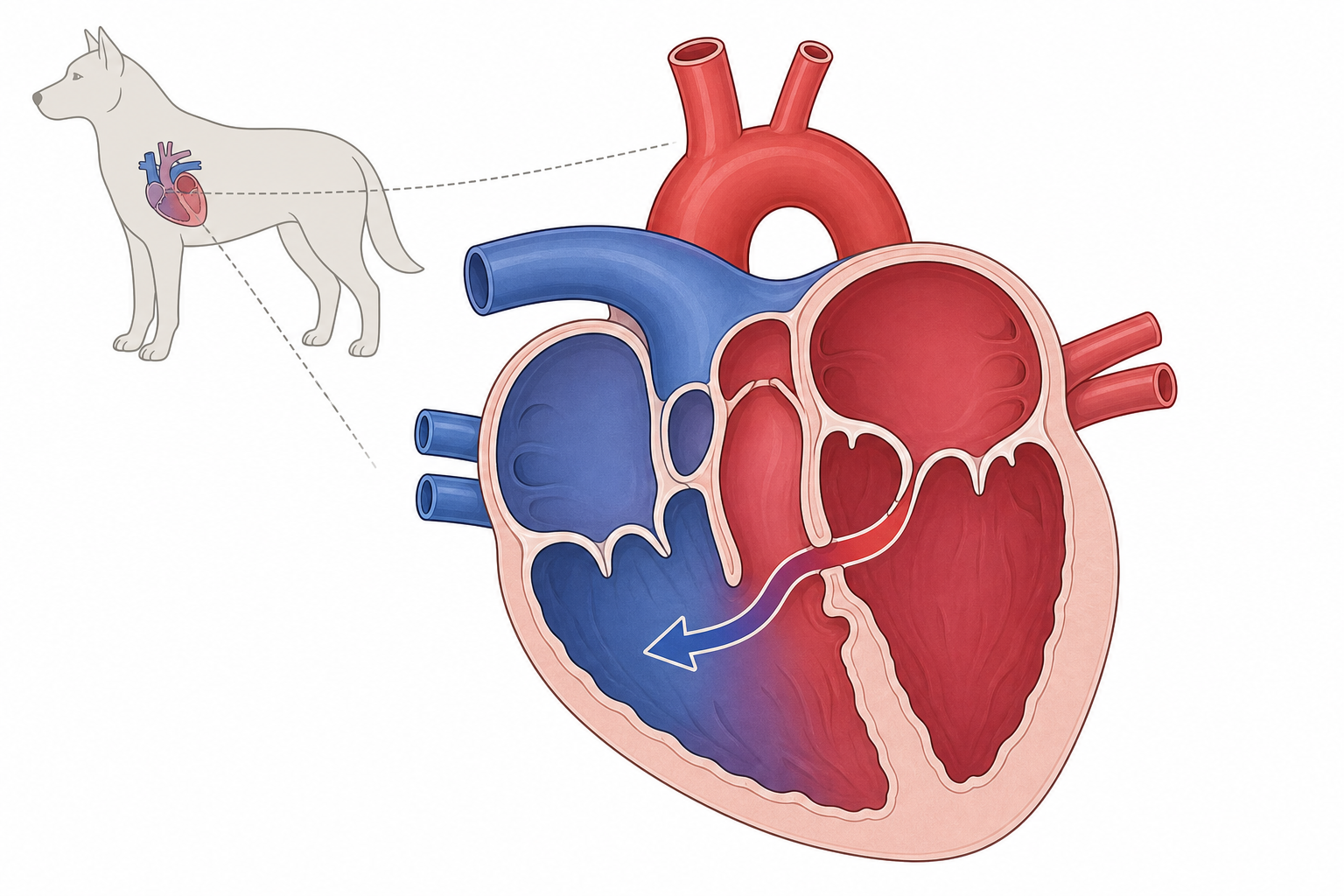
TL;DR. En ventrikkelseptumdefekt er et medfødt hull i veggen mellom kamrene; den kan være mild eller en alvorlig risiko for hjertesvikt.
VSD gir shunt fra venstre kammer (høyt trykk) til høyre.
Hva er det?
Medfødt hjertefeil: hull i kammerseptum. Blod shuntes venstre-til-høyre. Høyre side og lunger får for stort volum; venstresidig overbelastning og kongestiv svikt mulige.
Årsaker og risikofaktorer
Feil i fosterutvikling med genetisk komponent. Uvanlig. Risikohunder: English Bulldog, English Springer Spaniel, Keeshond, West Highland White Terrier, Lakeland Terrier. Også hos katt.
Tegn
- Holosystolisk bilyd [kardinal]
- Anstrengelsesintoleranse [vanlig]
- Asymptomatisk [vanlig] ved liten/moderat
- Systolisk utdrivningsbilyd [av og til]
- Venstresidig svikt [av og til]: hoste, dyspné, letargi
- Diastolisk decrescendo-bilyd [sjelden]

Anstrengelsesintoleranse er vanlig ved store VSD.
Diagnose
Auskultasjon. Bekreftelse: ekkokardiografi [GULL], Doppler, thoraxrøntgen, EKG, kateterisering ved behov.
Behandling
Ingen medisin lukker hullet. Små asymptomatiske: overvåking. Ved CHF/pulmonal hypertensjon: diuretika, vasodilatorer, hjertestøtte. Spontan lukking innen 2 år mulig.
"In some cases, the defect closes spontaneously within the first 2 years of life. Closure can result from myocardial hypertrophy around the VSD or a seal formed by the septal tricuspid leaflet or a prolapsed aortic leaflet."
Prognose
Liten/moderat: ofte normalt liv under kontroll. Stor: reservert.
"A very large VSD causes the ventricles to function as a common chamber and induces RV dilation and hypertrophy. Pulmonary hypertension secondary to overcirculation is more likely to develop with large shunts."
Forebygging
Ingen livsstilsforebygging. Ikke avle drabbade; hjertescreening av foreldre i risikoraser.
Når ringe veterinær
Akutt: andpustenhet, åpen munn-pust (særlig katt), vedvarende hoste, kollaps, blå/bleke slimhinner, ekstrem letargi. Pustefrekvens i hvile ofte <30/min.
For spesifikke raser
English Bulldog, English Springer Spaniel, Keeshond, Westie, Lakeland: grundig auskultasjon ved første valpekontroll.
Kilder
- Internal Medicine, 5th Edition, pages 140, 141
- Clinical Echocardiography of the Dog and Cat, page 292
My highlights & notes
Tegn og symptomer
Raser med høyere risiko
Hvordan det diagnostiseres
- EchocardiographyGullstandard
- Cardiac catheterization, oximetry, and angiocardiography
- Doppler echocardiography
- Electrocardiography
- Thoracic radiography
Vanlige spørsmål
What is Ventricular Septal Defect?
A ventricular septal defect (VSD) is an uncommon congenital heart condition where an abnormal hole exists in the wall separating the heart's lower chambers, which can range from a harmless, self-closing minor defect to a serious risk for heart failure.
What are the symptoms of Ventricular Septal Defect?
Holosystolic murmur、No visible symptoms、Tiring easily during activity、Systolic ejection murmur、left-sided congestive heart failure、diastolic decrescendo murmur
How is Ventricular Septal Defect diagnosed?
Echocardiography、Cardiac catheterization, oximetry, and angiocardiography、Doppler echocardiography、Electrocardiography、Thoracic radiography
Kilder
- Clinical Echocardiography of the Dog and Cat · p. 292
- Internal Medicine 5th · p. 141
- Internal Medicine 5th · p. 140
- Internal Medicine 5th · p. 140
Artikkelen er generell opplæring og erstatter ikke veterinærråd. Hvis dyret er sykt, kontakt veterinær.
Bekymret for dyret ditt?
Peqaboos AI hjelper deg følge symptomer, forstå labresultater og vite når du bør se veterinær.
Last ned Peqaboo-appen