

Ventricular Septal Defect
Ventricular septal defect
Juga dikenal sebagai: VSD
Singkatnya
A ventricular septal defect (VSD) is an uncommon congenital heart condition where an abnormal hole exists in the wall separating the heart's lower chambers, which can range from a harmless, self-closing minor defect to a serious risk for heart failure.
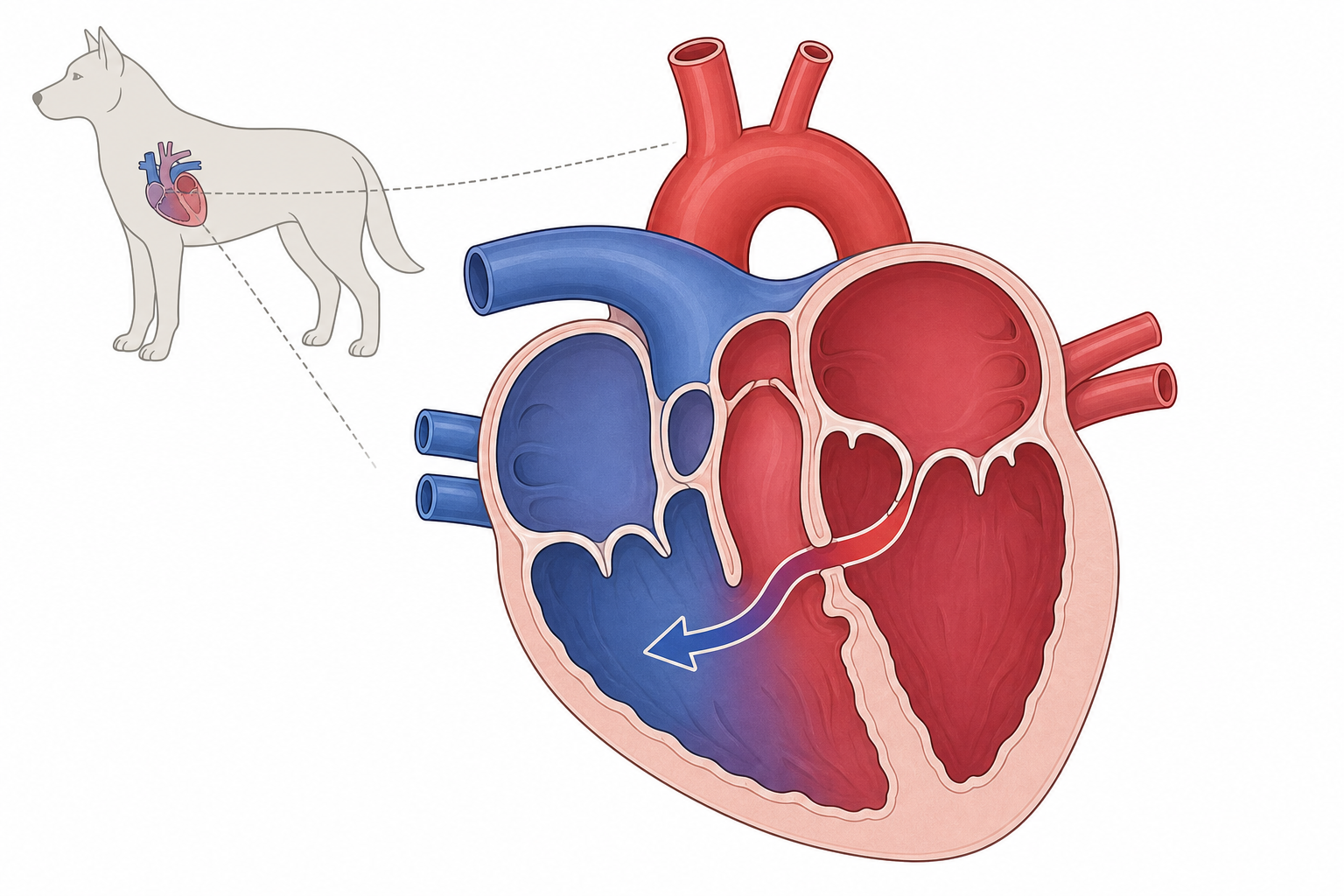
TL;DR. Defek septum ventrikel adalah lubang kongenital di dinding antara ventrikel; dapat ringan atau risiko serius gagal jantung.
VSD memungkinkan shunt dari ventrikel kiri bertekanan tinggi ke kanan.
Apa itu?
Malformasi jantung kongenital: lubang di septum ventrikel. Darah mengalir kiri-ke-kanan. Sisi kanan dan paru menerima volume berlebih; beban kiri dan gagal kongestif mungkin.
Penyebab dan faktor risiko
Kesalahan perkembangan janin dengan komponen genetik. Tidak umum. Anjing berisiko: English Bulldog, English Springer Spaniel, Keeshond, West Highland White Terrier, Lakeland Terrier. Juga pada kucing.
Tanda
- Bising holosistolik [kardinal]
- Intoleransi olahraga [umum]
- Asimtomatik [umum] jika kecil/sedang
- Bising ejeksi sistolik [sesekali]
- Gagal kiri [sesekali]: batuk, dispnea, letargi
- Bising diastolik decrescendo [jarang]

Intoleransi olahraga umum pada VSD besar.
Diagnosis
Auskultasi. Konfirmasi: ekokardiografi [EMAS], Doppler, rontgen toraks, EKG, kateterisasi jika perlu.
Pengobatan
Tidak ada obat yang menutup lubang. Kecil asimtomatik: pantau. Jika CHF/hipertensi paru: diuretik, vasodilator, dukungan jantung. Penutupan spontan dalam 2 tahun mungkin.
"In some cases, the defect closes spontaneously within the first 2 years of life. Closure can result from myocardial hypertrophy around the VSD or a seal formed by the septal tricuspid leaflet or a prolapsed aortic leaflet."
Prognosis
Kecil/sedang: sering hidup normal di bawah kontrol. Besar: waspada.
"A very large VSD causes the ventricles to function as a common chamber and induces RV dilation and hypertrophy. Pulmonary hypertension secondary to overcirculation is more likely to develop with large shunts."
Pencegahan
Tidak ada pencegahan gaya hidup. Jangan biakkan yang terdampak; skrining jantung orang tua pada ras berisiko.
Kapan menghubungi dokter hewan
Darurat: sesak napas, bernapas mulut terbuka (terutama kucing), batuk menetap, kolaps, membran biru/pucat, letargi ekstrem. Laju napas istirahat sering <30/menit.
Untuk ras tertentu
English Bulldog, English Springer Spaniel, Keeshond, Westie, Lakeland: auskultasi cermat pada pemeriksaan anak anjing pertama.
Sumber
- Internal Medicine, 5th Edition, pages 140, 141
- Clinical Echocardiography of the Dog and Cat, page 292
My highlights & notes
Tanda & gejala
Ras berisiko lebih tinggi
Cara didiagnosis
- EchocardiographyStandar emas
- Cardiac catheterization, oximetry, and angiocardiography
- Doppler echocardiography
- Electrocardiography
- Thoracic radiography
Pertanyaan umum
What is Ventricular Septal Defect?
A ventricular septal defect (VSD) is an uncommon congenital heart condition where an abnormal hole exists in the wall separating the heart's lower chambers, which can range from a harmless, self-closing minor defect to a serious risk for heart failure.
What are the symptoms of Ventricular Septal Defect?
Holosystolic murmur、No visible symptoms、Tiring easily during activity、Systolic ejection murmur、left-sided congestive heart failure、diastolic decrescendo murmur
How is Ventricular Septal Defect diagnosed?
Echocardiography、Cardiac catheterization, oximetry, and angiocardiography、Doppler echocardiography、Electrocardiography、Thoracic radiography
Sumber
- Clinical Echocardiography of the Dog and Cat · p. 292
- Internal Medicine 5th · p. 141
- Internal Medicine 5th · p. 140
- Internal Medicine 5th · p. 140
Artikel ini edukasi umum, bukan pengganti saran dokter hewan. Jika hewan sakit, konsultasikan dokter hewan.
Khawatir soal hewan peliharaan?
AI Peqaboo membantu melacak gejala, memahami hasil lab, dan tahu kapan ke dokter hewan.
Unduh app Peqaboo