

Ventricular Septal Defect
Ventricular septal defect
Also known as: VSD
In short
A ventricular septal defect (VSD) is an uncommon congenital heart condition where an abnormal hole exists in the wall separating the heart's lower chambers, which can range from a harmless, self-closing minor defect to a serious risk for heart failure.
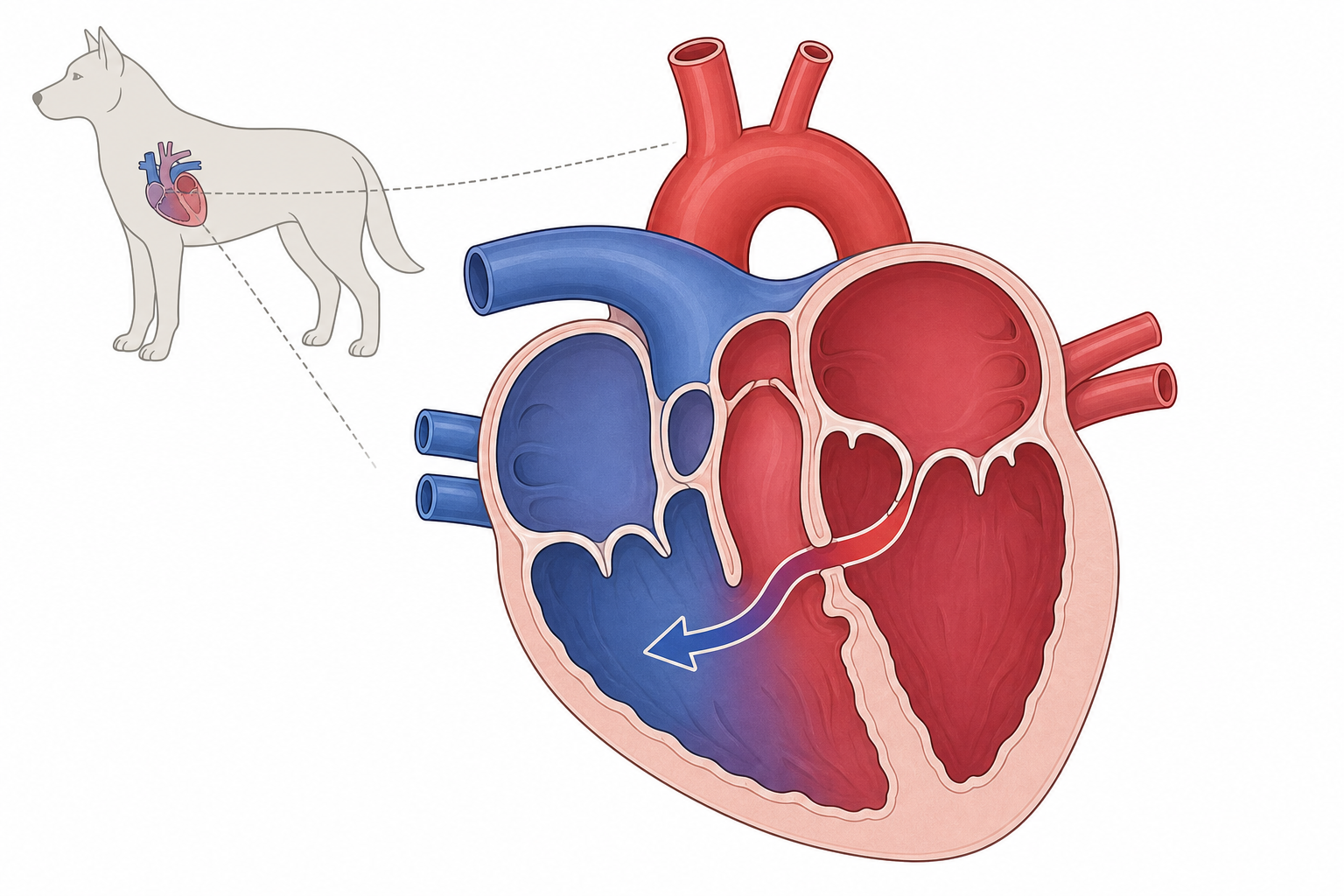
TL;DR. A ventricular septal defect is a congenital hole in the wall separating the heart's lower chambers, which can range from a harmless, self-closing minor defect to a serious risk for heart failure.
A ventricular septal defect allows blood to shunt abnormally from the high-pressure left ventricle to the right ventricle.
What is it?
A ventricular septal defect (VSD) is a congenital cardiac malformation, meaning it is a structural heart defect that an animal is born with. To understand this condition, it helps to look at how a healthy pet's heart functions. The heart is divided into four chambers: two upper chambers (the atria) and two lower chambers (the ventricles). The right and left sides of the heart are completely separated by a thick muscular wall called the septum. The portion of this wall separating the lower chambers is the ventricular septum.
In a healthy pet, the right side of the heart pumps oxygen-poor blood to the lungs, while the left side pumps oxygen-rich blood to the rest of the body. Because the left ventricle has to pump blood throughout the entire body, it operates under much higher pressure than the right ventricle, which only needs to push blood a short distance to the lungs.
When a pet has a VSD, there is an abnormal hole in the ventricular septum. Because of the pressure difference between the two sides, blood naturally takes the path of least resistance. Instead of flowing normally, blood is pushed from the high-pressure left ventricle through the hole into the low-pressure right ventricle. This abnormal movement of blood is known as a "left-to-right shunt."
This shunting of blood causes significant problems for the cardiovascular system. The right side of the heart and the blood vessels in the lungs are forced to handle a much larger volume of blood than they were designed for. Over time, this volume overload can cause the blood vessels in the lungs to become congested and can lead to enlargement of the left side of the heart, potentially culminating in congestive heart failure.
Causes & risk factors
Because a ventricular septal defect is a congenital condition, it is caused by an error in development while the fetus is growing in the womb. The complex process of heart formation occasionally fails to complete, leaving one or more holes in the ventricular septum. The exact trigger for this developmental failure is rarely known, but it is widely understood to have a genetic component.
While VSD can occur in any dog or cat, it is classified as an uncommon condition overall. However, certain breeds show a higher predisposition to this defect, suggesting an inherited genetic link. In dogs, breeds known to have an increased risk include the English Bulldog, English Springer Spaniel, Keeshond, West Highland White Terrier, and Lakeland Terrier. In cats, VSD is also observed, though specific breed predispositions are less clearly documented than in dogs.
Signs to watch for
Many pets with a ventricular septal defect show no outward signs of illness, especially early in life or if the defect is small. In these cases, the condition is often discovered incidentally during a routine veterinary examination. However, as the defect size increases, so does the severity of the clinical signs.
- Holosystolic murmur (cardinal): This is the most common sign detected by a veterinarian. It is a consistent, high-pitched murmur heard through a stethoscope during the contraction phase of the heartbeat.
- Exercise intolerance (common): Affected pets may tire out much faster than normal during play or walks, showing reluctance to run or climb stairs.
- Asymptomatic (common): Many pets, particularly those with small to moderate defects, live active lives without showing any physical signs of distress.
- Systolic ejection murmur (occasional): A specific type of murmur that peaks in intensity mid-beat, sometimes heard alongside or instead of the primary murmur.
- Left-sided congestive heart failure (occasional): If the shunt is large, fluid can back up into the lungs. Signs include coughing, rapid or labored breathing, and extreme lethargy.
- Diastolic decrescendo murmur (rare): A soft, fading murmur heard during the relaxation phase of the heartbeat, which may occur if the defect begins to affect the nearby aortic valve.

Exercise intolerance is a common sign of larger ventricular septal defects.
How vets diagnose it
Diagnosing a ventricular septal defect begins with a thorough physical examination. Your veterinarian will use a stethoscope to listen to your pet's heart. The presence of a characteristic holosystolic murmur, especially when loudest on the right side of the chest, strongly points toward a VSD. However, a murmur alone cannot confirm the diagnosis or determine the severity of the defect.
To get a definitive picture, your veterinarian will recommend several diagnostic tests:
- Echocardiography (Gold Standard): This is an ultrasound of the heart and is the definitive test for VSD. It allows the veterinary cardiologist to physically see the hole in the septum, measure its size, and assess whether the heart chambers have become enlarged.
- Doppler Echocardiography: Used in conjunction with standard ultrasound, this technology color-codes the blood flow. It allows the veterinarian to visualize the direction of the shunt (confirming it is left-to-right) and measure the velocity of the blood crossing the defect, which helps estimate the pressures inside the heart.
- Thoracic Radiography (Chest X-rays): X-rays are vital for assessing the impact of the VSD on the lungs and heart size. They allow the vet to see if there is fluid accumulation in the lungs (pulmonary congestion) or overall enlargement of the heart chambers.
- Electrocardiography (ECG): An ECG records the electrical activity of the heart. It is used to detect any abnormal heart rhythms (arrhythmias) or electrical patterns that suggest chamber enlargement.
- Advanced Diagnostics (Cardiac catheterization, oximetry, and angiocardiography): In complex cases, or when specialized surgical intervention is being considered, these invasive tests may be performed. They involve passing a tiny tube into the heart to measure oxygen levels and pressures directly, and injecting dye to map the blood flow.
Treatment options
There are no medications that can physically close a ventricular septal defect. Instead, treatment is highly tailored to the size of the hole and whether the pet is showing clinical signs.
Conservative Monitoring
For pets with small to moderate VSDs that are asymptomatic, the standard of care is regular monitoring. Your veterinarian will recommend periodic physical exams and repeat echocardiograms to ensure the heart is coping well with the shunt and that no signs of heart failure are developing.
Medical Management of Complications
If the VSD is large and has led to left-sided congestive heart failure or high blood pressure in the lungs (pulmonary hypertension), medical management is required. While these treatments do not fix the hole, they help manage the symptoms and improve quality of life. This typically involves medications to help the body eliminate excess fluid, dilate blood vessels to reduce the heart's workload, and support the heart muscle's ability to pump.
Spontaneous Closure
In some fortunate cases, the body's natural healing and growth processes can resolve the issue without intervention. As noted in a leading veterinary internal medicine reference:
"In some cases, the defect closes spontaneously within the first 2 years of life. Closure can result from myocardial hypertrophy around the VSD or a seal formed by the septal tricuspid leaflet or a prolapsed aortic leaflet."
If spontaneous closure does not occur within the first two years, the defect is highly likely to remain permanent.
Prognosis
The outlook for a pet with a ventricular septal defect depends almost entirely on the size of the hole and how much blood is shunting across it.
A small to moderate defect usually allows a relatively normal life span with minimal to no impact on the pet's quality of life. Many of these pets require no treatment other than routine monitoring.
Conversely, large defects carry a much more guarded prognosis. When the shunt is substantial, the heart must work incredibly hard to manage the extra blood volume. According to a leading veterinary internal medicine reference:
"A very large VSD causes the ventricles to function as a common chamber and induces RV dilation and hypertrophy. Pulmonary hypertension secondary to overcirculation is more likely to develop with large shunts."
If left-sided congestive heart failure or severe pulmonary hypertension develops, the pet's life span may be significantly shortened, and intensive lifelong medical management will be necessary to keep them comfortable.
Prevention
Because ventricular septal defects are congenital developmental abnormalities, they cannot be prevented through diet, exercise, or lifestyle modifications.
The primary method of prevention is responsible breeding. Dogs and cats diagnosed with a VSD, even a small and asymptomatic one, should not be used for breeding. If you own a breed that is predisposed to VSD, such as an English Bulldog or English Springer Spaniel, ensure that the breeder conducts cardiac screening on the parent dogs before breeding.
When to call your vet
If your pet has been diagnosed with a VSD, you must monitor them closely at home for any signs of cardiac decline.
Contact your veterinarian immediately or seek emergency veterinary care if you notice any of the following emergency red flags:
- Difficulty breathing, rapid breathing at rest, or breathing with an open mouth (especially in cats)
- Persistent coughing or gagging
- Sudden collapse, fainting spells, or severe weakness
- Gums or tongue that appear blue, purple, or pale grey
- Extreme lethargy or sudden refusal to move
For routine monitoring, keep a log of your pet's resting respiratory rate (breathing rate while they are sound asleep). A normal resting respiratory rate is typically under 30 breaths per minute. A consistent increase in this rate over several days is an early warning sign that you should schedule an appointment with your vet.
For specific breeds
If you own an English Bulldog, English Springer Spaniel, Keeshond, West Highland White Terrier, or Lakeland Terrier, it is important to be aware of their genetic predisposition to VSD. When bringing a new puppy of these breeds home, ensure your veterinarian performs a highly detailed chest auscultation (listening with a stethoscope) during their very first puppy exam. Early detection of a murmur allows for proactive monitoring and can help prevent complications before they become life-threatening.
Sources
- Internal Medicine, 5th Edition, pages 140, 141
- Clinical Echocardiography of the Dog and Cat, page 292
My highlights & notes
Signs & symptoms
Breeds at higher risk
How it is diagnosed
- EchocardiographyGold standard
- Cardiac catheterization, oximetry, and angiocardiography
- Doppler echocardiography
- Electrocardiography
- Thoracic radiography
Frequently asked questions
What is Ventricular Septal Defect?
A ventricular septal defect (VSD) is an uncommon congenital heart condition where an abnormal hole exists in the wall separating the heart's lower chambers, which can range from a harmless, self-closing minor defect to a serious risk for heart failure.
What are the symptoms of Ventricular Septal Defect?
Holosystolic murmur、No visible symptoms、Tiring easily during activity、Systolic ejection murmur、left-sided congestive heart failure、diastolic decrescendo murmur
How is Ventricular Septal Defect diagnosed?
Echocardiography、Cardiac catheterization, oximetry, and angiocardiography、Doppler echocardiography、Electrocardiography、Thoracic radiography
Sources
- Clinical Echocardiography of the Dog and Cat · p. 292
- Internal Medicine 5th · p. 141
- Internal Medicine 5th · p. 140
- Internal Medicine 5th · p. 140
This article is for general education and is not a substitute for professional veterinary advice. If your pet is unwell, please consult a veterinarian.
Worried about your pet?
Peqaboo’s AI helps you track symptoms, understand lab reports, and know when to see a vet.
Get the Peqaboo app