

Ventricular Septal Defect
Ventricular septal defect
Aussi appelé: VSD
En bref
A ventricular septal defect (VSD) is an uncommon congenital heart condition where an abnormal hole exists in the wall separating the heart's lower chambers, which can range from a harmless, self-closing minor defect to a serious risk for heart failure.
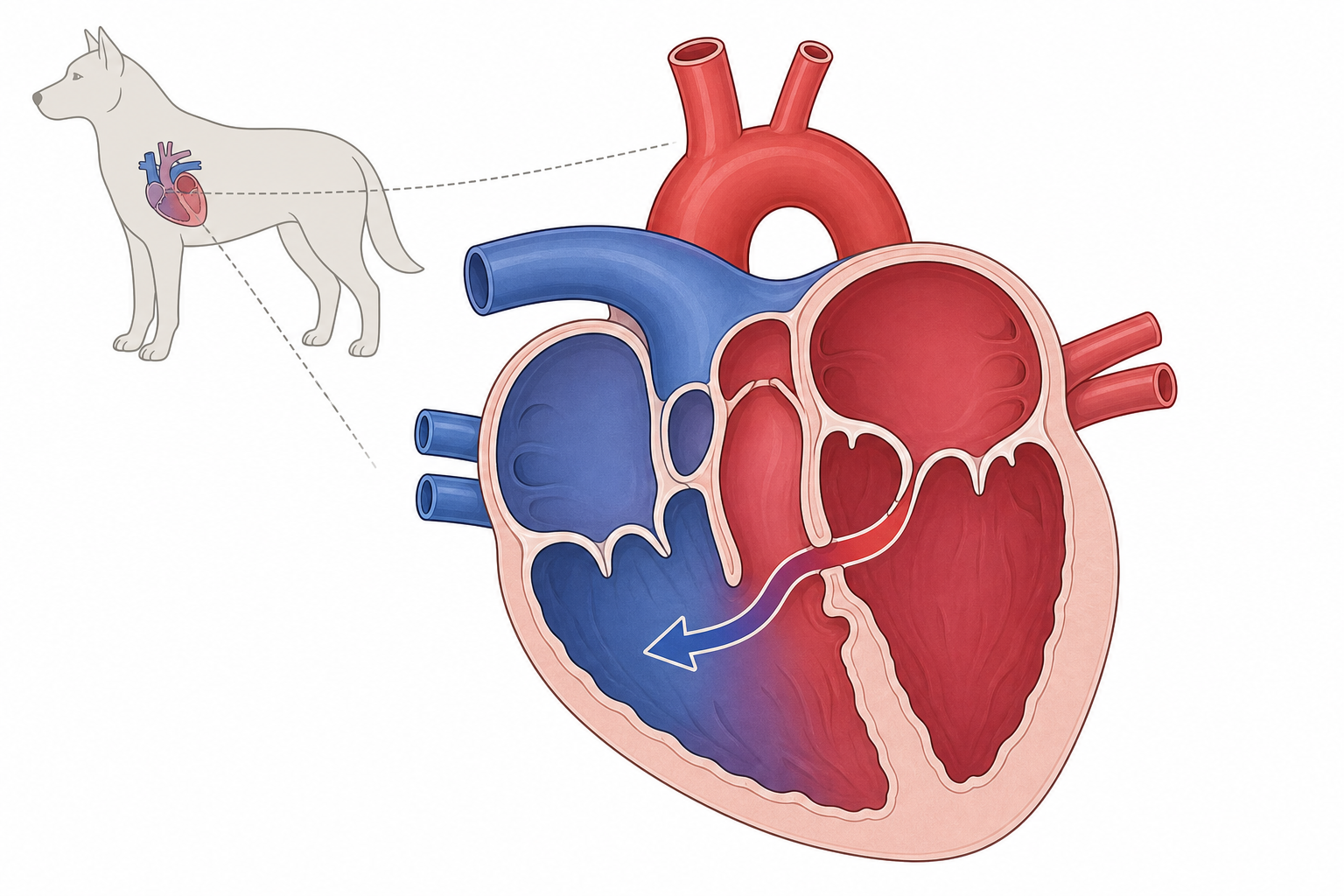
TL;DR. Une communication interventriculaire est un orifice congénital dans la cloison entre les ventricules ; elle peut être bénigne ou entraîner un risque sérieux d'insuffisance cardiaque.
La VSD permet un shunt de sang du ventricule gauche (haute pression) vers le droit.
Qu'est-ce que c'est ?
Malformation cardiaque congénitale : trou dans le septum interventriculaire. Le sang est poussé de gauche à droite (shunt). Le cœur droit et les poumons reçoivent un volume excessif ; surcharge gauche et insuffisance cardiaque congestive possibles.
Causes et facteurs de risque
Erreur de développement fœtal, composante génétique. Peu fréquent. Chiens à risque : English Bulldog, English Springer Spaniel, Keeshond, West Highland White Terrier, Lakeland Terrier. Aussi observé chez le chat.
Signes à surveiller
- Souffle holosystolique (cardinal)
- Intolérance à l'effort (fréquent)
- Asymptomatique (fréquent) si défaut petit/modéré
- Souffle d'éjection systolique (occasionnel)
- Insuffisance cardiaque gauche (occasionnel) : toux, dyspnée, léthargie
- Souffle diastolique en decrescendo (rare)

L'intolérance à l'effort est fréquente en cas de VSD large.
Comment les vétérinaires le diagnostiquent
Auscultation. Confirmation :
- Échocardiographie [OR]
- Doppler (direction et vitesse du shunt)
- Radiographie thoracique
- ECG
- Cathétérisme/angiocardiographie si besoin
Options de traitement
Aucun médicament ne ferme l'orifice. Petits asymptomatiques : surveillance. ICC ou hypertension pulmonaire : diurétiques, vasodilatateurs, soutien cardiaque. Fermeture spontanée possible dans les 2 premières années.
"In some cases, the defect closes spontaneously within the first 2 years of life. Closure can result from myocardial hypertrophy around the VSD or a seal formed by the septal tricuspid leaflet or a prolapsed aortic leaflet."
Pronostic
Petit/modéré : souvent vie normale sous contrôle. Large : réservé (surcharge, HTAP, ICC).
"A very large VSD causes the ventricles to function as a common chamber and induces RV dilation and hypertrophy. Pulmonary hypertension secondary to overcirculation is more likely to develop with large shunts."
Prévention
Pas de prévention par le mode de vie. Ne pas faire reproduire les animaux atteints ; dépistage cardiaque des parents dans les races à risque.
Quand appeler le vétérinaire
Urgence : dyspnée, respiration bouche ouverte (surtout chat), toux persistante, collapsus, muqueuses bleues ou pâles, léthargie extrême. Fréquence respiratoire au repos souvent <30/min.
Pour certaines races
Bulldog anglais, Springer anglais, Keeshond, Westie, Lakeland : auscultation soigneuse dès le premier examen de chiot.
Sources
- Internal Medicine, 5th Edition, pages 140, 141
- Clinical Echocardiography of the Dog and Cat, page 292
My highlights & notes
Signes et symptômes
Races à risque plus élevé
Comment c’est diagnostiqué
- EchocardiographyRéférence
- Cardiac catheterization, oximetry, and angiocardiography
- Doppler echocardiography
- Electrocardiography
- Thoracic radiography
Questions fréquentes
What is Ventricular Septal Defect?
A ventricular septal defect (VSD) is an uncommon congenital heart condition where an abnormal hole exists in the wall separating the heart's lower chambers, which can range from a harmless, self-closing minor defect to a serious risk for heart failure.
What are the symptoms of Ventricular Septal Defect?
Holosystolic murmur、No visible symptoms、Tiring easily during activity、Systolic ejection murmur、left-sided congestive heart failure、diastolic decrescendo murmur
How is Ventricular Septal Defect diagnosed?
Echocardiography、Cardiac catheterization, oximetry, and angiocardiography、Doppler echocardiography、Electrocardiography、Thoracic radiography
Sources
- Clinical Echocardiography of the Dog and Cat · p. 292
- Internal Medicine 5th · p. 141
- Internal Medicine 5th · p. 140
- Internal Medicine 5th · p. 140
Cet article est informatif et ne remplace pas un avis vétérinaire. Si votre animal est malade, consultez un vétérinaire.
Inquiet pour votre animal ?
L’IA Peqaboo aide à suivre les symptômes, comprendre les analyses et savoir quand consulter.
Télécharger l’app Peqaboo