

Panosteitis
In short
Panosteitis is a painful, temporary bone disease affecting young, growing dogs, particularly large breeds. It is characterized by shifting lameness, bone pain, and fever, but typically resolves as the dog matures.
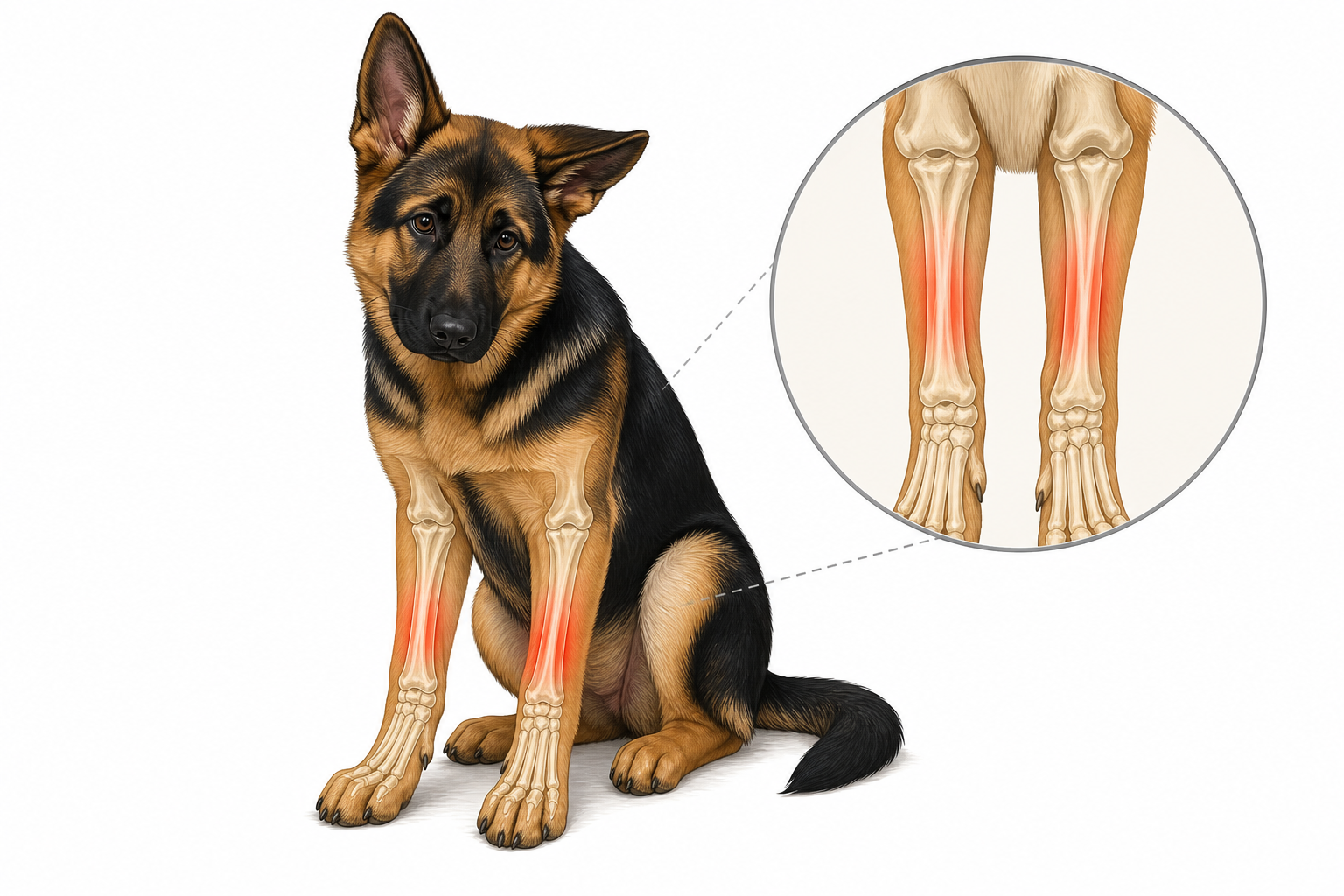
TL;DR. Panosteitis is a painful, temporary bone condition in young, growing dogs that causes shifting lameness, bone pain, and fever.
Panosteitis typically affects young, rapidly growing dogs, particularly large breeds.
What is it?
Panosteitis is a metabolic bone disorder that primarily affects young, rapidly growing dogs. Often referred to colloquially as "growing pains," this condition involves inflammation of the long bones in a dog's legs. It typically targets the humerus (upper arm), radius and ulna (forearm), femur (thigh), and tibia (shin).
Inside a healthy bone, the marrow cavity is filled with fatty tissue and blood vessels. In a dog developing panosteitis, this normal marrow is temporarily replaced by a dense, fibrous tissue and excess bone formation. This process increases pressure within the bone cavity and irritates the periosteum—the highly sensitive, nerve-rich outer membrane covering the bone. The result is significant localized pain and discomfort for the growing pup.
While the condition can be highly distressing for owners to witness, it is important to understand that panosteitis is a self-limiting disease. This means it will eventually resolve on its own as the dog's skeletal system matures, typically leaving behind no permanent damage or long-term structural defects.
Causes & risk factors
Despite decades of study, the precise underlying cause of panosteitis remains unknown. Because it is classified as a metabolic bone disorder, researchers suspect a combination of genetic factors, rapid growth rates, nutritional influences (such as high-protein or high-calorie diets that accelerate growth), and temporary circulatory issues within the bone marrow.
While any dog can theoretically develop the condition, it is most frequently diagnosed in young dogs between the ages of 5 and 18 months. Large and giant breed dogs are highly predisposed due to their rapid growth curves. Males are also more commonly affected than females, though it can occur in any young canine.
Signs to watch for
Recognizing the signs of panosteitis is key to getting your dog prompt relief. The symptoms can wax and wane, often shifting from one leg to another over weeks or months.
- Bone pain (Cardinal): Your dog will show intense sensitivity or pain when the shafts of their long leg bones are touched or squeezed.
- Lameness (Common): A sudden, unexplained limp is often the first sign. This lameness is unique because it can "shift" from a front leg to a hind leg, or vice versa, as different bones undergo inflammatory phases.
- Fever (Common): Because panosteitis is an inflammatory metabolic process, affected dogs frequently run a mild to moderate fever.
- Reluctance to move (Common): Your puppy may seem unusually lethargic, hesitate to climb stairs, or refuse to play.
- Decreased appetite (Common): The discomfort and fever can cause a temporary loss of interest in food.

Shifting lameness and reluctance to bear weight are common signs of panosteitis.
How vets diagnose it
Diagnosing panosteitis begins with a comprehensive physical and orthopedic examination. Your vet will systematically evaluate your dog's gait and palpate each limb to localize the source of the pain.
During the exam, the vet will apply gentle pressure directly to the shafts of the long bones. A sharp pain response during this specific bone palpation, rather than joint manipulation, is a classic indicator of panosteitis. This helps distinguish the condition from joint-specific issues like Osteochondritis Dissecans (OCD) or joint laxity. As noted in a leading veterinary internal medicine reference:
"The bones should also be thoroughly palpated, particularly in young dogs, because metabolic bone disorders such as hypertrophic osteodystrophy and panosteitis can cause fever associated with bone pain."
Your vet must also rule out other causes of fever and limb pain, such as immune-mediated polyarthritis or infectious diseases. In some cases, dogs with joint inflammation do not present with obvious joint swelling, making a meticulous physical exam even more critical:
"Because some animals with polyarthritis do not have obvious joint pain or detectable joint swelling or effusion, it is important to maintain a high index of suspicion for this disorder. Animals with nonspecific pain, a stiff gait, reluctance to exercise, or fever of unknown origin should always be evaluated with a careful physical examination in an attempt to localize a region..."
To confirm the diagnosis, your vet will recommend digital X-rays of the affected limbs. On an X-ray, panosteitis appears as characteristic "smudgy" or dense white areas inside the normally dark marrow cavity of the long bones. These radiographic changes can lag behind the clinical symptoms by several days, so a repeat X-ray may sometimes be necessary if early images are inconclusive.
Treatment options
There is no specific cure or direct drug treatment for panosteitis. Because the disease is self-limiting, veterinary management focuses entirely on supportive care, pain control, and keeping the dog comfortable during flare-ups.
Pain Management
Your vet will prescribe veterinary-specific non-steroidal anti-inflammatory drugs (NSAIDs) to manage the bone pain and reduce fever. These medications are highly effective at restoring mobility and improving your puppy's quality of life. Never administer human pain relievers, as they can be highly toxic to dogs.
Activity Restriction
During active flare-ups, strict exercise restriction is essential. High-impact activities like running, jumping, and rough play should be avoided, as they can exacerbate the pain. Short, controlled leash walks are recommended to maintain muscle tone without overstressing the inflamed bones.
Nutritional Management
If your puppy is on a high-calorie or high-protein diet, your vet may recommend transitioning to a balanced diet formulated specifically for large breed puppies. This helps regulate their growth rate, preventing rapid growth spurts that can trigger or worsen metabolic bone disorders.
Prognosis
While specific long-term prognosis data is not detailed in the provided clinical record, panosteitis is widely recognized in veterinary medicine as having an excellent prognosis.
Most dogs experience episodic flare-ups that last from a few days to several weeks. These episodes will gradually decrease in frequency and severity as the dog approaches skeletal maturity. By the time the dog reaches 18 to 24 months of age, the condition typically resolves completely, leaving no long-term lameness, joint damage, or structural abnormalities behind.
Prevention
Because the exact cause of panosteitis remains unknown, there is no guaranteed way to prevent it. However, you can minimize the risk and severity of metabolic bone disorders through careful nutritional management:
- Avoid overfeeding: Keep large breed puppies at a lean, healthy body condition to prevent excess weight from stressing developing bones.
- Use appropriate puppy food: Feed a high-quality diet specifically formulated for large breed puppies. These diets have carefully balanced calcium-to-phosphorus ratios and controlled energy densities to promote steady, safe skeletal growth.
- Avoid calcium supplements: Never add calcium or mineral supplements to a balanced commercial puppy food, as excess calcium can disrupt normal bone development.
When to call your vet
If your young dog develops a sudden limp, seems lethargic, or shows signs of pain when handled, schedule a veterinary evaluation. While panosteitis is not a medical emergency, prompt veterinary care is necessary to manage your dog's pain and rule out more serious orthopedic conditions.
Seek immediate veterinary attention if your dog exhibits any of the following emergency red flags:
- Complete inability or refusal to stand or walk
- An extremely high fever accompanied by severe lethargy or depression
- Complete refusal to eat or drink for more than 24 hours
- Severe, acute swelling in one or more limbs
Sources
- Internal Medicine, 5th Edition, pages 1137, 1315.
- Current Techniques in Small Animal Surgery, 5th Edition, page 1111.
My highlights & notes
Signs & symptoms
How it is diagnosed
- Bone palpation
Frequently asked questions
What is Panosteitis?
Panosteitis is a painful, temporary bone disease affecting young, growing dogs, particularly large breeds. It is characterized by shifting lameness, bone pain, and fever, but typically resolves as the dog matures.
What are the symptoms of Panosteitis?
Bone pain、Fever、Limping
How is Panosteitis diagnosed?
Bone palpation
Sources
- Current Techniques in Small Animal Surgery, 5th Edition (VetBooks.ir) · p. 1111
- Internal Medicine 5th · p. 1137
- Internal Medicine 5th · p. 1315
This article is for general education and is not a substitute for professional veterinary advice. If your pet is unwell, please consult a veterinarian.
Worried about your pet?
Peqaboo’s AI helps you track symptoms, understand lab reports, and know when to see a vet.
Get the Peqaboo app