

Laminitis
In short
Laminitis is a painful, potentially devastating equine emergency affecting the connection between the hoof wall and the coffin bone. Learn the signs, drug-related risks, and treatment options.
TL;DR. Laminitis is a highly painful, emergency condition in horses where the critical bond between the hoof wall and the coffin bone breaks down, requiring immediate veterinary intervention.
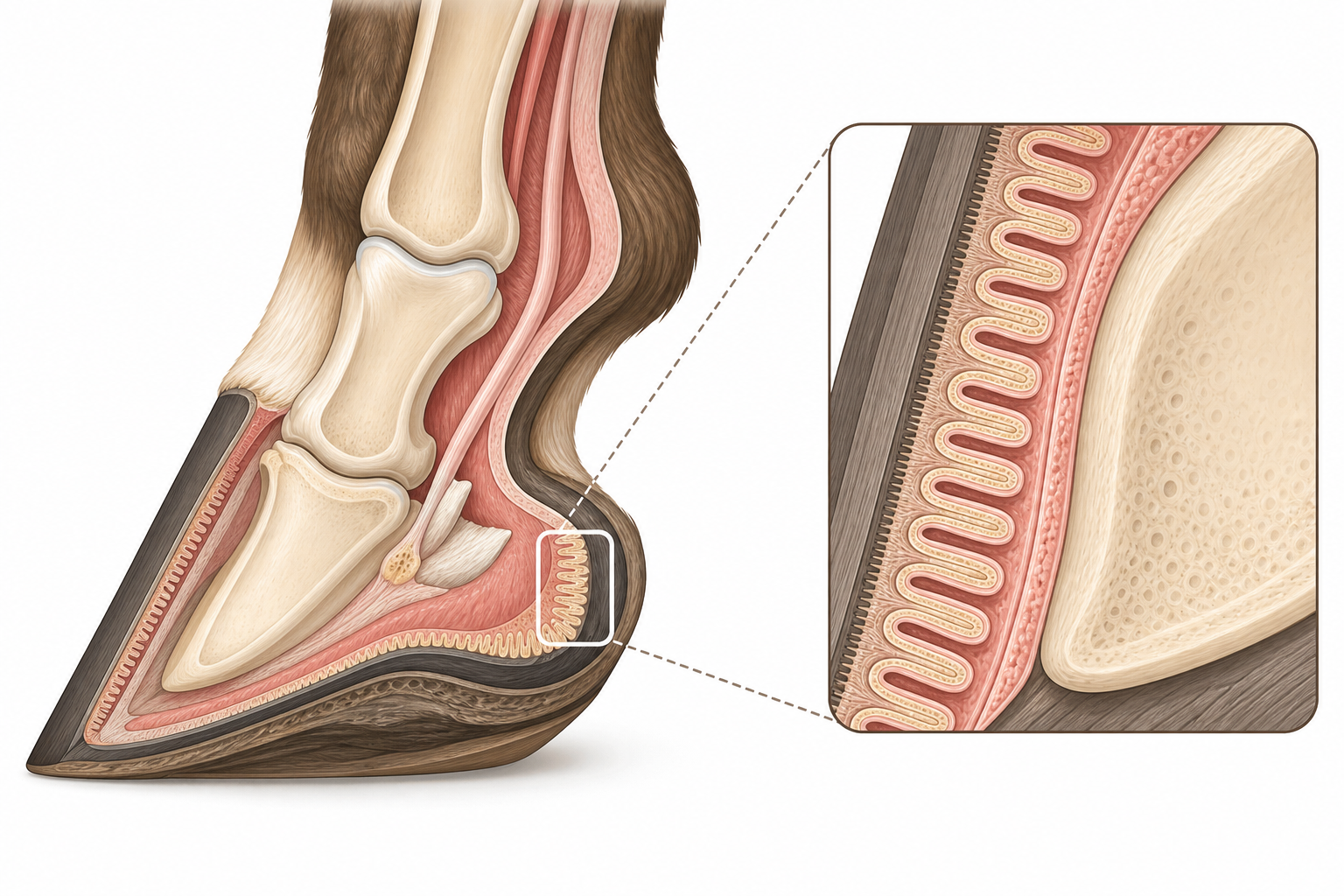
The delicate laminae bond the hard hoof wall to the internal coffin bone.
What is it?
Laminitis is one of the most severe, painful, and potentially debilitating conditions that can affect horses. To understand laminitis, it is helpful to look at the anatomy of the equine foot. The horse's hoof is not just a solid block of horn; it contains a complex, living system of tissues. The pedal bone (also known as the coffin bone or third phalanx) is the bony core of the hoof. This bone is suspended inside the hard hoof wall by a highly specialized tissue called the laminae.
The laminae consist of two interlocking layers: the sensitive dermal laminae, which are rich in blood vessels and nerves and attach to the pedal bone, and the insensitive epidermal laminae, which line the inside of the hoof wall. These layers interlock like microscopic fingers, creating an incredibly strong bond that supports the entire weight of the horse.
When a horse develops laminitis, this delicate bond becomes inflamed and begins to fail. As the inflammation progresses, the laminae lose their structural integrity and separate. Without the support of the laminae, the pedal bone is no longer suspended securely. The downward force of the horse's weight, combined with the upward pull of the deep digital flexor tendon at the back of the leg, can cause the pedal bone to rotate downward or sink toward the sole of the hoof. This structural failure causes excruciating pain and can lead to permanent lameness or, in severe cases, euthanasia.
Causes & risk factors
Laminitis can occur as an acute primary disease or as a secondary complication of other systemic conditions or medical treatments. Understanding the diverse triggers is essential for early recognition and prevention.
One significant risk factor is the administration of certain medications. Glucocorticoids, which are powerful anti-inflammatory steroid hormones (such as isoflupredone), are known to carry a risk of inducing laminitis in horses. While these medications are highly effective for treating various inflammatory and autoimmune conditions, their use must be carefully managed and monitored by a veterinarian.
Another drug-associated trigger is nitazoxanide, an antiprotozoal medication. Nitazoxanide can disrupt the normal bacterial flora in the horse's digestive tract, leading to enterocolitis (inflammation of the small and large intestines). This disruption can release harmful endotoxins into the bloodstream, triggering a systemic inflammatory response that culminates in laminitis. As noted in a leading veterinary drug reference:
"The manufacturer states that stallions may be more prone to developing laminitis than either geldings or mares. Nitazoxanide may disrupt normal flora in the horse leading to enterocolitis. If patient develops any of the following: a high fever (>103°F), scant or loose feces, diarrhea, colic, or signs of laminitis, nitazoxanide treatments should be stopped immediately and appropriate veterinary [care initiated]."
In addition to drug-induced risks, certain demographic factors play a role. Stallions appear to have a higher susceptibility to developing laminitis compared to geldings or mares, particularly when exposed to triggering medications. While some metabolic conditions and pasture access are common general risk factors, no specific breed predispositions are identified in the clinical record for this condition.
Signs to watch for
Recognizing the early signs of laminitis is critical, as early intervention can significantly improve the chances of a successful outcome. The clinical signs of laminitis are primarily driven by the intense pain associated with lamellar separation and structural instability within the hoof.
- Pain (Cardinal): Severe, debilitating pain is the primary sign of laminitis. This pain is typically most pronounced in the front hooves, though it can affect all four feet.
- Rocked-Back Stance (Common): To relieve pressure on the painful toes of their front feet, horses will often stand with their hind legs tucked far underneath their body and their front legs stretched forward, rocking their weight backward.
- Reluctance to Move (Common): Affected horses are often extremely hesitant to walk, turn, or move on hard surfaces. When forced to walk, they may exhibit a stiff, short-strided gait.
- Increased Digital Pulses (Common): A strong, throbbing pulse (bounding digital pulse) can be felt over the digital arteries at the back of the pastern.
- Heat in the Hoof Wall (Common): The external hoof wall and coronary band may feel noticeably warm or hot to the touch.
- Frequent Weight Shifting (Common): The horse may constantly shift its weight from one foot to another while standing to alleviate discomfort.
- Lying Down Excessively (Common): Horses with severe laminitis will spend an unusual amount of time lying down to remove all weight-bearing pressure from their hooves.

The characteristic "rocked-back" stance is a clear indicator of severe hoof pain.
How vets diagnose it
A veterinarian will diagnose laminitis through a combination of physical examination, clinical history, and diagnostic imaging. Because laminitis is a medical emergency, a prompt and thorough evaluation is essential.
The physical examination begins with an assessment of the horse's posture, gait, and vital signs. The vet will palpate the digital arteries to check for a bounding pulse and feel the hoof wall for elevated temperature. Hoof testers—a specialized tool used to apply gentle, localized pressure to different areas of the sole—will be used to locate the exact site of pain, which is typically concentrated around the toe region.
Digital radiography (X-rays) is the gold standard for confirming a diagnosis of laminitis and assessing the severity of the disease. Radiographs allow the veterinarian to visualize the position of the pedal bone within the hoof capsule. By measuring the alignment of the pedal bone relative to the dorsal hoof wall, the vet can determine if rotation has occurred. Radiographs also reveal whether the bone has sunk downward (indicated by an increased distance between the coronary band and the top of the pedal bone) and help monitor the progression of the disease over time.
Additionally, the veterinarian will review the horse's recent medical history, looking for potential triggers such as recent colic episodes, retained placenta in post-foaling mares, dietary changes, or the administration of high-risk medications like glucocorticoids or nitazoxanide.
Treatment options
Treating laminitis requires a multi-faceted approach aimed at controlling pain, reducing inflammation, addressing the underlying cause, and providing mechanical support to the hoof.
Non-Steroidal Anti-inflammatory Drugs (NSAIDs)
Pain management is a cornerstone of laminitis therapy. Non-steroidal anti-inflammatory drugs are critical for reducing both pain and the inflammatory cascade within the laminae. Phenylbutazone is widely considered the most effective NSAID for managing acute laminitis. However, vets must carefully calibrate the dosage. If pain is completely eliminated, the horse may feel well enough to walk or run, which can cause further mechanical damage to the compromised laminae. As noted in a leading veterinary reference:
"Phenylbutazone appears to be the most effective NSAID for the treatment of acute laminitis and is given at an initial dose of 4 grams (for an average adult-sized horse) and is immediately decreased to 1 to 1.5 grams twice daily. This lower dose is used to keep the horse comfortable, but not relieve pain to the extent the horse [overuses the limb]."
Free Radical Scavengers and Anti-inflammatories
In the acute phase of laminitis, tissue damage is exacerbated by the release of harmful free radicals. Dimethyl Sulfoxide (DMSO) may be administered intravenously by your veterinarian. DMSO acts as a potent free radical scavenger and anti-inflammatory agent, helping to minimize secondary tissue damage and improve local blood flow within the hoof.
Anticoagulant Therapy
In cases where laminitis is triggered by systemic illness, endotoxemia, or Disseminated Intravascular Coagulation (DIC), microvascular clotting can severely restrict blood flow to the hoof laminae. Unfractionated heparin may be administered to prevent the formation of these microclots and maintain essential perfusion to the hoof tissues. As a leading reference notes:
"Alleviation of the precipitating causes, administration of fluids, blood, aspirin, and diligent monitoring of coagulation tests (APTT, PT), fibrin degradation products, and fibrinogen may all be important factors in the treatment of DIC. a) Heparin at 80–100 Units/kg IV q4–6h (may be added to fluids and given as a slow drip)."
Nutritional Support
Dietary supplements are sometimes incorporated into the long-term management plan to support hoof health. Methionine, an essential amino acid, is occasionally utilized under the theory that it provides the necessary building blocks for disulfide bonds, which help maintain the structural integrity of the hoof-pedal bone connection. However, its clinical efficacy is not universally established. According to a leading veterinary reference:
"It has been touted as a treatment for laminitis in horses and cattle (purportedly provides a disulfide bond substrate to maintain the hoof-pedal bone bond), but definitive studies demonstrating its effectiveness for this indication are lacking."
Prognosis
The prognosis for a horse with laminitis is highly variable and depends on several critical factors, including the severity of the initial insult, the degree of pedal bone rotation or sinking, and how quickly veterinary treatment is initiated.
Horses with mild laminitis that receive prompt, aggressive treatment and have no structural displacement of the pedal bone often have a favorable prognosis for recovery and can return to their previous level of activity. However, if significant rotation or sinking of the pedal bone has occurred, the prognosis for future athletic soundness becomes guarded to poor. These horses often require intensive, lifelong corrective farriery and specialized management to remain comfortable.
Long-term prognosis data in this species is limited regarding specific drug-induced laminitis cases, making early detection and immediate cessation of any triggering medications the most critical factors in securing a positive outcome.
Prevention
While not all cases of laminitis can be prevented, proactive management can significantly reduce the risk of this devastating disease.
- Careful Medication Monitoring: If your horse is prescribed glucocorticoids (such as isoflupredone) or nitazoxanide, monitor them closely for any signs of adverse effects. If you notice a fever, changes in manure consistency, signs of colic, or subtle lameness, contact your veterinarian immediately to discuss discontinuing the medication.
- Dietary Management: Avoid sudden changes in diet. Limit access to lush, rapidly growing pastures, especially in the spring and autumn when soluble carbohydrate levels are high. Maintain a consistent feeding schedule with high-quality forage and minimal concentrates.
- Weight Control: Maintain your horse at a healthy body condition score. Obesity is a significant risk factor for metabolic conditions that predispose horses to laminitis.
- Regular Farriery: Ensure your horse receives regular, professional hoof care to maintain proper hoof balance and structural integrity.
When to call your vet
Laminitis is a life-threatening veterinary emergency. If you suspect your horse is developing laminitis, call your veterinarian immediately. Delaying treatment by even a few hours can lead to irreversible structural damage within the hoof.
Contact your veterinarian immediately if you observe any of the following red flags:
- A sudden reluctance to walk or turn, or a stiff, painful gait.
- The characteristic rocked-back standing posture.
- Noticeably warm hooves or a strong, throbbing digital pulse in the pasterns.
- A high fever (above 103°F), loose stool, or signs of colic, especially if the horse is currently receiving nitazoxanide or glucocorticoid therapy.
Sources
- Plumb's Veterinary Drug Handbook, pp. 1188, 1749, 1928, 2324, 2580, 2851.
My highlights & notes
Signs & symptoms
Treatment approaches
Treatment must be prescribed by a licensed veterinarian based on your pet. Specific drug doses are intentionally not shown here.
Frequently asked questions
What is Laminitis?
Laminitis is a painful, potentially devastating equine emergency affecting the connection between the hoof wall and the coffin bone. Learn the signs, drug-related risks, and treatment options.
What are the symptoms of Laminitis?
Pain
How is Laminitis treated?
Treatment must be prescribed by a licensed veterinarian based on your pet. Specific drug doses are intentionally not shown here.
Sources
- Plumb · p. 1749
- Plumb · p. 2324
- Plumb · p. 2851
- Plumb · p. 1188
- Plumb · p. 2580
- Plumb · p. 1928
This article is for general education and is not a substitute for professional veterinary advice. If your pet is unwell, please consult a veterinarian.
Worried about your pet?
Peqaboo’s AI helps you track symptoms, understand lab reports, and know when to see a vet.
Get the Peqaboo app