

Osteosarcoma
Osteosarcoma
Also known as: OSA
In short
Osteosarcoma is a highly aggressive, painful bone cancer primarily affecting large-breed dogs and occasionally cats. Learn about the symptoms, diagnostic steps, and treatment options like surgery and chemotherapy to help manage your pet's comfort and lifespan.
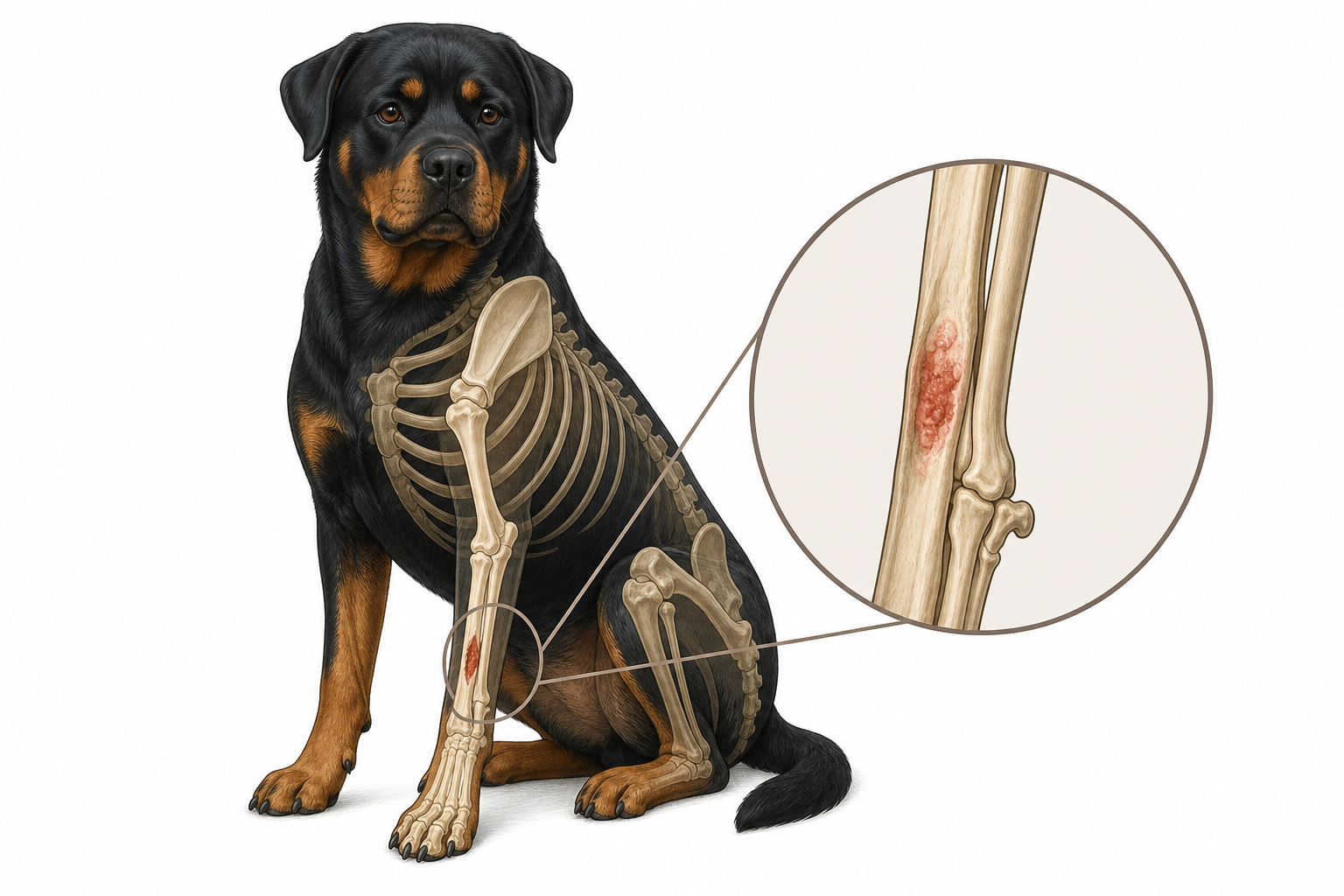
TL;DR. Osteosarcoma is a fast-moving, painful bone cancer in dogs and cats that requires prompt veterinary care, typically involving surgery and chemotherapy to manage pain and slow down spread to the lungs.
Osteosarcoma most commonly develops in the long bones of the limbs in large-breed dogs.
What is it?
Osteosarcoma (OSA) is a highly malignant, aggressive primary bone tumor that primarily affects dogs, though it can also occur in cats. It is the most common type of bone cancer diagnosed in companion animals. The disease is characterized by its ability to rapidly destroy normal bone tissue, replace it with weak, abnormal tumor bone, and spread quickly to other parts of the body.
In dogs, osteosarcoma typically develops in the limbs (known as appendicular osteosarcoma), though it can occasionally form in the skull, ribs, spine, or pelvis (axial osteosarcoma). The tumor most commonly targets specific locations on the long bones of the legs. Veterinarians often remember these common sites with the phrase "away from the elbow, towards the knee." This refers to the lower front leg (distal radius), upper front leg (proximal humerus), lower thigh (distal femur), and shin bone (proximal or distal tibia).
What makes osteosarcoma particularly dangerous is its highly metastatic nature. By the time a dog is diagnosed, the cancer has almost always spread microscopically through the bloodstream, primarily to the lungs. While these microscopic tumor deposits (pulmonary micrometastases) are usually too small to see on initial chest X-rays, they represent the primary long-term threat to your pet's life. In cats, the disease behaves somewhat differently; while still locally destructive and painful, feline osteosarcoma is much less likely to spread rapidly to the lungs, making local treatment more successful.
Causes & risk factors
The exact cause of osteosarcoma is not fully understood, but it is considered a multifactorial disease influenced by genetics, rapid growth, and physical stress on the bones.
- Size and Weight: Large and giant breed dogs are overwhelmingly predisposed to osteosarcoma. The rapid bone growth during puppyhood and the immense weight-bearing stress placed on their skeletal systems throughout life are believed to cause microscopic bone damage that can trigger malignant changes in bone cells.
- Age: Osteosarcoma most commonly affects middle-aged to older dogs, typically between 7 and 10 years of age. However, there is also a smaller peak in incidence among young dogs between 1 and 2 years of age.
- Genetic Factors: There is a strong genetic component to the disease. Certain breeds have a significantly higher risk of developing osteosarcoma than the general dog population.
Signs to watch for
Recognizing the signs of osteosarcoma early is vital for managing your pet's pain and exploring treatment options. Watch for the following symptoms:
- Pain (Cardinal): This is the most significant and distressing sign. The tumor causes intense, deep-seated bone pain that worsens as the cancer expands within the rigid bone cavity.
- Pulmonary micrometastases (Cardinal): Although these microscopic cancer cells in the lungs do not cause early symptoms like coughing, they are almost always present at the time of diagnosis.
- Lameness (Common): Limping is often the first sign owners notice. It may start as a mild, intermittent limp that looks like arthritis, but it quickly progresses to a constant, painful limp that does not respond to standard pain medications.
- Swelling (Common): As the tumor grows, it breaks through the outer layer of the bone and invades the surrounding soft tissues, causing a visible, firm, and often warm swelling on the leg.
- Pathologic fractures (Occasional): Because the tumor destroys healthy bone structure, the limb becomes incredibly fragile. A minor slip, step, or jump can cause the bone to break directly through the tumor site.

Persistent lameness and localized swelling are the most common early signs of osteosarcoma.
How vets diagnose it
If your vet suspects a bone tumor, they will perform a thorough physical and orthopedic examination, followed by a series of diagnostic tests to confirm the diagnosis and determine if the cancer has spread.
Your vet will start by taking X-rays (radiographs) of the affected limb. Osteosarcoma has a highly characteristic appearance on X-rays, often showing a "moth-eaten" pattern of bone destruction combined with a "sunburst" pattern of abnormal new bone growth extending into the surrounding soft tissue.
Because this cancer spreads so rapidly, evaluating the lungs is a critical step in the diagnostic process. As noted in a leading veterinary internal medicine reference:
"Once a presumptive radiographic diagnosis has been established and if the owners are contemplating treatment, thoracic radiographs or CT should be obtained to determine the extent of the disease. The author's clinic usually obtains three radiographic views of the thorax and does not perform a skeletal radiographic survey (or radionuclide bone scan). Thoracic CT allows for detection of smaller nodu[les]."
To confirm the diagnosis, your vet may perform a fine-needle aspiration (FNA) or a bone biopsy to collect cells for microscopic evaluation. Applying a special alkaline phosphatase (ALP) stain to these cells can help confirm that the tumor is indeed an osteosarcoma. The gold standard for diagnosis is a histopathologic evaluation, where a pathologist examines a larger tissue sample—often obtained after the limb is amputated—to confirm the tumor type and grade.
Treatment options
Treatment for osteosarcoma is focused on two primary goals: eliminating the severe pain caused by the bone tumor and slowing down the spread of the cancer to the lungs.
Surgical Therapy
Removing the primary tumor is the most effective way to eliminate the source of your pet's pain. In most cases, this involves amputating the affected limb. While the idea of amputation is understandably difficult for owners, dogs and cats adapt remarkably well to three legs. Most pets are up and walking within a day or two of surgery, experiencing an immediate improvement in comfort because the painful tumor is gone.
In cases where the X-rays are highly characteristic, your vet may discuss proceeding directly to surgery. A leading internal medicine reference explains:
"...the high likelihood of their dog dying of metastatic lung disease within 4-6 months of amputation if no chemotherapy is used) and as long as the clinical and radiographic features of the lesion are highly suggestive of OSA, the limb can be amputated in the absence of a histopathologic diagnosis. The amputated leg (or representative samples) and the regional lymph nodes should always be submitted" for confirmation and staging.
For tumors in very specific locations, a complex limb-sparing surgery may be considered, though this is less common and carries a higher risk of complications.
Chemotherapy
Because microscopic spread to the lungs is almost always present at the time of diagnosis, surgery alone is not a cure. To extend your pet's life, systemic chemotherapy is highly recommended after the surgical site has healed. Chemotherapy targets the microscopic cancer cells in the lungs, delaying their growth.
- First-Line Agents: Platinum-based alkylating agents such as Carboplatin or Cisplatin, and anthracycline antibiotics such as Doxorubicin, are the primary chemotherapy drugs used. These are given intravenously in multiple cycles, usually spaced three to four weeks apart. Most pets tolerate chemotherapy very well, with minimal side effects compared to humans.
Palliative Care and Pain Management
If amputation is not an option due to severe arthritis in the other legs, neurological disease, or other factors, treatment focuses entirely on keeping your pet comfortable.
- Bisphosphonates: Medications like Pamidronate can be given intravenously to help slow down bone destruction. This helps stabilize the bone, reduce pain, and lower the risk of a pathologic fracture.
- Palliative Radiation: Targeted radiation therapy can be used to shrink the tumor locally and temporarily relieve pain.
- Multi-modal Pain Medications: A combination of strong pain relievers, including non-steroidal anti-inflammatory drugs (NSAIDs), gabapentin, and other analgesics, is used to manage discomfort.
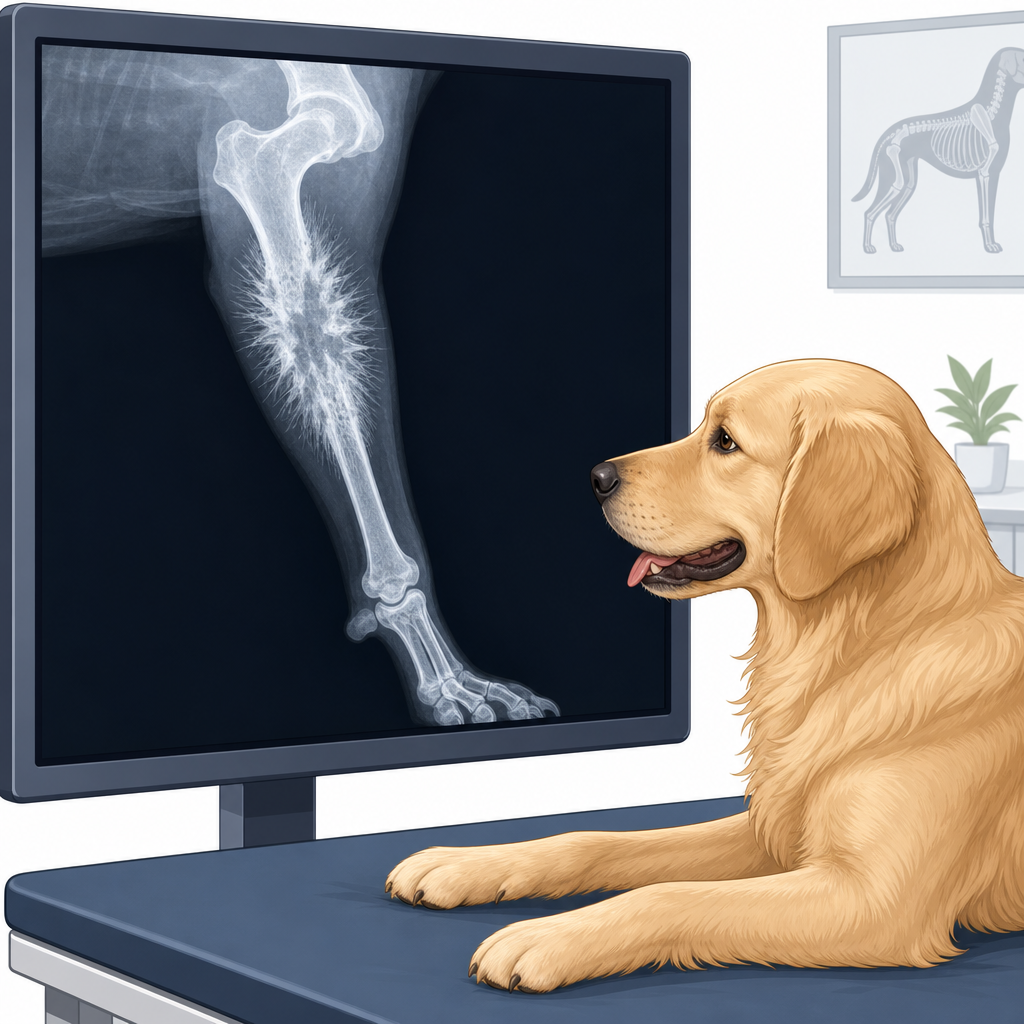
X-rays are the primary tool used to identify the characteristic bone destruction caused by osteosarcoma.
Prognosis
The prognosis for osteosarcoma depends heavily on the treatment path you choose:
- Amputation Alone: The median survival time is approximately 4 to 5 months. While amputation successfully removes the local pain, the microscopic cancer already in the lungs will eventually grow and cause respiratory issues.
- Amputation with Chemotherapy: The median survival time increases to 12 to 18 months, with some pets surviving two years or longer.
- Negative Prognostic Factors: Factors that may indicate a shorter survival time include an elevated level of alkaline phosphatase (ALP) in the blood at diagnosis, a tumor located in the upper arm (proximal humerus), or visible lung spread on initial chest scans.
- Cats: The prognosis for cats is generally much better. Feline osteosarcoma spreads much more slowly, and many cats achieve long-term survival (often exceeding 12 to 24 months) with amputation alone.
Prevention
There is currently no known way to prevent osteosarcoma in dogs or cats. Because the disease has a strong genetic basis, responsible breeding practices are the most important preventative measure.
For owners of large and giant breed dogs, the best approach is early detection. Regularly monitor your pet for any subtle limping, changes in gait, or firm swellings on their legs. Additionally, there is ongoing research regarding the timing of spaying and neutering in giant breeds; some studies suggest that delaying sterilization until physical maturity (around 1 to 2 years of age) may help reduce the risk of bone cancer by allowing the growth plates to close naturally. Discuss the best timing for your specific dog with your veterinarian.
When to call your vet
You should contact your veterinarian immediately if you notice any of the following signs:
- Any unexplained, persistent, or worsening limp, especially in a large or giant breed dog.
- A firm, painful swelling on any part of your pet's limbs.
- A sudden, severe worsening of lameness or a complete inability to bear weight on a leg, which may indicate a pathologic fracture.
- Signs of respiratory distress, such as rapid breathing, heavy panting, or coughing, which could indicate advanced spread to the lungs.
For specific breeds
Certain breeds carry a significantly higher risk of developing osteosarcoma:
- Greyhounds: Former racing Greyhounds have an exceptionally high genetic predisposition to this disease. As documented in a leading veterinary internal medicine reference:
"...dogs and in Greyhounds; they are common in middle-age to older dogs. There is a distinct genetic predisposition to OSA in dogs; for example, in former racing Greyhounds OSA is the most common cause of death (i. e. , 25%), whereas OSAs are extremely rare in show Greyhounds in the United States."
Any lameness in a retired racing Greyhound should be evaluated with X-rays promptly. - Other Giant and Large Breeds: Great Danes, Rottweilers, Great Pyrenees, and Labrador Retrievers also have an increased risk. Owners of these breeds should remain highly vigilant for any signs of orthopedic pain or limb swelling.
Sources
- Small Animal Internal Medicine, 5th Edition, pp. 1222-1224.
- AAHA Oncology Guidelines for Dogs and Cats, 2016.
My highlights & notes
Signs & symptoms
Breeds at higher risk
How it is diagnosed
- Histopathologic EvaluationGold standard
- 3-view thoracic radiographs
- Alkaline phosphatase (ALP) stain
- Bone scintigraphy
- Fine-needle aspiration (FNA)
- Thoracic CT
Treatment approaches
Treatment must be prescribed by a licensed veterinarian based on your pet. Specific drug doses are intentionally not shown here.
Frequently asked questions
What is Osteosarcoma?
Osteosarcoma is a highly aggressive, painful bone cancer primarily affecting large-breed dogs and occasionally cats. Learn about the symptoms, diagnostic steps, and treatment options like surgery and chemotherapy to help manage your pet's comfort and lifespan.
What are the symptoms of Osteosarcoma?
Pain、pulmonary micrometastases、Limping、swelling、pathologic fractures
How is Osteosarcoma diagnosed?
Histopathologic Evaluation、3-view thoracic radiographs、Alkaline phosphatase (ALP) stain、Bone scintigraphy、Fine-needle aspiration (FNA)、Thoracic CT
How is Osteosarcoma treated?
Treatment must be prescribed by a licensed veterinarian based on your pet. Specific drug doses are intentionally not shown here.
Sources
- Internal Medicine 5th · p. 1223
- Internal Medicine 5th · p. 1224
- 2016 oncology guidelines
- Internal Medicine 5th · p. 1222
- Internal Medicine 5th · p. 1222
- 2016 oncology guidelines
This article is for general education and is not a substitute for professional veterinary advice. If your pet is unwell, please consult a veterinarian.
Worried about your pet?
Peqaboo’s AI helps you track symptoms, understand lab reports, and know when to see a vet.
Get the Peqaboo app