

Bloat
Gastric dilatation-volvulus
Also known as: Gastric Dilatation-Volvulus, GDV, Gastric Dilation, Gastric Dilation/Volvulus
In short
Gastric dilatation-volvulus (GDV), commonly known as bloat, is a rapid, life-threatening emergency in dogs where the stomach fills with gas and twists. Immediate veterinary intervention is critical for survival.
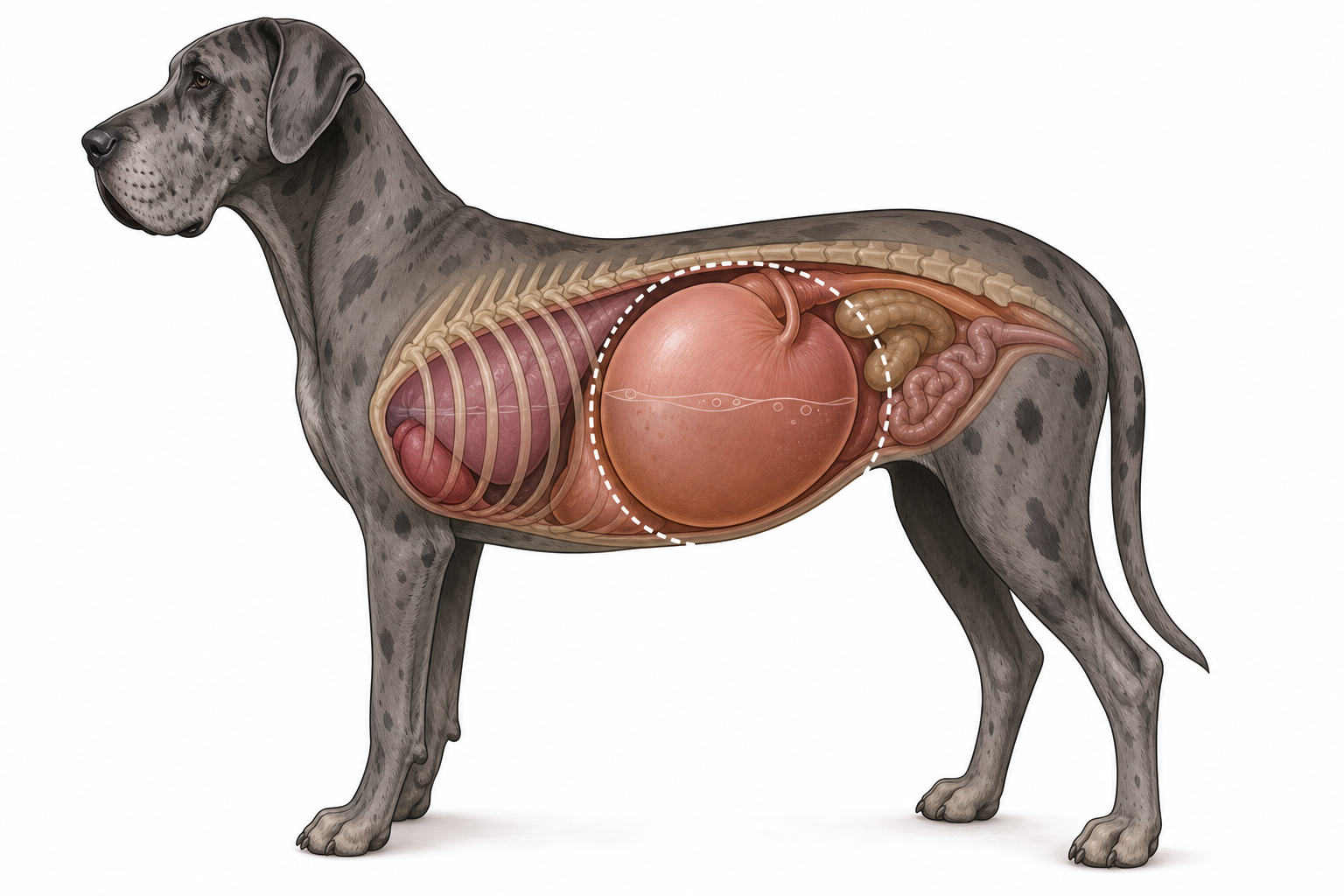
TL;DR. Gastric dilatation-volvulus (GDV), or bloat, is a sudden, life-threatening emergency where a dog's stomach fills with gas and twists, requiring immediate veterinary surgery to save their life.
Deep-chested, large breed dogs are anatomically predisposed to gastric dilatation-volvulus.
What is it?
Gastric dilatation-volvulus (GDV), commonly referred to as "bloat," is one of the most severe, rapidly progressing emergencies seen in veterinary medicine. The condition occurs in two phases. First, the dog's stomach fills rapidly with gas, fluid, or food, causing it to stretch and balloon (dilatation). Second, the distended stomach rotates along its axis (volvulus), twisting closed both the entrance from the esophagus and the exit to the small intestine. This twisting traps the gas and fluid inside, creating a closed, high-pressure system.
As the stomach continues to expand, it exerts massive pressure on the surrounding organs and major blood vessels. This pressure compresses the caudal vena cava and the portal vein—the primary blood vessels responsible for returning blood from the abdomen and hindlimbs back to the heart. When this blood flow is obstructed, it leads to a dramatic drop in cardiac output, resulting in severe cardiovascular compromise and obstructive shock.
Without blood returning to the heart, the dog's tissues are rapidly deprived of oxygen. The stomach wall itself begins to die (gastric necrosis) because its blood supply is cut off by the twist. This lack of oxygen and blood flow triggers a cascade of systemic failures, as noted in a leading veterinary critical care reference:
"Disseminated intravascular coagulation (DIC) is another of the organ dysfunctions seen frequently in dogs with GDV. Likely contributing factors include pooling of blood in the caudal vena cava, portal vein, or splanchnic circulation, tissue hypoxia, acidosis, systemic inflammation, endotoxemia, and potentially sepsis."
— Small Animal Critical Care Medicine, p. 721
This is a true medical emergency. Every minute that passes without treatment increases the risk of irreversible tissue damage, shock, and death.
Causes & risk factors
GDV is classified as an idiopathic condition, meaning the exact, single cause remains unknown. Instead, veterinarians understand it to be a complex, multifactorial disease influenced by both genetic and environmental factors. As a leading veterinary textbook explains:
"The pathogenesis of GDV is complex and multifactorial, with apparent genetic and environmental influences. GDV is predominantly a syndrome of large and giant breed dogs, although small dogs, cats, and others [can be affected]."
— Small Animal Critical Care Medicine, p. 720
The primary physical risk factor is a dog's conformation. Deep-chested, narrow-bodied dogs have more physical space in their abdomen for the stomach to swing and twist.
In addition to breed and anatomy, several environmental and lifestyle factors are suspected to increase the risk of bloat:
- Feeding only one large meal a day instead of multiple smaller meals.
- Eating rapidly or gulping air while eating.
- Exercising vigorously immediately before or after eating.
- Having a first-degree relative (parent or sibling) who has experienced GDV, suggesting a strong genetic component.
- Increased age, as the ligaments holding the stomach in place may stretch and weaken over time.
- High stress or an anxious temperament.
Signs to watch for
Recognizing the signs of bloat early is the single most important factor in saving a dog's life. The symptoms progress rapidly, and owners must act immediately if they suspect the condition.
Cardinal Sign
- Unproductive retching: The dog will repeatedly try to vomit, but nothing will come up except perhaps a small amount of white foam or saliva. This occurs because the twist in the stomach has sealed both the entrance and exit, preventing anything from being expelled.
Common Signs
- Abdominal distention: The dog's abdomen will appear visibly swollen, tight, and hard to the touch. If you gently tap the side of the abdomen, it may sound hollow or drum-like.
- Restlessness and anxiety: The dog will pace, whine, pant heavily, and appear unable to find a comfortable position to lie down.
- Hypersalivation: Excessive drooling or foaming at the mouth, caused by the inability to swallow saliva past the esophageal obstruction.
- Tachycardia: A very rapid heart rate as the body attempts to compensate for falling blood pressure.
- Pale mucous membranes: The gums will appear pale, grey, or white instead of a healthy pink, indicating poor blood circulation and shock.
- Weak pulses: The dog's pulse (felt on the inner thigh) may feel faint or difficult to find.
- Arrhythmias: Irregular heartbeats, which can develop due to toxins releasing into the bloodstream and poor oxygen delivery to the heart muscle.
Occasional Signs
- Collapse: As shock worsens and the cardiovascular system fails, the dog will become weak in the hind limbs and eventually collapse, unable to stand.

A visibly swollen, tight abdomen combined with unproductive retching is a classic sign of bloat.
How vets diagnose it
When a suspected bloat patient arrives at a veterinary hospital, diagnosis and emergency stabilization happen simultaneously. The veterinary team will immediately assess the dog's vital signs and initiate life-saving therapy before performing extensive diagnostic imaging.
Once the dog is stable enough for diagnostics, the gold standard for confirming GDV is a right lateral abdominal radiograph (an X-ray taken with the dog lying on its right side). This specific view allows the veterinarian to see the classic "double bubble" or "reverse C" shape of the stomach. This shape is created when the stomach twists and is divided into two gas-filled compartments by a band of tissue. As a veterinary surgery textbook notes:
"Abdominal radiographs are usually not needed to diagnose gastric dilatation, but may be used to confirm the clinical diagnosis or to distinguish between simple gastric dilatation and GDV."
— Current Techniques in Small Animal Surgery, p. 286
It is important to note that veterinarians cannot rely on physical manipulation alone to diagnose a twist. As a leading internal medicine reference states:
"It is impossible to distinguish between dilation and dilation/torsion on the basis of ability or inability to pass an orogastric tube."
— Internal Medicine, p. 482
In addition to X-rays, several blood tests are critical for assessing the dog's systemic health and predicting their prognosis:
- Plasma lactate measurement: Lactate is a byproduct of anaerobic metabolism, which occurs when tissues are deprived of oxygen. High lactate levels indicate severe tissue hypoxia or stomach wall death. Rather than relying on a single reading, veterinarians track how lactate levels change during treatment:
"Hyperlactatemia is often present and failure of severe hyperlactatemia to improve with stabilization is a predictor of nonsurvival in dogs with GDV."
— Small Animal Critical Care Medicine, p. 722"However, change in lactate during the treatment period provides more useful information regarding prognosis than the plasma lactate level at a single point in time."
— Current Techniques in Small Animal Surgery, p. 286 - Complete blood count (CBC) & Biochemical profile: These tests evaluate overall organ function, check for hemoconcentration (thickening of the blood due to fluid loss), and identify a stress leukogram (changes in white blood cells due to extreme stress). They also identify critical electrolyte imbalances, such as low potassium (hypokalemia).
- Coagulation panel: This test checks the blood's clotting ability to monitor for the onset of Disseminated Intravascular Coagulation (DIC), a severe and often fatal clotting disorder.
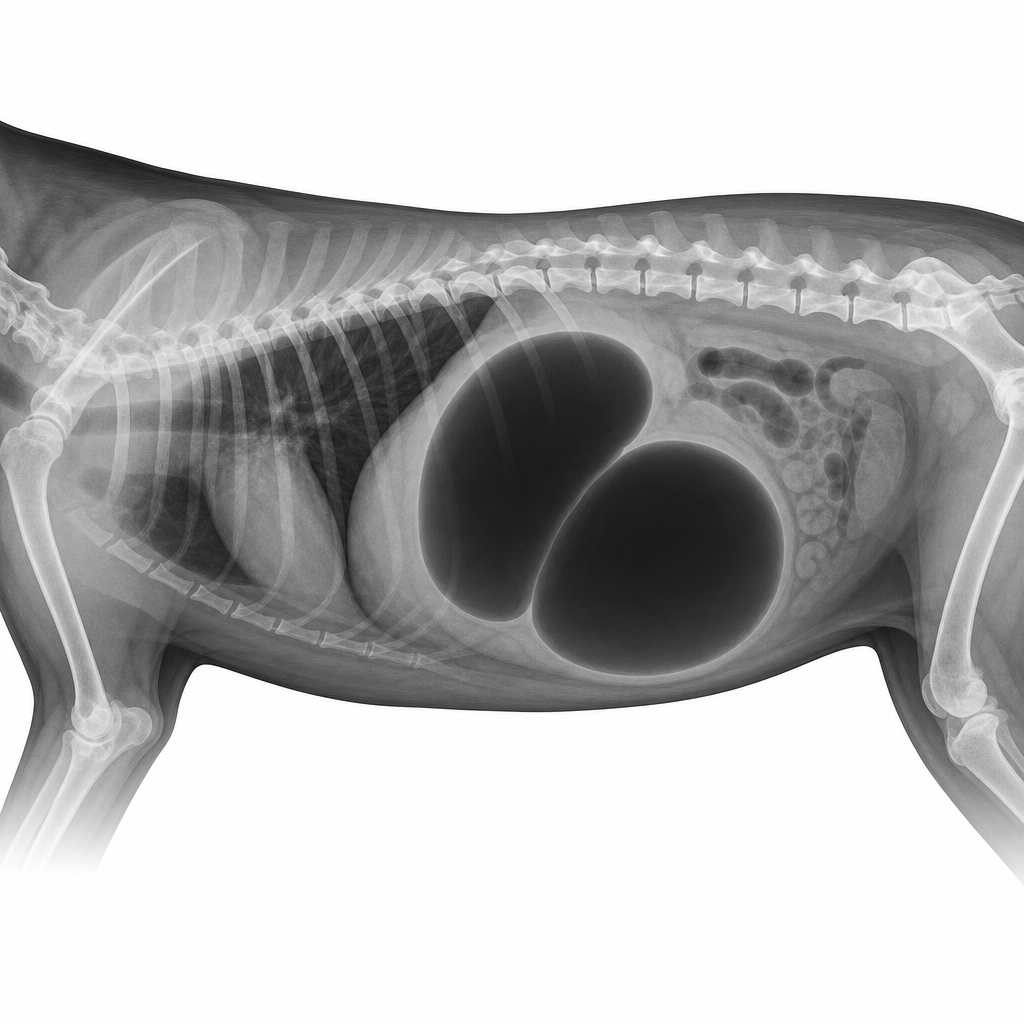
An abdominal radiograph is the gold standard for distinguishing simple dilatation from a true twist (volvulus).
Treatment options
Treatment for GDV is intensive, multi-staged, and always requires emergency surgery. The primary goals are to stabilize the cardiovascular system, decompress the stomach, untwist the stomach, remove any dead tissue, and secure the stomach so it cannot twist again.
Phase 1: Emergency Stabilization (First-Line Therapy)
Before surgery can safely begin, the veterinary team must treat the life-threatening shock. This involves:
- Aggressive Fluid Resuscitation: Large-bore intravenous catheters are placed, and rapid fluids are administered. First-line therapies often include colloid volume expanders such as Hydroxyethyl Starch (HES) or hypertonic saline. These specialized fluids pull moisture into the blood vessels quickly, raising blood pressure and restoring circulation faster than standard fluids alone.
- Antibiotic Therapy: Broad-spectrum antibiotics, such as Cefazolin (a first-generation cephalosporin), are administered intravenously to combat potential bacterial translocation and endotoxemia caused by the compromised gut wall.
- Stomach Decompression: Releasing the trapped gas pressure is vital to restore blood flow. The vet may attempt to pass an orogastric tube down the esophagus into the stomach. If the twist prevents this, they will perform temporary decompression by inserting a sterile, large-gauge needle through the body wall directly into the stomach (trocarization).
Phase 2: Managing Electrolytes and Arrhythmias
Electrolyte imbalances are common and dangerous in bloat patients. In particular, low potassium must be addressed before the dog goes under general anesthesia:
"Although electrolyte changes (e. g. , hypokalemia) are common, they are impossible to accurately predict. Severe hypokalemia predisposes to cardiac arrhythmias and should usually be corrected before anesthesia is induced."
— Internal Medicine, p. 482
The vet will also take a final radiograph immediately before anesthesia to ensure no further anatomical changes have occurred.
Phase 3: Surgical Intervention
Once the dog's blood pressure is stabilized, they are taken to surgery. The surgeon will:
- Decompress and Untwist: Fully deflate the stomach and rotate it back to its normal anatomical position.
- Assess Tissue Viability: Inspect the stomach wall and the spleen (which is attached to the stomach and often twists with it). Any dead or severely damaged tissue must be surgically removed (partial gastrectomy or splenectomy).
- Gastropexy: This is the most crucial preventive step. The surgeon permanently tacks the stomach wall to the inside of the right abdominal wall. This prevents the stomach from twisting in the future, even if it dilates with gas again.
Phase 4: Post-Operative Care (Second-Line Therapy)
After surgery, the dog requires intensive monitoring for several days. Second-line medications like Metoclopramide (a gastrointestinal prokinetic agent and antiemetic) may be used to stimulate normal stomach motility and prevent postoperative ileus (paralysis of the gut). Pain medications, continuous ECG monitoring for arrhythmias, and supportive fluid therapy are also maintained.
Prognosis
With prompt veterinary care and modern surgical techniques, the survival rate for dogs treated surgically for GDV is approximately 85%.
The prognosis remains generally good as long as the dog is treated quickly. However, several complications can significantly lower the chances of survival:
- Gastric Necrosis: If a portion of the stomach wall has died due to lack of blood flow, the surgeon must remove that tissue, which increases the risk of postoperative complications and mortality.
- Disseminated Intravascular Coagulation (DIC): If the clotting system has been severely disrupted, the prognosis becomes guarded to poor.
- Septic Peritonitis: If the stomach wall perforates (ruptures) before or during surgery, bacteria and stomach contents spill into the abdomen, causing a massive, life-threatening infection.
- Severe Debilitation: Dogs that are already weak, elderly, or suffering from concurrent diseases have a harder time recovering from the intense physical stress of GDV and surgery.
Prevention
While the idiopathic nature of bloat means it cannot always be entirely prevented, there are highly effective measures owners can take to minimize the risk:
- Prophylactic Gastropexy: For high-risk breeds, this is the single most effective preventive measure. This surgical procedure tacks the stomach to the abdominal wall, preventing the life-threatening twist (volvulus) from occurring. It is commonly performed as a preventative measure when a young dog is spayed or neutered.
- Dietary Management: Feed your dog two or three smaller meals throughout the day rather than one large meal. Avoid using elevated food bowls unless specifically recommended by your vet, as some studies suggest they may increase gas intake.
- Exercise Restrictions: Restrict vigorous exercise, running, or heavy play for at least one hour before and two hours after meals.
- Reduce Stress: Keep feeding times calm and minimize stress around meals, especially in anxious dogs.
When to call your vet
GDV is an absolute medical emergency. If you suspect your dog is bloating, do not wait. Drive to the nearest emergency veterinary hospital immediately.
Call the clinic while you are on your way to let them know you are coming with a suspected bloat case. This allows the veterinary team to prepare intravenous fluids, oxygen, and decompression equipment so they can begin life-saving treatment the second you walk through the door.
For specific breeds
GDV is primarily a disease of large and giant, deep-chested dog breeds. If you own one of the following breeds, you should be highly vigilant and discuss a preventive gastropexy with your veterinarian:
- Great Dane (highest suspected risk)
- Weimaraner
- Gordon Setter
- Irish Setter
- Standard Poodle
- German Shepherd Dog
- St. Bernard
For these breeds, the anatomical depth of the chest cavity creates a significant risk. Discussing a prophylactic gastropexy during their routine spay or neuter surgery is one of the most proactive steps you can take to protect your dog from this sudden and devastating condition.
Sources
- Small Animal Critical Care Medicine, 2nd Edition, pp. 720-722.
- Current Techniques in Small Animal Surgery, 5th Edition, p. 286.
- Internal Medicine, 5th Edition, p. 482.
My highlights & notes
Signs & symptoms
Breeds at higher risk
How it is diagnosed
- Right lateral abdominal radiographGold standard
- Biochemical profile
- Coagulation panel
- Complete blood count
- Plasma lactate measurement
Treatment approaches
Treatment must be prescribed by a licensed veterinarian based on your pet. Specific drug doses are intentionally not shown here.
Frequently asked questions
What is Bloat?
Gastric dilatation-volvulus (GDV), commonly known as bloat, is a rapid, life-threatening emergency in dogs where the stomach fills with gas and twists. Immediate veterinary intervention is critical for survival.
What are the symptoms of Bloat?
Unproductive retching、Bloated belly、Irregular heartbeat、Excessive drooling、Pale mucous membranes、Restlessness、Fast heart rate、Weak pulses
How is Bloat diagnosed?
Right lateral abdominal radiograph、Biochemical profile、Coagulation panel、Complete blood count、Plasma lactate measurement
How is Bloat treated?
Treatment must be prescribed by a licensed veterinarian based on your pet. Specific drug doses are intentionally not shown here.
Sources
- Small Animal Critical Care Medicine, 2nd Edition (VetBooks.ir) · p. 721
- Small Animal Critical Care Medicine, 2nd Edition (VetBooks.ir) · p. 722
- Small Animal Critical Care Medicine, 2nd Edition (VetBooks.ir) · p. 720
- Internal Medicine 5th · p. 482
- Current Techniques in Small Animal Surgery, 5th Edition (VetBooks.ir) · p. 286
- Internal Medicine 5th · p. 482
This article is for general education and is not a substitute for professional veterinary advice. If your pet is unwell, please consult a veterinarian.
Worried about your pet?
Peqaboo’s AI helps you track symptoms, understand lab reports, and know when to see a vet.
Get the Peqaboo app