

Leukemia
Auch bekannt als: Leukaemia, Myeloproliferative disease, Myeloproliferative disorder
Kurz gesagt
Leukemia is a rare but serious cancer of the blood-forming cells in the bone marrow of dogs and cats. Understanding the difference between acute and chronic forms is crucial, as treatments and outlooks vary significantly from weeks to several years.

TL;DR. Seltene Knochenmarkskrebserkrankung; akute Formen verlaufen rasch und haben eine schlechte Prognose, chronische Formen lassen sich oft jahrelang managen.
Leukämie betrifft Hund und Katze und verläuft akut oder chronisch.
Was ist das?
Maligne Neubildung aus hämatopoetischen Vorläuferzellen im Knochenmark. Abnorme Klone verdrängen die normale Blutbildung (Zytopenien). Akut: unreife Blasten, aggressiv. Chronisch: reifere Zellen, langsamer. Einteilung lymphatisch vs. myeloisch nach Zelllinie.
Ursachen und Risikofaktoren
Meist idiopathische Mutationen. Katze: FeLV-Risiko. Auch Strahlung, Toxine, Chemotherapie. Manche Hunderassen überrepräsentiert.
Anzeichen
- Lethargie, blasse Schleimhäute, Gewichtsverlust, Fieber (häufig)
- Lymphadenopathie, Spleno-/Hepatomegalie, Zytopenien (häufig)
- Petechien/Ekchymosen, GI-Zeichen, Lahmheit, neurologische Zeichen (gelegentlich)
- Ikterus, okuläre Läsionen (gelegentlich)

Blasse Schleimhäute und Petechien sind Warnzeichen einer Blutkrankheit.
Diagnose
Blutbild und Ausstrich; Knochenmarksaspirat/Core als Goldstandard; Flow-Zytometrie und Zytochemie zur Linienbestimmung.
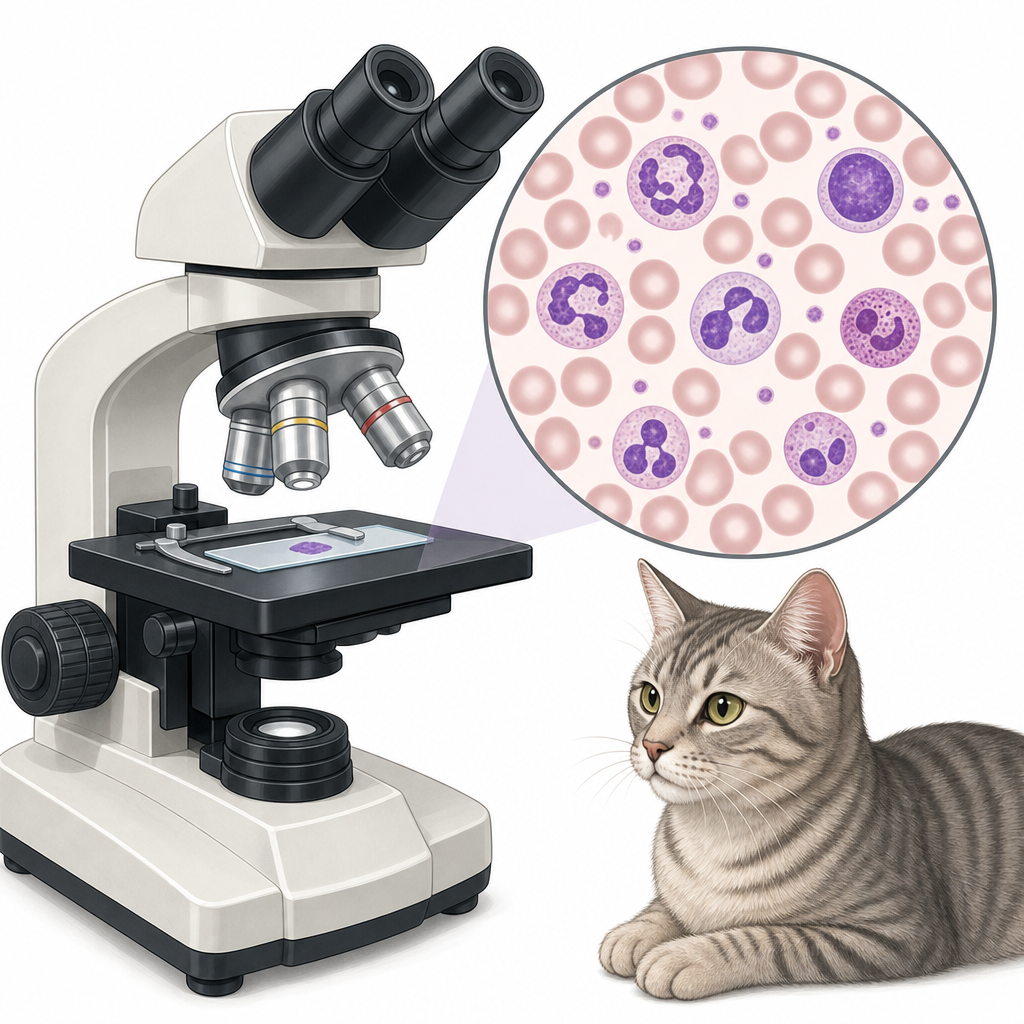
Blutbild und mikroskopische Auswertung sind erste Schritte.
Behandlung
Chemotherapie je nach Typ: Chlorambucil bei CLL; Glucocorticoids; Vincristine; Cyclophosphamide; Cytarabine; Asparaginase; Hydroxycarbamid bei CML. Supportiv: Transfusionen, Flüssigkeit, Antibiotika.
Prognose
Akut: schlecht bis infaust (Wochen bis Monate). Chronische CLL: gut bis sehr gut (Jahre möglich).
Vorbeugung
Katze: FeLV vermeiden (Indoor, Test, Impfung bei Risiko). Hund: Vorsorge und Blutkontrollen für frühe chronische Formen.
Wann den Tierarzt rufen
Dringend: extreme Schwäche, weiße/blasse Schleimhäute, Petechien, anhaltendes Fieber, Kollaps, Atemnot, rascher Gewichtsverlust/Anorexie.
Quellen
- Small Animal Internal Medicine, 5th Edition, pp. 1209, 1210, 1216, 1217.
- Cowell and Tyler's Diagnostic Cytology and Hematology of the Dog and Cat, 5th Edition, p. 515.
My highlights & notes
Anzeichen & Symptome
Rassen mit höherem Risiko
Diagnose
- Bone marrow aspirateGoldstandard
- Complete blood count and peripheral blood smear
- Cytochemical staining
- Flow cytometry
Behandlungsansätze
Behandlungen müssen von einem approbierten Tierarzt verordnet werden. Konkrete Dosierungen werden absichtlich nicht angezeigt.
Häufige Fragen
What is Leukemia?
Leukemia is a rare but serious cancer of the blood-forming cells in the bone marrow of dogs and cats. Understanding the difference between acute and chronic forms is crucial, as treatments and outlooks vary significantly from weeks to several years.
What are the symptoms of Leukemia?
Loss of appetite、Cytopenias、Fever、Enlarged liver、Lethargy、Enlarged spleen、Weight loss (getting thinner)、Swollen lymph nodes
How is Leukemia diagnosed?
Bone marrow aspirate、Complete blood count and peripheral blood smear、Cytochemical staining、Flow cytometry
How is Leukemia treated?
Behandlungen müssen von einem approbierten Tierarzt verordnet werden. Konkrete Dosierungen werden absichtlich nicht angezeigt.
Quellen
- Internal Medicine 5th · p. 1216
- Internal Medicine 5th · p. 1217
- Internal Medicine 5th · p. 1209
- Internal Medicine 5th · p. 1210
- Cowell and Tyler s Diagnostic Cytology and Hematology of the Dog and Cat, 5th Edition (VetBooks.ir) · p. 515
Dieser Artikel dient der allgemeinen Information und ersetzt keinen tierärztlichen Rat. Bei Krankheit bitte einen Tierarzt aufsuchen.
Sorgen um Ihr Tier?
Peqaboos KI hilft Symptome zu tracken, Laborberichte zu verstehen und zu wissen, wann der Tierarzt nötig ist.
Peqaboo-App laden