

Cholangitis
Cholangitis
Auch bekannt als: Cholangiohepatitis, Neutrophilic cholangitis, Lymphocytic cholangitis, Suppurative cholangitis, Nonsuppurative cholangitis
Kurz gesagt
Cholangitis is a common and treatable inflammatory disease of the liver and bile ducts, primarily affecting cats. Learn about its bacterial and immune-mediated forms, key symptoms like jaundice, and how veterinarians diagnose and treat this complex condition.

TL;DR. Cholangitis ist eine häufige, behandelbare Entzündung der Gallenwege; rasche tierärztliche Versorgung steuert Infektion oder Immunentzündung.

Früherkennung und tierärztliche Betreuung sind entscheidend.
Was ist das?
Entzündung der Gallenwege. Bei Leberbeteiligung: Cholangiohepatitis. Häufiger bei Katzen. Formen: neutrophil (oft bakteriell aszendierend) und lymphozytär (oft immunvermittelt, chronisch). Bei Katzen Nähe zu Pankreas und Darm (Triaditis).
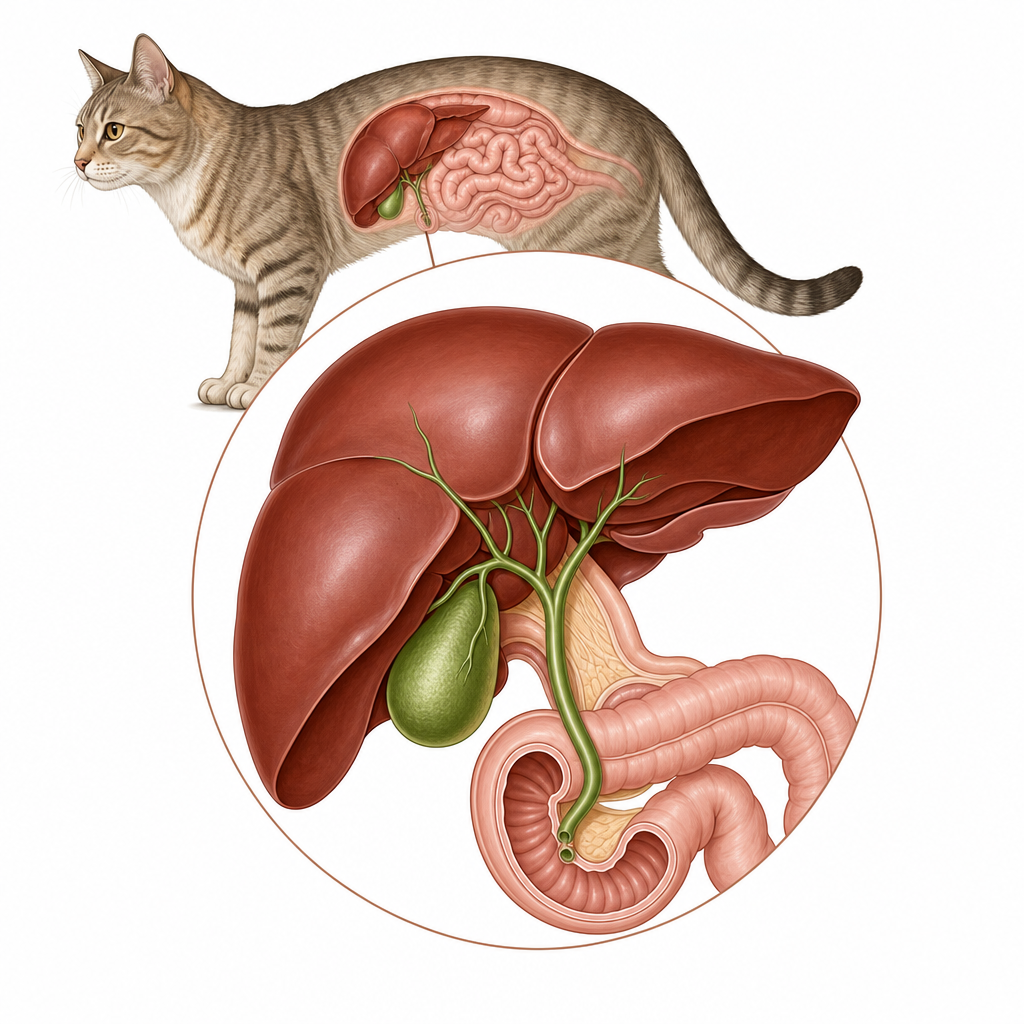
Enge Verbindung von Gallengang und Pankreasgang.
Ursachen und Risikofaktoren
Neutrophil: aszendierende Bakterien (E. coli, Enterococcus, Streptococcus), oft mit IBD/Pankreatitis. Lymphozytär: immunvermittelt mit Fibrose-Risiko. Historisch Perser und Norwegische Waldkatze; heute oft ältere Katzen ohne klare Rasseprädisposition.
"Cats with lymphocytic cholangitis were previously reported to be typically young to middle-aged, and Persians appeared to be overrepresented, but recent studies report it in older cats with no obvious breed predisposition (Callahan Clark et al, 2011; Warren et al, 2011)."
Anzeichen
Häufig: Ikterus, Erbrechen, Anorexie, Dehydratation, Gewichtsverlust, Lethargie.
Gelegentlich: Bauchschmerz, Durchfall, Aszites, PU/PD, Fieber, Hepatomegalie.
Selten: Ptyalismus, Stupor, Krampfanfälle (hepatische Enzephalopathie).

Ikterus ist ein häufiges Zeichen fortgeschrittener Gallenwegsentzündung.
Diagnostik
Biochemie (Leberenzyme, Bilirubin), Abdominalultraschall, Gallenzytologie und Kultur, Leberbiopsie (Goldstandard zur Unterscheidung der Formen).
Behandlung
Neutrophil: Antibiotika 4–6 Wochen nach Kultur, z. B. Amoxicillin/Ampicillin, oft mit Metronidazol. Ursodiol und SAMe. Lymphozytär: Glukokortikoide erst nach Ausschluss/Therapie einer Infektion. Flüssigkeitssupport.
Prognose
Meist gut bei früher Therapie. Neutrophil: oft vollständige Erholung. Lymphozytär: chronisch, Remission möglich.
Vorbeugung
Keine sichere Prävention. Frühe Behandlung von GI-Erkrankungen und regelmäßige Checks.
Wann den Tierarzt rufen
Sofort: Ikterus, anhaltendes Erbrechen, Kollaps, Krampfanfälle, starke Bauchschmerzen.
Rassen
Perser und Norwegische Waldkatze: historisch höheres Risiko der lymphozytären Form; heute jede Rasse möglich.
Quellen
- Small Animal Critical Care Medicine, 2nd Edition, page 679.
- Internal Medicine, 5th Edition, pages 577, 579, 580.
My highlights & notes
Anzeichen & Symptome
Rassen mit höherem Risiko
Diagnose
- Liver BiopsyGoldstandard
- Abdominal Ultrasonography
- Bile culture
- Bile cytology
- Serum Biochemistry
Behandlungsansätze
Behandlungen müssen von einem approbierten Tierarzt verordnet werden. Konkrete Dosierungen werden absichtlich nicht angezeigt.
Häufige Fragen
What is Cholangitis?
Cholangitis is a common and treatable inflammatory disease of the liver and bile ducts, primarily affecting cats. Learn about its bacterial and immune-mediated forms, key symptoms like jaundice, and how veterinarians diagnose and treat this complex condition.
What are the symptoms of Cholangitis?
Loss of appetite、Dehydration、Yellowing of the skin and eyes (jaundice)、Lethargy、Vomiting (throwing up)、Weight loss (getting thinner)、Fluid in the belly (ascites)、Diarrhoea
How is Cholangitis diagnosed?
Liver Biopsy、Abdominal Ultrasonography、Bile culture、Bile cytology、Serum Biochemistry
How is Cholangitis treated?
Behandlungen müssen von einem approbierten Tierarzt verordnet werden. Konkrete Dosierungen werden absichtlich nicht angezeigt.
Quellen
- Internal Medicine 5th · p. 580
- Small Animal Critical Care Medicine, 2nd Edition (VetBooks.ir) · p. 679
- Internal Medicine 5th · p. 579
- Internal Medicine 5th · p. 577
- Internal Medicine 5th · p. 580
Dieser Artikel dient der allgemeinen Information und ersetzt keinen tierärztlichen Rat. Bei Krankheit bitte einen Tierarzt aufsuchen.
Sorgen um Ihr Tier?
Peqaboos KI hilft Symptome zu tracken, Laborberichte zu verstehen und zu wissen, wann der Tierarzt nötig ist.
Peqaboo-App laden