

How to Size a Filter for Your Tank (GPH and Turnover Rules)
An underpowered filter lets waste build up; an overpowered one blasts your fish around. This guide explains GPH, the turnover rule of thumb, how to adjust for stocking and fish type, and why the number on the box is not the flow you actually get.

Quick answer

How to Size a Filter for Your Tank (GPH and Turnover Rules)
Aim for a filter that turns over roughly 4-6 times your tank's volume per hour. Multiply your tank's volume by 4-6 to get a target flow rating, then choose a filter rated at or above it, because real-world flow is always lower than the box number. Adjust upward for messy or heavily stocked tanks, downward for gentle-water fish.
- Turnover target: about 4-6x tank volume per hour.
- GPH (gallons per hour) or LPH (litres per hour) is the flow rating.
- Real flow is lower than the rated number once media and head height are added.
- Messy fish like goldfish want higher turnover; bettas want less current.
- It is safer to slightly oversize and reduce flow than to undersize.
- Species
- fish
- Category
- environment
- Risk level
- low
- Content focus
- practical owner decisions + mechanism
- When to escalate
- same-day if pain, not eating, breathing issues, or rapid decline
Decide in 60 seconds
| Situation | Do now |
|---|---|
| Mild / stable at home | Follow steps in this guide and monitor for 12–24 hours |
| Not eating, hiding, or clear pain | Same-day vet (species-savvy if exotic) |
| Breathing hard, collapse, continuous distress | Emergency vet now |
| You are unsure after reading | Call a clinic with your notes rather than waiting days |
Understand turnover and GPH
Filter flow is quoted as GPH (gallons per hour) or LPH (litres per hour) , the volume of water it moves in an hour. "Turnover" is how many times per hour that flow cycles your whole tank. A common rule of thumb is 4-6 times the tank volume per hour, which keeps water circulating and debris moving toward the filter without creating a washing machine.

Start from your true tank volume in litres, then match the filter's flow rating to it.
Do the simple maths
First find your real tank volume in litres , measure it rather than trusting the box, and remember substrate and decor reduce the actual water volume. Multiply that figure by your target turnover. For example, a genuine 100 litre tank at 5x turnover needs roughly 500 litres per hour of flow. Then pick a filter rated at that number or a little higher.
Why the box number lies
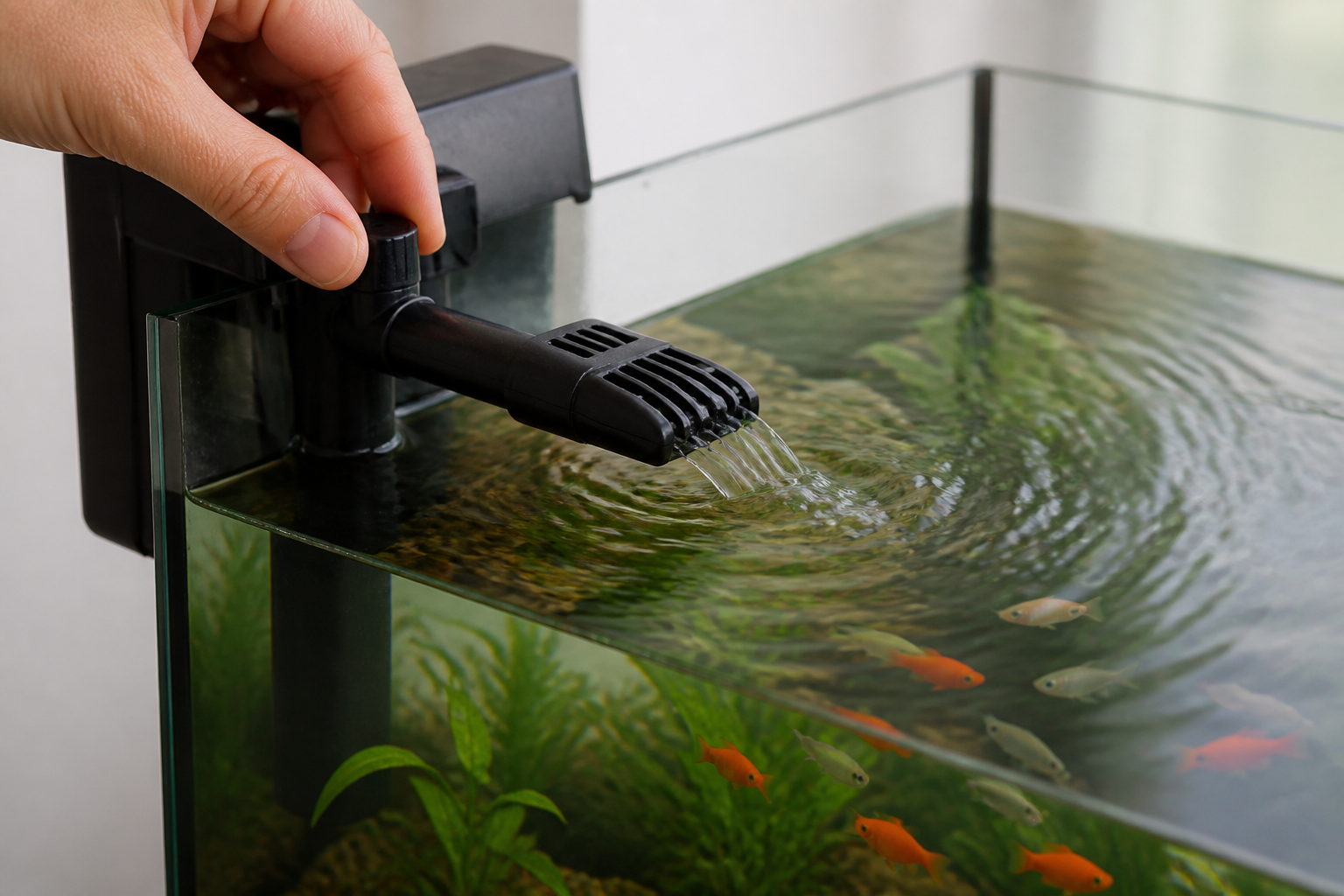
Manufacturers rate flow for an empty filter with no lift. Once you add media, a dirty sponge, and the height the water is pushed up (head height), real flow can drop by a third or more. This is exactly why sizing up slightly is wise: a filter rated at 500 litres per hour may only deliver 350 in practice.
Adjust for your fish and stocking
Stocking and species shift the target.
Aim for the right turnover, then fine-tune the current so gentle-water fish stay comfortable.
Heavily stocked tanks or messy eaters like goldfish benefit from the higher end, 6x or more. Calm-water species such as bettas and many gouramis dislike strong current, so choose a moderate filter or one with an adjustable outflow and baffle the flow. In small flats where a tank shares a room you sleep in, a quieter, slightly larger filter run at moderate flow is often the sweet spot.
Living context by region
This guide is written for multi-region English readers (US/UK/AU/NZ/CA/EU and more). Where climate, products, or vet access differ, prefer local veterinary advice and local product labels. Use metric first; keep °F/lb in mind for North American homes.
When to call your vet
-
Signs are getting worse over hours, not better
-
Pain, persistent vomiting/diarrhea, or neurological signs
-
You needed force or guesswork to keep going at home
Common mistakes
-
Waiting because the animal 'still looks okay' while prey species hide pain
-
Changing five variables at once so you cannot tell what helped
-
Copying drug doses from social media
-
Skipping species-appropriate husbandry while buying more gadgets
FAQ
What turnover should I aim for?
Should I trust the GPH on the box?
Can a filter be too powerful?
Do goldfish need a bigger filter?
My highlights & notes
This article is for general education and is not a substitute for professional veterinary advice. If your pet is unwell, please consult a veterinarian.
Worried about your pet?
Peqaboo’s AI helps you track symptoms, understand lab reports, and know when to see a vet.
Get the Peqaboo app