

Tortoise vs Turtle: Different Pets, Different Care
Tortoises and turtles are often confused but need completely different setups. Tortoises are land grazers that need a large dry enclosure and UVB; aquatic turtles need a heavily filtered water tank with a basking platform. This guide compares housing, diet, and lifespan so you choose the right pet.

Quick answer

Tortoise vs Turtle: Different Pets, Different Care
Tortoises live on land, eat mostly plants, and need a large dry enclosure with strong UVB and heat. Aquatic turtles live mostly in water, are often omnivorous, and need a big, heavily filtered tank plus a dry basking platform under a UVB and heat lamp. Both are long-lived, high-commitment pets, but their setups have almost nothing in common.
- Tortoise: domed shell, stumpy elephant-like legs, land-dwelling, plant-focused diet.
- Aquatic turtle: flatter shell, webbed feet, water-dwelling, often omnivorous.
- Both need UVB lighting and a warm basking zone to stay healthy.
- Many species live 30-50+ years, so both are multi-decade commitments.
- Setups are not interchangeable; a tortoise cannot live in a turtle tank or vice versa.
- Species
- tortoise, turtle, reptile
- Category
- environment
- Risk level
- low
- Content focus
- practical owner decisions + mechanism
- When to escalate
- same-day if pain, not eating, breathing issues, or rapid decline
Decide in 60 seconds
| Situation | Do now |
|---|---|
| Mild / stable at home | Follow steps in this guide and monitor for 12–24 hours |
| Not eating, hiding, or clear pain | Same-day vet (species-savvy if exotic) |
| Breathing hard, collapse, continuous distress | Emergency vet now |
| You are unsure after reading | Call a clinic with your notes rather than waiting days |
Telling them apart
The fastest visual clues are the shell and legs. Tortoises have a high, domed shell and thick, column-like legs for walking on land. Aquatic turtles have a flatter, more streamlined shell and webbed or flipper-like feet for swimming. If the animal spends its day in water and hauls out to bask, it is a turtle; if it walks and grazes on land, it is a tortoise.

Body shape is the quickest clue: domed shell and stumpy legs mean tortoise; flatter shell and webbed feet mean turtle.
Housing compared
A tortoise needs a large, dry floor-based enclosure or open table, far bigger than most people expect, with a deep substrate to dig, a warm basking spot, and strong UVB. In small high-rise flats this footprint is the biggest practical hurdle, and outdoor time is limited by weather and space. An aquatic turtle needs a large volume of water with powerful filtration, because they are messy and foul water quickly, plus a dry ramp or platform under a combined UVB and heat lamp so it can fully dry off and warm up.
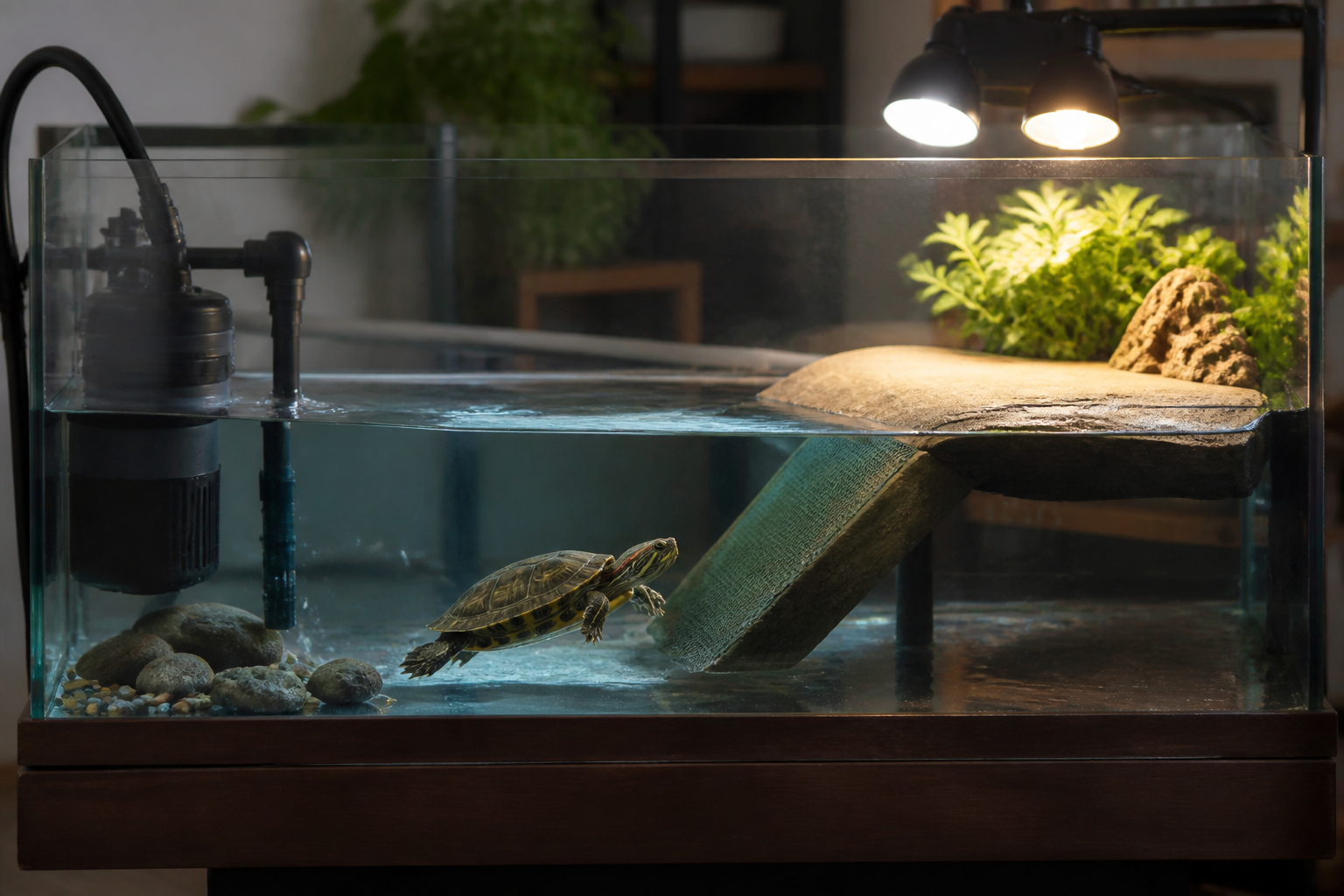
Aquatic turtles need a large filtered water volume plus a dry, warm basking area under UVB.
Diet compared
Most popular pet tortoises are herbivores that thrive on a high-fibre mix of weeds, leafy greens, and flowers, with calcium supplementation and strictly limited fruit. Aquatic turtles are commonly omnivores, especially when young, eating a balanced commercial pellet alongside some plant matter and occasional protein, shifting more towards plants with age. Feeding a tortoise a turtle diet, or vice versa, causes long-term harm.
Lifespan and commitment
Both are long-lived. Many tortoises and turtles reach 30 to 50 years or more, meaning they often outlive the initial owner and become a genuine multi-decade or even inherited responsibility. Before choosing either, confirm you can house an adult, not just the small hatchling in the shop, and that you have access to a reptile-savvy exotics vet, which is limited in many cities.
Living context by region
This guide is written for multi-region English readers (US/UK/AU/NZ/CA/EU and more). Where climate, products, or vet access differ, prefer local veterinary advice and local product labels. Use metric first; keep °F/lb in mind for North American homes.
When to call your vet
-
Signs are getting worse over hours, not better
-
Pain, persistent vomiting/diarrhea, or neurological signs
-
You needed force or guesswork to keep going at home
Common mistakes
-
Waiting because the animal 'still looks okay' while prey species hide pain
-
Changing five variables at once so you cannot tell what helped
-
Copying drug doses from social media
-
Skipping species-appropriate husbandry while buying more gadgets
FAQ
Is a turtle easier to keep than a tortoise?
Can tortoises swim?
Do they recognise their owners?
Which lives longer?
My highlights & notes
This article is for general education and is not a substitute for professional veterinary advice. If your pet is unwell, please consult a veterinarian.
Worried about your pet?
Peqaboo’s AI helps you track symptoms, understand lab reports, and know when to see a vet.
Get the Peqaboo app