

Scratching Post Buying Guide: Vertical, Horizontal, and Material Choices
A cat that ignores its post and shreds the sofa usually has the wrong post, not a behaviour problem. This guide compares vertical vs horizontal designs and sisal, cardboard and carpet surfaces, so you buy a post your cat actually chooses to use.

Quick answer

Scratching Post Buying Guide: Vertical, Horizontal, and Material Choices
Buy a post that is tall and sturdy enough for your cat to scratch at a full stretch without it wobbling, wrapped in sisal for most cats, and place it where your cat already wants to scratch. Offer both a vertical post and a horizontal or angled scratcher, since cats have individual preferences. The right post protects your furniture far better than any deterrent spray.
- Scratching is a normal, healthy need , cats scratch to stretch, mark territory and shed claw sheaths.
- A vertical post must be taller than your cat's full upright stretch, often 70 to 90 cm or more.
- Stability matters: a wobbly post feels unsafe and cats abandon it for the solid sofa.
- Sisal rope and sisal fabric are the most popular, durable scratching surfaces.
- Placement near existing scratch spots and rest areas beats hiding the post in a corner.
- Species
- cat
- Category
- environment
- Risk level
- low
- Content focus
- practical owner decisions + mechanism
- When to escalate
- same-day if pain, not eating, breathing issues, or rapid decline
Decide in 60 seconds
| Situation | Do now |
|---|---|
| Mild / stable at home | Follow steps in this guide and monitor for 12–24 hours |
| Not eating, hiding, or clear pain | Same-day vet (species-savvy if exotic) |
| Breathing hard, collapse, continuous distress | Emergency vet now |
| You are unsure after reading | Call a clinic with your notes rather than waiting days |
Vertical vs horizontal: offer both
Cats scratch in different orientations. Vertical scratchers let a cat reach up and pull down in a full-body stretch, which many cats prefer and which doubles as a satisfying morning stretch. Horizontal and angled scratchers suit cats that rake at carpets and rugs. Because you cannot always predict your cat's style, the safest approach is to provide one of each and see which gets used.
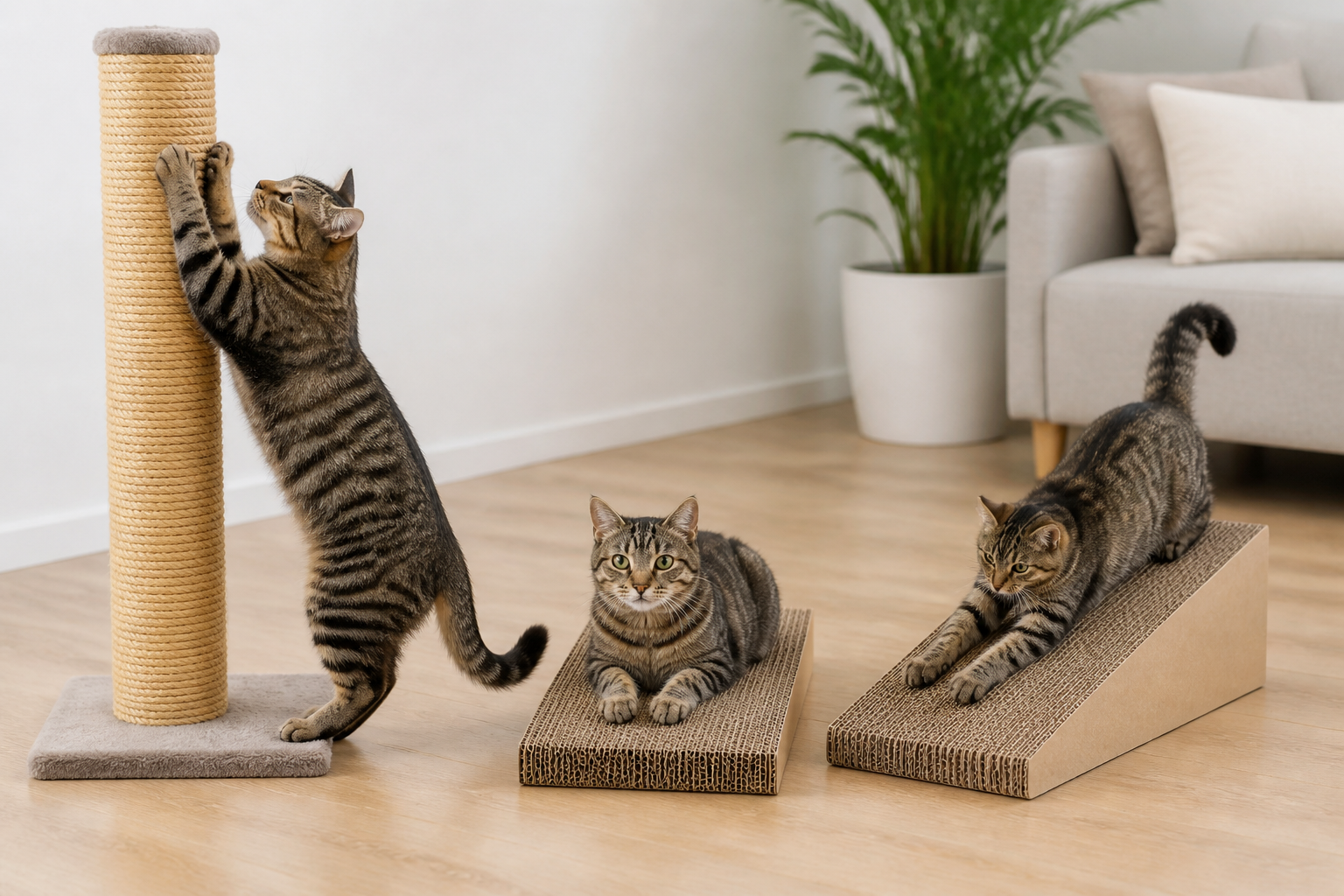
Offer both vertical and horizontal options , cats have individual scratching styles.
Height and stability
The two most common reasons a post is ignored are that it is too short or too wobbly. A cat wants to scratch at a full vertical stretch, so a good post is taller than your cat standing on its hind legs , often 70 to 90 cm at minimum for an adult. It also needs a wide, heavy base that does not rock, because any wobble makes the post feel unsafe and sends the cat straight back to the stable, reliable sofa arm.
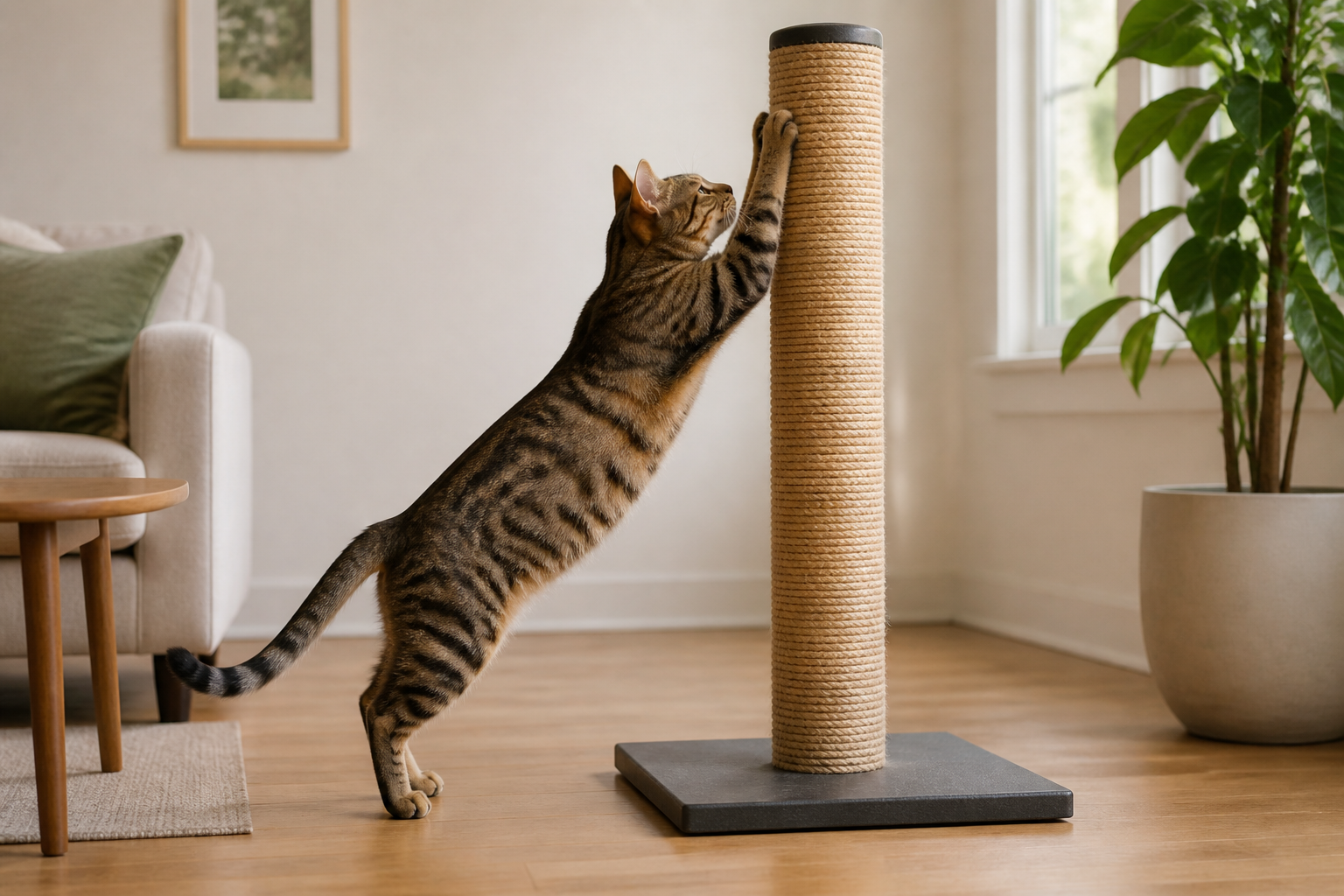
A good post is tall enough for a full stretch and heavy enough not to wobble.
Surface materials compared
Sisal rope and sisal fabric are the durable favourites: they give the satisfying resistance cats want and last well. Cardboard scratchers are cheap, popular and effective, especially the flat and angled kind, but wear out faster and shed bits. Carpet-covered posts are the weakest choice , they can confuse a cat into thinking carpet and rugs are fair game, and they snag claws. Lean sisal for a main post, cardboard as an extra.
Getting your cat to use it
Make the post the obvious choice. Put it near sleeping spots (cats love to scratch after waking), rub a little catnip on it, and reward your cat when it uses the post. Never grab your cat's paws and force them onto it , that creates a bad association. If your cat targets the sofa, cover that spot temporarily and place an attractive post right beside it.
For multi-cat and small homes
In a multi-cat home, provide several posts in different spots so cats are not forced to share or compete over one. In a small flat, a tall post with a small footprint or a wall-mounted scratcher saves floor space while still giving a full stretch. A cat tree combines scratching, climbing and a perch, which suits vertical living in a compact home.
Living context by region
This guide is written for multi-region English readers (US/UK/AU/NZ/CA/EU and more). Where climate, products, or vet access differ, prefer local veterinary advice and local product labels. Use metric first; keep °F/lb in mind for North American homes.
When to call your vet
-
Signs are getting worse over hours, not better
-
Pain, persistent vomiting/diarrhea, or neurological signs
-
You needed force or guesswork to keep going at home
Common mistakes
-
Waiting because the animal 'still looks okay' while prey species hide pain
-
Changing five variables at once so you cannot tell what helped
-
Copying drug doses from social media
-
Skipping species-appropriate husbandry while buying more gadgets
FAQ
What height should a scratching post be?
Is sisal or cardboard better?
Why does my cat ignore the post and scratch the sofa?
Should I ever declaw a cat?
My highlights & notes
This article is for general education and is not a substitute for professional veterinary advice. If your pet is unwell, please consult a veterinarian.
Worried about your pet?
Peqaboo’s AI helps you track symptoms, understand lab reports, and know when to see a vet.
Get the Peqaboo app