

Reptile claw and beak overgrowth: what to trim, what never to touch, and the husbandry behind it
Reptiles have no coat to groom, but claws and the keratin beak grow continuously and captivity removes the abrasion that used to wear them down. Here is what healthy looks like by species, which overgrowths you can trim at home, the look-alikes that are emergencies, and the husbandry that stops it recurring.

Quick answer
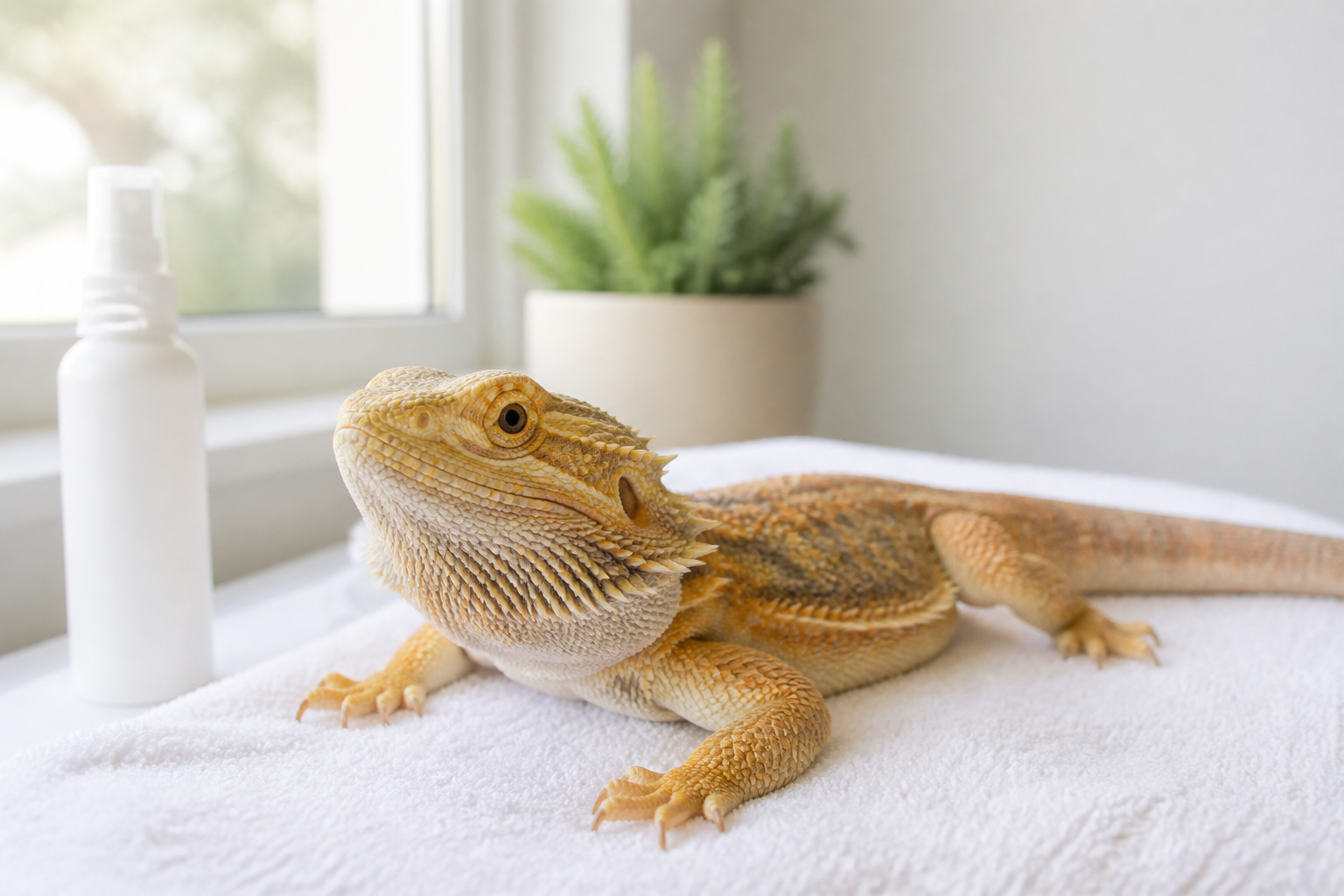
Side on, at eye level, is the angle that tells you the truth about a lizard's claws. From above they always look fine.
Reptiles have no fur, so there is nothing to brush and no coat to strip. The maintenance job that actually exists is at the ends: claws on lizards and chelonians, and the keratin beak on tortoises and turtles.
Both grow continuously and are worn down by use. Wild reptiles walk on rock, bark and grit, and tear at fibrous plants. Captive reptiles stand on glass, tile and kitchen paper and eat chopped salad. Growth outpaces wear, and the result is claws that curl and beaks that hook.
- Claws are trimmable at home on most lizards, with small clippers and a light touch.
- Beaks are not a home job. Correcting one badly can lame an animal that then stops eating.
- A jaw that will not close, or a soft, rubbery lower jaw, is metabolic bone disease and no amount of trimming fixes it.
- Snakes have neither claws nor a beak. If you keep a boa or python, the small spurs beside the vent are normal anatomy and must never be trimmed.
- The long front claws on a male red-eared slider are normal courtship anatomy. Do not cut them.
:::danger
A tortoise whose beak has hooked so far that the mouth no longer closes, or whose lower jaw feels soft and flexes under gentle pressure, has metabolic bone disease until proven otherwise.
The beak is the visible end of a whole-skeleton problem caused by inadequate UVB, wrong calcium to phosphorus balance, or wrong temperatures. Trimming the beak on an animal like this treats the symptom while the skeleton keeps demineralising, and handling can fracture bones. This needs a reptile vet, not a file.
:::
- Species
- reptiles, chiefly lizards, tortoises and turtles
- Category
- grooming
- Risk level
- medium
- Home job
- claw tips on most lizards
- Vet job
- any beak, any suspected metabolic bone disease, any dark claw with severe overgrowth
- When to escalate
- food being dropped, a jaw that will not close, a claw torn out, or a toe that is swollen and dark
Decide in 60 seconds
| What you see | Do now |
|---|---|
| Claw tips extend past the toe pad, animal walks normally | Routine. Trim the tips at home or increase abrasive surfaces. |
| Claws curling sideways, toes rotating, animal slipping on smooth surfaces | Trim in stages, and fix the enclosure surfaces. Recheck in a few weeks. |
| A claw has torn off or is bleeding at the base | Stop the bleeding with pressure and styptic, keep on clean paper, and get it seen. |
| A toe is swollen, dark or cool below a pale ring | Retained shed strangling the toe. Same-day problem. Do not pull the ring. |
| Beak hooked past the lower jaw, food being dropped or crushed on one side | Book a reptile vet. Do not file it yourself. |
| Jaw will not close, or lower jaw feels soft or flexible | Urgent reptile vet. Assume metabolic bone disease. |
| Long, elegant front claws on a male aquatic turtle, everything else normal | Normal courtship anatomy. Leave them alone. |
| Small horny spurs beside the vent on a boa or python | Normal. Never trim. |
Why captivity causes this
The keratin at the tip of a claw and the sheath that forms a tortoise's beak both grow continuously through life. Nothing stops them. What limits their length in a wild animal is abrasion.
A tortoise grazing on wiry, gritty plants drags the beak across silica-rich leaves and soil hundreds of times a day. A lizard crossing rock and bark files its claws with every step. A wild animal also covers ground, and distance is what turns a rough surface into a file.
Now look at a typical vivarium. Kitchen paper, tile, smooth soil or a soft substrate. A basking platform of moulded plastic. Food chopped into soft cubes in a shallow dish. There is almost no abrasion anywhere in that picture, and the animal walks a few metres a day.
That is the whole mechanism, and it explains why the fix is mostly environmental rather than a monthly appointment with clippers.
It also explains the shape overgrowth takes. Claws follow their natural curve, so an unworn claw curls, first sideways and then back toward the pad. A tortoise's upper beak grows forward and down into a hook, because the lower jaw no longer meets it in the place that wore it flat.
What healthy looks like, and where it differs by species
Bearded dragons, skinks, and other terrestrial lizards.
Stand the animal on a flat, firm surface and look from the side at eye level. The toes should lie flat and point forward. Claws curve gently down and the tip should not be lifting the toe or splaying it sideways.
Arboreal lizards and chameleons.
Sharp claws are working equipment. A chameleon grips branches with specialised feet and needs the points. Take the very tip only, and only if the animal is catching and hanging. A blunted arboreal lizard falls, and falls in this group cause fractures and organ injury.
Geckos.
Leopard geckos and crested geckos rarely need any claw work. If a toe looks thickened, assume retained shed first. A shed ring forms a discoloured band, and the toe beyond it becomes swollen, dark, dry and eventually falls off. That is a husbandry and hydration problem, not a trimming problem, and pulling the ring takes the toe with it.
Tortoises.
The upper beak should overlap the lower slightly, with clean, even edges and no forward hook. The jaw should close fully and evenly. Watch the animal eat: a healthy tortoise crops a leaf cleanly. One that mouths at food repeatedly, drops pieces, or tears with the side of the mouth is telling you the beak no longer meets.
Tortoise claws should be checked at the same time. Overgrowth on the front feet is common in animals kept on soft substrate with no hard-standing area.
Aquatic turtles.
Beak overgrowth is common in turtles kept on soft pellets alone. The one thing not to touch is the front claws of an adult male slider or cooter, which are naturally long and are used to display in front of females. Trimming them is a cosmetic mistake with no benefit.
Snakes.
No claws, no beak. Boas and pythons carry a pair of pelvic spurs beside the vent, larger in males, which are bony structures covered in keratin. They are normal and they are not nails. Trimming or pulling them causes bleeding and infection.

This is the photograph to take for a vet: side on, mouth closed, in good light. It shows how the jaws meet, the line of the rostrum, and the ear opening in the same frame.
The look-alikes that are not overgrowth
Retained shed.
Constricting bands on toes and tail tips, common in geckos and in snakes kept too dry. The tissue beyond the band swells and darkens. Treat as urgent.
Gout.
Swollen, painful joints in the toes, associated with dehydration and diet. Firm swellings around joints rather than a long claw.
Septic arthritis or an abscess.
One hot, swollen toe, often after a bite or an injury. Reptile pus is solid, so this needs surgery rather than drainage.
Fracture or old injury.
A toe that points the wrong way and has done since you got the animal is often an old healed injury. Note it so you do not misread it later.
Metabolic bone disease.
Splayed limbs, a tremor, a soft jaw, a bumpy or bowed spine and limbs, and abnormal weight bearing that changes how claws wear. The claws are a symptom here.
Trimming claws at home
What you need.
Small scissor-type clippers made for cats or small animals. Human clippers crush rather than cut on a thick claw. A nail file to smooth the cut. Styptic powder or plain cornflour. Strong light. A towel. A second pair of hands.
Restraint.
Support the whole body, and never hold or pull a single limb. Take one foot at a time, letting the animal keep its weight on the other three. Work in short sessions and stop before the animal fights you, not after.
Do not use so-called tonic immobility, where a lizard is turned on its back to make it go still. It is a stress response, not relaxation, and it does nothing to make a trim safer.
Finding the quick.
On a pale claw, hold a small torch behind it. The quick shows as a pink core, and you cut beyond the end of it. On a dark claw you cannot see it, so take several very small slices instead and look at the cut face after each one. When a grey or pink oval appears in the centre, stop immediately.
How much to take.
The hook, and only the hook. The aim is a claw that does not catch and does not lift the toe, not a blunt stub. On a badly overgrown claw the quick has grown out with it, so a short claw is not achievable in one session. Repeated small trims over several weeks let the quick recede.
If it bleeds.
Firm pressure with styptic powder or cornflour. Then keep the animal on clean kitchen paper rather than soil, bark or sand for a couple of days, so the exposed quick does not become infected. For aquatic species, ask your vet before making any change to water time.
The husbandry that means you rarely have to trim
Surfaces.
Textured stone, slate, cork bark and natural wood where the animal actually walks and basks. For tortoises, an area of hard standing alongside the soft substrate they dig in.
Distance.
An enclosure large enough that the animal walks somewhere to bask, somewhere to drink and somewhere to feed. Wear is a product of surface and mileage.
Food that fights back.
For tortoises and herbivorous lizards, feed whole leaves, weeds and grasses rather than everything diced small. Cropping and tearing is what shapes the beak. Cuttlebone provides calcium and some abrasion, but it does not replace a coarse diet and it will not correct an established overgrowth.
For aquatic turtles, a diet with some hard-shelled and whole items does more for the beak than pellets alone.
Correct UVB and calcium.
This is the one that prevents the version of the problem you cannot fix at home. Get the bulb type, the distance and the replacement interval right for your species, and keep the calcium to phosphorus balance correct. Beak and jaw deformity from metabolic bone disease is permanent once the bone has remodelled.
Outdoor time where climate and law allow.
In warm regions, safe supervised outdoor access on natural ground gives unfiltered UVB, real abrasion and real walking distance at the same time. Availability, legality and predator risk vary hugely by country, so plan it locally.
What the vet will ask for
Photographs: the feet from the side while the animal stands on a flat surface, and the head side on with the mouth closed. Both taken in daylight or under white light rather than under the enclosure's coloured lamps.
The full diet, by name and by proportion, including supplements and how often they are dusted.
The UVB setup: bulb type and brand, its age, the distance from the animal, and whether there is glass or fine mesh between them, since both filter UVB.
Temperatures measured at the basking surface and at the cool end, with a probe or an infrared thermometer rather than estimated.
A weight trend, and whether food is being dropped, crushed, or refused.
Expect the vet to assess jaw firmness, limb straightness and gait for metabolic bone disease, to check for retained shed, and to consider blood work or imaging if the picture points that way. Beak correction is usually done with a rotary tool under sedation, and the vet will want to correct the cause at the same appointment.
What never to do
Do not brush, comb or use grooming products on a reptile. There is no coat, and the skin is the barrier.
Do not sand, file or grind a beak yourself.
Do not line an enclosure with sandpaper or fit abrasive perches. They wear skin and scutes before they wear claws, and the lesions they cause get infected.
Do not trim an arboreal lizard's claws short. Grip is survival for a climbing animal.
Do not trim a snake's spurs or a male slider's long front claws.
Do not pull a retained shed ring off a toe.
Do not keep trimming a beak that keeps hooking without fixing the diet, the UVB and the temperatures. The trim is maintenance; the husbandry is the treatment.
How often should I be trimming claws?
I cut too far and it is bleeding. What now?
My tortoise's beak keeps overgrowing even after the vet corrected it. Why?
Can I file the claws instead of cutting them?
When to get help
Same day for a torn or avulsed claw, a bleeding nail bed that will not stop, a toe that is swollen or dark below a shed ring, or an animal that has suddenly stopped bearing weight on a foot.
Promptly, within days, for any beak that has hooked or that is interfering with eating, for a jaw that does not close, for a soft or flexible lower jaw, and for any weight loss alongside these signs.
Ask for a vet with reptile experience. Sedation, correct restraint and knowing how far the sensitive tissue extends into a beak are all species-specific skills, and this is the kind of job where a well-meaning generalist can leave an animal unable to eat.
Bring the photographs, the temperature readings, the UVB details and the diet. Most beak and claw problems are read off that list before the animal is even out of the box.
My highlights & notes
This article is for general education and is not a substitute for professional veterinary advice. If your pet is unwell, please consult a veterinarian.
Worried about your pet?
Peqaboo’s AI helps you track symptoms, understand lab reports, and know when to see a vet.
Get the Peqaboo app