

Reef Tank for Beginners: What It Really Takes to Start
A reef tank is one of the most rewarding but demanding aquariums you can keep. Success comes from stable water chemistry, the right gear and patience, not luck. This honest beginner guide covers the equipment, costs, timeline and habits that decide whether your first reef thrives or crashes.

Quick answer

Reef Tank for Beginners: What It Really Takes to Start
A reef tank keeps live corals and marine fish together, and it succeeds or fails on stability. You will need a tank of reasonable size, a protein skimmer, strong water movement, quality reef lighting, live rock, a heater and reliable salinity testing. Budget realistically, cycle the tank fully before adding livestock, and add slowly over months. Reefs punish impatience, so the single most useful skill is doing nothing while the system matures.
- Species
- marineFish
- Category
- environment
- Risk level
- high
- Content focus
- practical owner decisions + mechanism
- When to escalate
- same-day if pain, not eating, breathing issues, or rapid decline
Decide in 60 seconds
| Situation | Do now |
|---|---|
| Mild / stable at home | Follow steps in this guide and monitor for 12–24 hours |
| Not eating, hiding, or clear pain | Same-day vet (species-savvy if exotic) |
| Breathing hard, collapse, continuous distress | Emergency vet now |
| You are unsure after reading | Call a clinic with your notes rather than waiting days |
Start bigger than you think
Counter-intuitively, small nano reefs are harder for beginners, not easier. A larger volume of water dilutes mistakes , a missed top-up or a dead snail causes a smaller swing in temperature, salinity and chemistry. A tank in the 75–150 litre range is a sensible first reef; anything tiny leaves almost no margin for error.

The core equipment
Reef gear is a real step up from freshwater.
A reef needs more gear than freshwater: skimmer, flow, reef light and salt testing.
- A protein skimmer to export dissolved organic waste.
- One or more powerheads for turbulent flow corals need.
- A dedicated reef LED with the right spectrum and intensity.
- A heater and a backup thermometer.
- A refractometer for accurate salinity (never rely on a cheap swing-arm hydrometer alone).
- An RODI unit or a supply of purified water, because tap water introduces phosphate and metals that fuel algae.
Live rock and cycling
Live rock is both your filter and your aquascape.
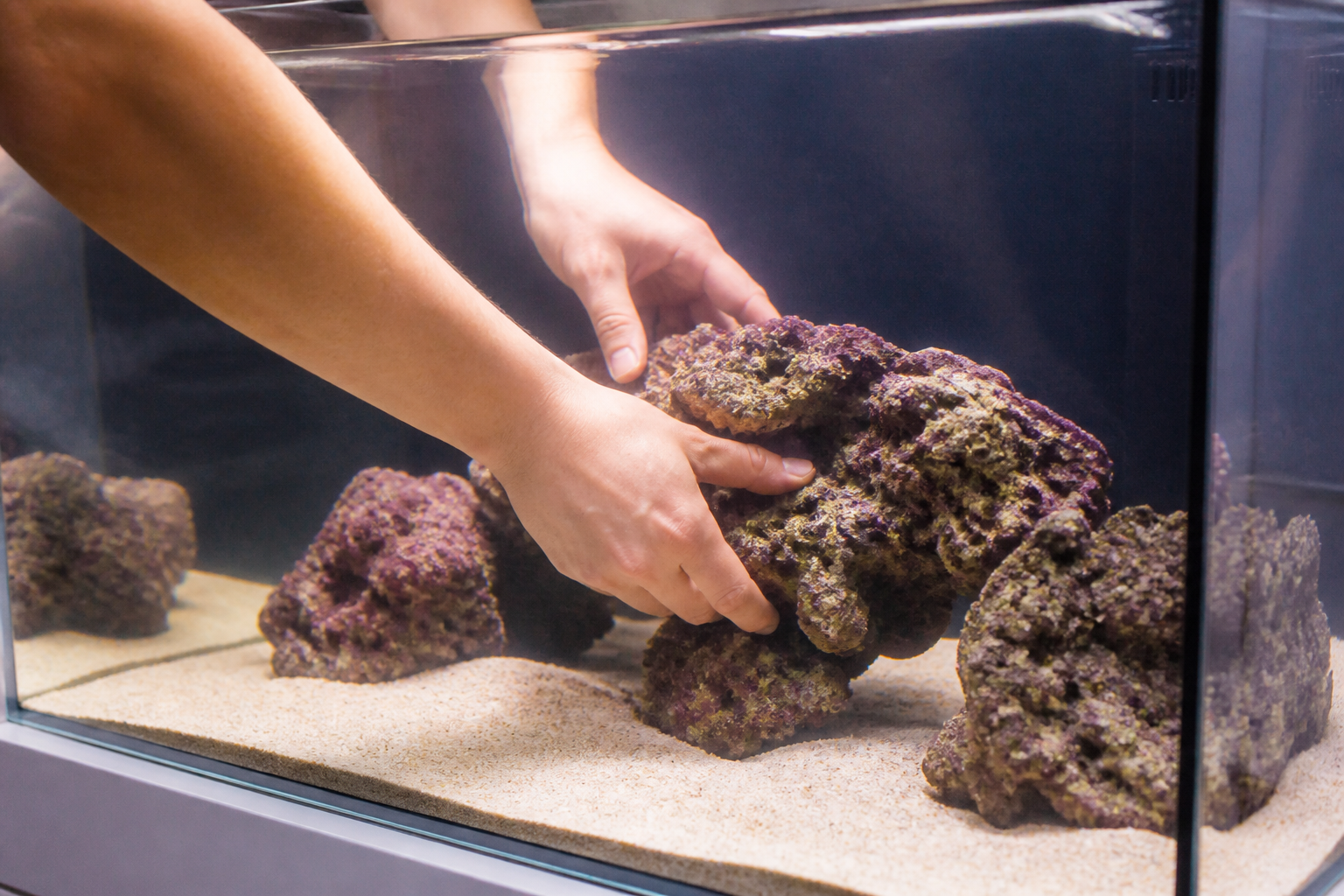
Live rock is your biological filter and the structure corals will grow on.
Arrange it with open flow and caves, then cycle the tank fully , let ammonia and nitrite rise and fall to zero before any livestock. This takes several weeks and cannot be rushed. Start with hardy cleanup crew and one or two beginner-friendly fish such as a clownfish, then wait before adding soft corals. Leave demanding stony corals for later.
Habits that keep a reef alive
Consistency beats intensity. Test salinity, alkalinity, calcium and magnesium on a set schedule, top up evaporation daily, do modest regular water changes with properly mixed saltwater, and change one thing at a time. Chasing perfect numbers by dumping in additives is how beginners crash reefs.
Living context by region
This guide is written for multi-region English readers (US/UK/AU/NZ/CA/EU and more). Where climate, products, or vet access differ, prefer local veterinary advice and local product labels. Use metric first; keep °F/lb in mind for North American homes.
When to call your vet
-
Signs are getting worse over hours, not better
-
Pain, persistent vomiting/diarrhea, or neurological signs
-
You needed force or guesswork to keep going at home
Common mistakes
-
Waiting because the animal 'still looks okay' while prey species hide pain
-
Changing five variables at once so you cannot tell what helped
-
Copying drug doses from social media
-
Skipping species-appropriate husbandry while buying more gadgets
FAQ
Is a reef tank very expensive?
How long before I can add corals?
Do I need an RODI unit?
Can beginners really keep corals alive?
My highlights & notes
This article is for general education and is not a substitute for professional veterinary advice. If your pet is unwell, please consult a veterinarian.
Worried about your pet?
Peqaboo’s AI helps you track symptoms, understand lab reports, and know when to see a vet.
Get the Peqaboo app