

Setting Up the Perfect Rabbit Litter Box: Substrate and Placement
Rabbits naturally toilet in one spot, which makes litter training realistic. This step-by-step guide covers choosing a safe substrate, layering hay on top, placing the box where your rabbit already goes, and troubleshooting the most common litter-training setbacks.

Quick answer

Setting Up the Perfect Rabbit Litter Box: Substrate and Placement
Use a shallow, roomy box with a paper-based or wood-pellet litter on the bottom and a generous pile of fresh hay on top, placed in the corner your rabbit already uses. Avoid clumping cat litter, clay, and softwood shavings. Neuter for reliable results, and be patient, most rabbits learn within a few weeks.
- Rabbits eat while they toilet, so hay must always be within reach of the box.
- Safe substrates, paper-based pellets, kiln-dried aspen, or compressed wood pellets.
- Avoid, clumping or clay cat litter, cedar and pine shavings, and clay-based crystals.
- Placement beats persuasion, put the box where the rabbit has already chosen to go.
- Neutering (絕育) hugely improves litter reliability by reducing territorial marking.
- Species
- rabbit
- Category
- environment
- Risk level
- low
- Content focus
- practical owner decisions + mechanism
- When to escalate
- same-day if pain, not eating, breathing issues, or rapid decline
Decide in 60 seconds
| Situation | Do now |
|---|---|
| Mild / stable at home | Follow steps in this guide and monitor for 12–24 hours |
| Not eating, hiding, or clear pain | Same-day vet (species-savvy if exotic) |
| Breathing hard, collapse, continuous distress | Emergency vet now |
| You are unsure after reading | Call a clinic with your notes rather than waiting days |
Choosing a safe substrate
Rabbits nibble their litter, so safety comes first. Good choices are paper-based pellets, kiln-dried aspen shavings, or compressed wood-stove pellets, all absorbent and low-dust. Avoid clumping and clay cat litters, which can cause a fatal blockage if eaten, and steer clear of cedar and pine shavings, whose aromatic oils can harm the liver and airways. A thin layer of litter is enough, you want it to absorb urine, not to bury the rabbit.

Hay over litter is the trick, rabbits like to munch hay while they toilet.
Adding hay, the key trick
The single most effective step is piling fresh hay on top of the litter or in a rack right beside the box. Rabbits instinctively eat and toilet at the same time, so hay at the box draws them in and keeps them there long enough to build the habit. Refresh the hay daily, it is food, so it must always be clean and dry.
Placement, follow the rabbit
Do not decide where the toilet should be, watch where your rabbit already goes. Rabbits pick a corner and stick to it, so place the box exactly there. If it favours several spots, start with a box in each and remove them one by one as habits settle. Boxes tucked into corners feel safer and get used more.
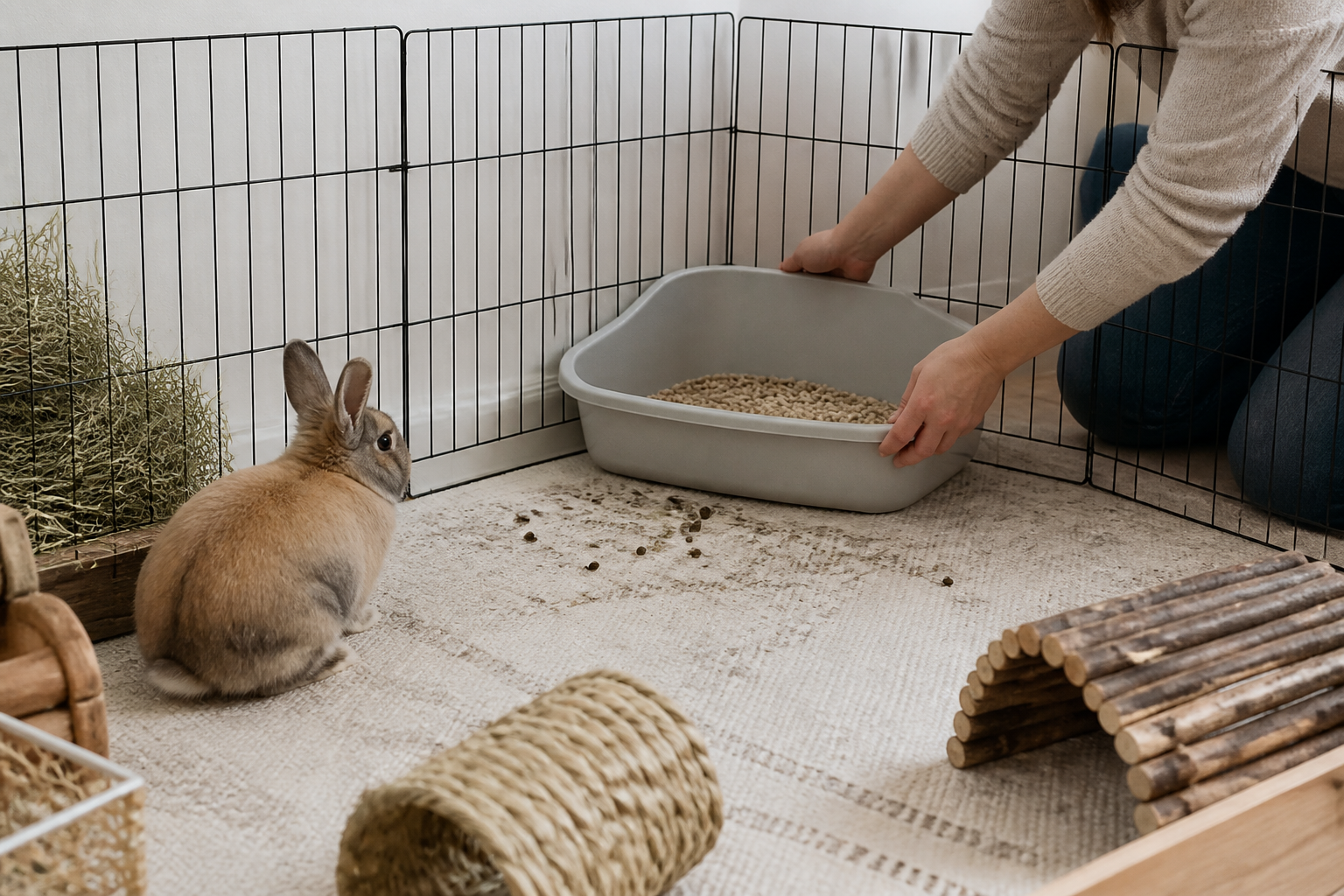
Work with your rabbit, put the box where it already goes, not where you wish it would.
Keeping it clean, but not too clean
Scoop or fully change the litter every one to two days, stale boxes push rabbits to go elsewhere. But when you clean, leave a few droppings or a hay wisp behind at first, the familiar scent reminds the rabbit this is the toilet. A splash of white vinegar rinses away urine scale between changes.
Living context by region
This guide is written for multi-region English readers (US/UK/AU/NZ/CA/EU and more). Where climate, products, or vet access differ, prefer local veterinary advice and local product labels. Use metric first; keep °F/lb in mind for North American homes.
When to call your vet
-
Signs are getting worse over hours, not better
-
Pain, persistent vomiting/diarrhea, or neurological signs
-
You needed force or guesswork to keep going at home
Common mistakes
-
Waiting because the animal 'still looks okay' while prey species hide pain
-
Changing five variables at once so you cannot tell what helped
-
Copying drug doses from social media
-
Skipping species-appropriate husbandry while buying more gadgets
FAQ
Why does my rabbit lie in its litter box?
Can I use cat litter?
How many boxes do I need?
Does neutering really help?
My highlights & notes
This article is for general education and is not a substitute for professional veterinary advice. If your pet is unwell, please consult a veterinarian.
Worried about your pet?
Peqaboo’s AI helps you track symptoms, understand lab reports, and know when to see a vet.
Get the Peqaboo app