

Lizards: Escape Proofing the Enclosure and Finding an Escaped Lizard Indoors
Escaped lizards head for warmth indoors, not the garden. Learn the gaps that let them out, how to secure enclosure, room and household, and a search protocol that actually finds them.

Quick answer
Almost every escape starts at the enclosure, not at the front door. A latched lid and sealed cable ports do most of the work.
Escaped lizards are almost never found in the garden. They are found indoors, close to something warm: behind a fridge, under a radiator, inside a sofa, behind a bookcase on an interior wall.
That is because a loose reptile is not exploring. It is looking for heat and for a tight, dark space to wedge into, and it will keep moving until it finds both.
- Escape proof the enclosure first, then the room, then the doorway.
- A lizard can pass through a gap far smaller than it looks, especially a juvenile.
- Search warm, dark, low, tight spaces before anything else.
- Search at the animal's active time of day, not yours.
- Cold and dehydration are what kill an escapee, usually within days rather than hours.
:::danger
Never house a lizard outdoors in a yard or garden unless the species and setup are specifically designed for it, and never let one loose outside for exercise.
Outside, a pet lizard cannot regulate its temperature reliably, is easy prey, and in many regions becomes an ecological and legal problem if it survives.
:::
- Species
- lizards
- Category
- environment
- Risk level
- medium
- Content focus
- preventing escapes and recovering an escaped lizard indoors
- Most common exit points
- sliding door tracks, cable ports, ventilation panels, unlatched lids
- When to escalate
- a lizard found cold and unresponsive, or one missing long enough to be dehydrated
Decide in 60 seconds
| Situation | Do now |
|---|---|
| Lizard missing, discovered within minutes | Close every door in the room, stop moving furniture, and search low and warm first. |
| Missing overnight | Shut off and unplug appliances that could trap or crush, then search room by room with a torch. |
| Found behind a warm appliance | Turn the appliance off first. Do not reach into a running machine. |
| Found and cold to the touch | Return to the enclosure at normal temperature and let it rewarm gradually. Do not use direct heat. |
| Missing several days | Keep searching, leave shallow water at floor level, and contact a reptile vet about rehydration once recovered. |
| Escaped outdoors | Search immediately near warm surfaces such as walls and paving, and inform a local reptile group or vet. |
Why lizards leave and where they go
A reptile that is loose in a house is under two pressures at once. It is cooling down, and it is exposed.
Both push the same behaviour. Move along an edge, follow the warmth, wedge into the tightest space that fits.
That is why escapees turn up behind fridges and freezers, where the compressor is warm. Under radiators. Inside upholstery. Behind wall mounted units. In the gap under kitchen units.
Ground dwelling species travel along skirting boards and rarely cross open floor. Arboreal species climb curtains, shelving and the backs of furniture, and can end up surprisingly high.
Understanding this narrows the search dramatically. Systematic checking of warm, tight, edge locations beats wandering around calling the animal, which achieves nothing since lizards do not respond to their names.
Escape proofing the enclosure

Latches, a fitted mesh top and sealed cable entries are the three fixes that close most exit routes.
The head is the guide. If a lizard's head fits through a gap, the rest of the body will follow.
Juveniles are the usual escapees, because keepers judge gaps against the adult size the animal will eventually reach.
The second and third barriers
Treat the room as the second barrier. Keep the door closed whenever the enclosure is open, block the gap under the door during maintenance, and cover floor level vents.
Treat the household as the third. Know which rooms have exterior doors, cat flaps or open chimneys, and keep those shut when anyone is working in the reptile room.
If you have cats or dogs, they should never have access to the reptile room unsupervised. Most fatal outcomes after an escape involve another pet, not the escape itself.
The search protocol
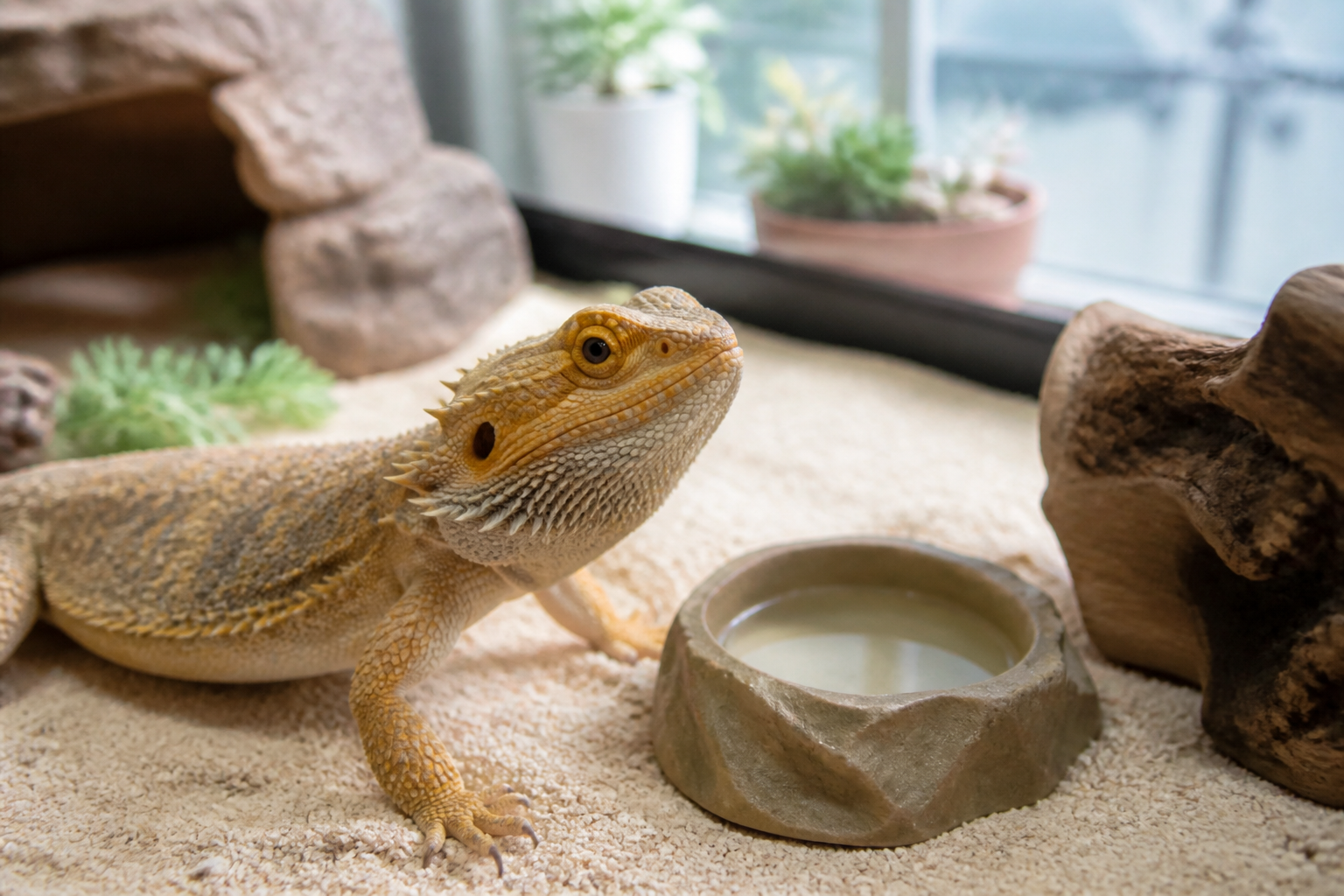
Warmth draws an escapee. A shallow dish of water and a low hide near a warm appliance give the animal a reason to stay put and be found.
Start by containing. Close doors, and stop other pets from entering.
Search warm first. Behind and underneath the fridge, freezer, washing machine, oven, boiler and radiators. Turn appliances off before reaching anywhere.
Then search tight. Under and inside furniture, in folded fabric, behind books, inside boxes, along skirting boards, under floor level cupboards.
Then search high, if the species climbs. Curtain tops, picture frames, the tops of wardrobes and the backs of shelving.
Search with a torch at floor level, angled along the floor. The beam picks out eye shine and a body outline in gaps you cannot see into.
Search when the animal is active. For a nocturnal gecko, that is after the lights go out, in a quiet house.
Leave a shallow water dish and a warm, tempting hide near where you think it is, and check both regularly.
After recovery

Back in a warm, secure enclosure, a recovered lizard usually returns to normal basking and movement within a few days.
Return the lizard to a preheated enclosure and let it rewarm at its own pace.
Offer water. Dehydration is the most common consequence of a multi day escape, and it shows as sunken eyes, wrinkled skin and a lack of energy.
Delay feeding until the animal is basking and moving normally.
Check the whole body for injuries, dust, adhesive, or anything stuck to the skin. Never pull adhesive residue off, and never use a glue trap anywhere in a home with a reptile.
Weigh the animal and record it, then weigh again in a week.
What never to do
Do not use glue traps or snap traps to catch a lizard. Glue traps cause severe injury and are a common cause of death in escaped reptiles.
Do not run appliances during a search. Fridges, washing machines and heaters have all killed escapees.
Do not put a lizard straight onto a hot surface or under a lamp to warm it quickly. Gradual rewarming is safer.
Do not assume the animal has left the room. Most are found within a few metres of the enclosure.
Do not give up after a day. Lizards have been recovered in good condition well over a week later.
How long can an escaped lizard survive indoors?
Should I search the garden?
My lizard is behind the fridge and will not come out. What now?
Will it come back to its enclosure on its own?
When to get help
Contact a reptile or exotics veterinarian for any lizard recovered cold and unresponsive, visibly dehydrated, injured, or coated in adhesive or chemicals.
Also seek advice if the animal will not eat once it has rewarmed, or if it has lost noticeable weight during the time it was missing.
Bring your weight log, an estimate of how long the animal was loose, and a note of where it was found and what it may have contacted.
Knowing whether it spent days behind a warm appliance or in a cold hallway changes what the vet checks first.
My highlights & notes
This article is for general education and is not a substitute for professional veterinary advice. If your pet is unwell, please consult a veterinarian.
Worried about your pet?
Peqaboo’s AI helps you track symptoms, understand lab reports, and know when to see a vet.
Get the Peqaboo app