

Ferret hydration: why they dry out fast and how to tell
Ferrets have a very short gut, a high metabolic rate and almost no fluid reserve, so vomiting, diarrhoea or heat dries them out within a day. This guide covers why bowls beat bottles, how to assess hydration when skin tenting is unreliable, why a ferret that stops drinking usually has an obstruction, an ulcer, low blood sugar or a blocked urethra, and what never to put in its mouth.

Quick answer
Ferrets dehydrate faster than almost any other pet mammal in the house. They are small, they run hot, and food passes through their gut in a matter of hours rather than a day, so anything that causes vomiting or diarrhoea empties them out very quickly.
The practical version is short. Give water in heavy open bowls, in more than one place, and treat a bottle as a backup rather than the main supply. Add water to food. And understand that a ferret which has gone off its water is almost never simply fussy: nausea, mouth pain, a swallowed piece of rubber, or low blood sugar are the usual reasons, and each of them needs a vet rather than a new bottle.
A wide, heavy, open bowl at floor level gets far more water into a ferret than a sipper bottle does.
- Ferrets drink considerably more from an open bowl than from a bottle. Offer both, but make the bowl primary.
- Vomiting or diarrhoea in a ferret is a same-day problem, not a wait-and-see one.
- A ferret pawing at its mouth, drooling or grinding its teeth is nauseous or in pain. Both reduce drinking.
- Straining in the litter tray with nothing produced is a urinary emergency in male ferrets.
- Never syringe water into a weak or collapsed ferret. It goes into the lungs.
:::danger
A male ferret straining in the litter tray may be blocked, not constipated.
Adrenal disease in ferrets enlarges the prostate, which surrounds the urethra. The result is a male ferret that squats repeatedly, strains, cries, and produces nothing or only drops. Owners consistently read this as constipation and wait. Urine backing up damages the kidneys within hours and the animal deteriorates fast. Any ferret straining without producing urine needs an emergency vet immediately.
:::
- Species
- ferret
- Category
- nutrition and hydration
- Risk level
- high
- Why it matters
- very short gut transit, small body mass, poor heat tolerance
- Best water delivery
- heavy open bowls in more than one location
- Fastest causes of dehydration
- vomiting, diarrhoea, gut obstruction, heat, low blood sugar
- When to escalate
- any vomiting, any diarrhoea, straining, drooling, or a ferret that will not drink
Decide in 60 seconds
| What you see | Do now |
|---|---|
| Vomiting, or repeated retching with nothing produced | Same-day vet. Bring a photograph of anything produced. |
| Diarrhoea, especially green, mucoid or black and tarry | Same-day vet. Black tarry stool means digested blood. |
| Pawing at the mouth, drooling, teeth grinding | Same-day vet. Nausea, ulcers, obstruction or low blood sugar. |
| Straining in the litter tray, nothing produced, male ferret | Emergency now. |
| Weak, wobbly hind end, staring, then collapse | Emergency now. Likely low blood sugar. |
| Flat out, panting, bright red pads or lips, in warm weather | Emergency. Cool gradually, do not use ice or cold water, go. |
| Gums tacky rather than slick, eyes slightly sunken | Dehydrated. Vet the same day. |
| Ferret simply drinking less than usual, otherwise bright | Switch to bowls, add water to food, weigh daily, review within a day or two. |
| Litter tray noticeably drier than usual | Reduced urine output. Worth a call. |
Why the ferret is built to dry out
A ferret is a small obligate carnivore with a gut designed for speed. There is no caecum, the intestine is short, and transit from mouth to litter tray is measured in a few hours. That design suits an animal that eats whole prey frequently, and it means a ferret has almost no reserve capacity when things go wrong.
Two consequences follow.
Fluid loss is fast. A bout of diarrhoea that would leave a dog a bit flat can leave a ferret genuinely dehydrated within a day.
Absorption windows are short. A ferret that is not eating and drinking regularly does not have days of buffer.
On top of that, ferrets have a high metabolic rate and no sweat glands. They lose heat only by panting and by radiating from a small body surface, so warm weather increases fluid demand at the same time as it reduces their willingness to move to the bowl.
Older ferrets add another layer. Kidney disease is common with age and reduces the ability to concentrate urine, so an elderly ferret loses more water per day simply by existing.
Bowls, bottles and how to actually get water in
Bowls first.
Ferrets drink more from open water than from a sipper bottle. Drinking from a bottle means holding the head up at an awkward angle and working the ball with the tongue, which is slow. Given both, most ferrets go to the bowl and leave the bottle.
Use a heavy ceramic or a clamped stainless bowl. Ferrets tip everything, and a spilled bowl is a bowl that was not available for the rest of the day.
Put bowls in more than one place: one in the sleeping area, one where the ferret plays.
Refresh daily and wash properly. Ferrets are fussy about stale or slimy water.
Bottles as backup only.
A bottle is useful because it cannot be tipped, and because it lets you see roughly how much has gone. It is not a good primary supply. Check the ball every day by pressing it; blocked bottles are silent failures and ferrets have been found dehydrated in front of a full bottle.
Water in the food.
This is the highest-yield trick. Adding warm water to kibble, or feeding a wet food or an appropriate raw or complete fresh diet, moves a meaningful volume of water into an animal that likes eating more than it likes drinking.
Introduce a soaked or wet diet before your ferret ever needs it. Ferrets imprint strongly on food textures when young and can be extremely stubborn about new ones later, which is exactly the wrong moment to be teaching a sick ferret to accept soup.
Meat-flavoured water.
A small amount of the water from poaching plain chicken, unsalted and with no onion, garlic or seasoning, offered cool, will get many reluctant ferrets drinking. Use it as a temporary bridge, not a permanent supply.
Never syringe water into a weak ferret.
A ferret that is flat, wobbly or semi-conscious has a poor swallow reflex, and fluid delivered into the mouth ends up in the lungs. Aspiration pneumonia turns a bad day into a fatal one. A ferret that needs fluids and cannot drink needs them given by a vet, under the skin or into a vein.

Weigh the ferret daily during any illness. Body weight is a faster and more honest measure of fluid balance than anything you can see.
How to tell a ferret is dehydrated
Gums.
Lift the lip. Healthy gums are slick and wet and your finger slides. Tacky gums that grip slightly are an early sign. Dry gums are a late one.
Eyes.
Compare with your memory of the animal. Eyes that sit further back in the socket, with a slightly dulled surface, indicate meaningful fluid loss.
Skin tent, with caution.
Lift the skin between the shoulder blades and let go. Slow return suggests dehydration, but ferret skin is loose and elastic, thin ferrets tent readily when well hydrated, and obese ferrets may not tent even when dry. Use it as one input, not as the answer.
Weight.
The most useful number you have. Weigh on a kitchen scale at the same time each day during any illness. Body weight falls with fluid loss before most physical signs appear.
Urine output.
A noticeably drier litter tray, or fewer wet patches, means less urine is being made. Combined with reduced drinking, that is a clear picture.
Behaviour.
A dehydrated ferret sleeps more deeply, is slower to rouse, and plays less. Ferrets sleep very heavily when well, so the distinction is how the animal behaves once awake.
Why a ferret stops drinking
The reason matters far more than the drinking itself.
Gastrointestinal obstruction.
Ferrets swallow rubber bands, foam earplugs, sponge, silicone, erasers and pieces of soft toy. A partial obstruction produces intermittent vomiting, pawing at the mouth, teeth grinding, reduced appetite and thin or absent stools, sometimes for days. A complete one produces rapid deterioration. This is a surgical emergency and it is one of the most common reasons a ferret needs an operation.
Gastric ulceration.
Helicobacter mustelae is widespread in ferrets, and stress, other illness or diet change can tip it into ulceration. The signs are nausea, drooling, grinding, reduced appetite, and black tarry faeces, which is digested blood. Ferrets with ulcers stop eating and drinking because it hurts.
Epizootic catarrhal enteritis and other infectious diarrhoea.
Profuse green mucoid diarrhoea, classically after contact with a new ferret, causes rapid fluid loss and needs supportive care.
Insulinoma.
A pancreatic tumour producing insulin, common in middle-aged and older ferrets, causes low blood sugar. The picture is a ferret that becomes glassy-eyed and stares, salivates, paws at its mouth, becomes weak in the back end, and eventually collapses or seizures. Nausea from low blood sugar reduces both eating and drinking.
If a ferret collapses and insulinoma is known or suspected, rubbing a small amount of a sugar syrup onto the gums is an accepted emergency bridge while you travel, but it is only a bridge. Sugar provokes further insulin release from the tumour, so the ferret must go straight to a vet rather than being managed with syrup at home.
Adrenal disease.
Symmetrical hair loss, a swollen vulva in a spayed female, and in males prostatic enlargement that can obstruct urine flow. The urinary obstruction is the emergency.
Dental disease and oral ulcers.
Painful mouths reduce drinking before they reduce eating of soft food. Check the teeth and gums on any ferret that has become fussy.
Heat.
Ferrets cope badly with warm weather. A ferret that is flat out, panting, with reddened lips and footpads, and thick mucus around the mouth, is in heat crisis. Move it somewhere cool, wet the fur with tepid, not cold, water, and go to a vet. Cooling too fast causes its own problems.
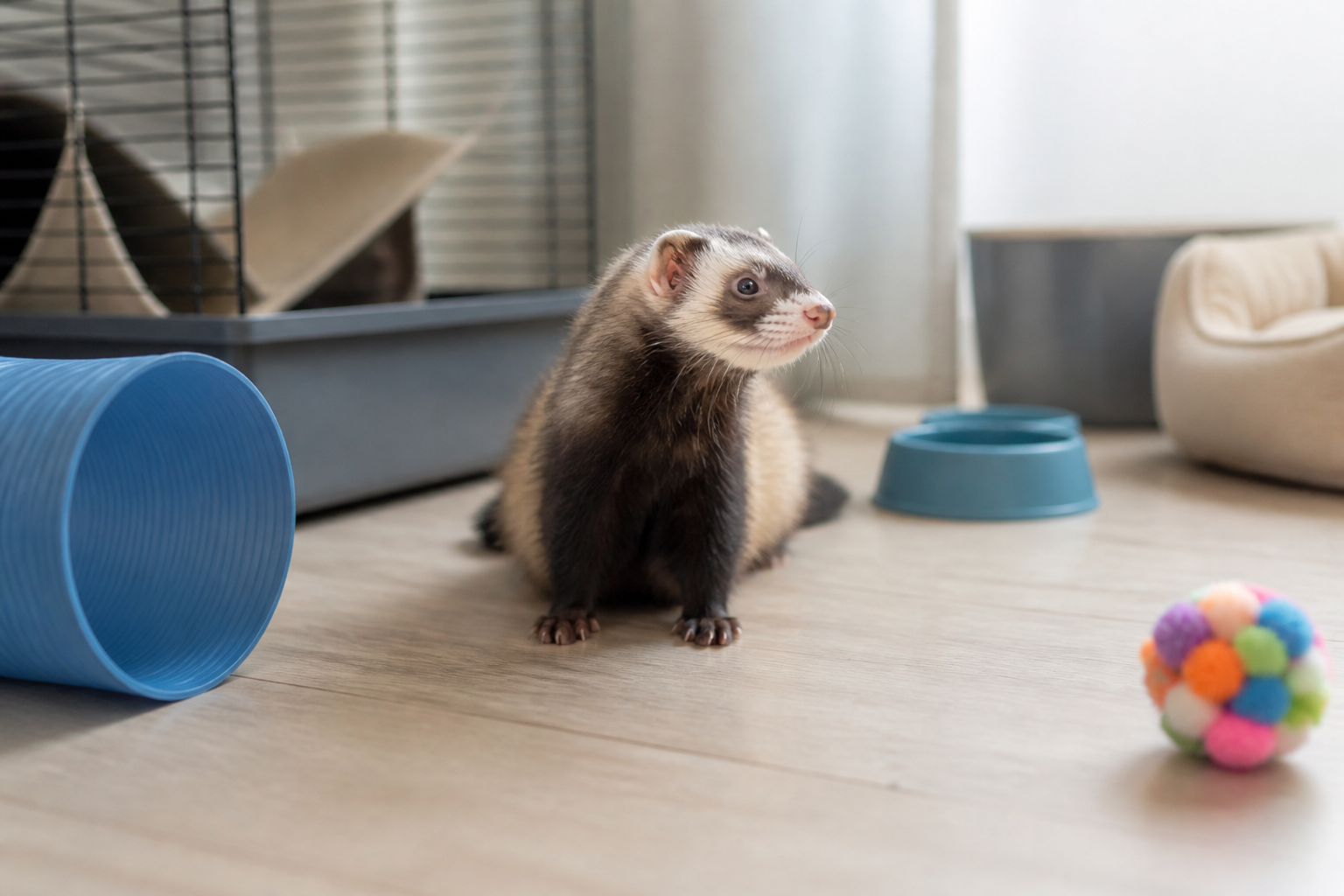
Getting a ferret used to soaked food while it is well is the single best preparation for the week it is not.
Keeping a ferret ahead of the problem
Multiple heavy bowls, refreshed daily, in the places the ferret actually spends time.
A bottle as a spare, checked by hand every day.
Some moisture in every meal, either wet food or kibble with warm water added, established as normal long before it is needed.
A ferret-proofed home, because the biggest single hydration threat is a swallowed piece of rubber. Foam, sponge, rubber bands, earplugs, silicone bakeware, shoe insoles, headphone tips and cheap soft toys all belong out of reach.
Weekly weighing when well, daily when not.
A cool room in summer, with tile or stone to lie on, a fan moving air across the room rather than onto the animal, and frozen water bottles wrapped in a towel that the ferret can choose to lie against.
An exotics or ferret-experienced vet identified in advance, with their out-of-hours arrangement noted.
What never to do
Do not syringe fluid into a weak, wobbly or collapsed ferret.
Do not give cow's milk. Ferrets do not digest lactose well and it worsens diarrhoea.
Do not use sugary drinks as routine rehydration, particularly in an older ferret, because of the insulinoma risk.
Do not give oral electrolyte solutions or any medication intended for another species without veterinary direction.
Do not assume straining in the litter tray is constipation.
Do not treat vomiting or diarrhoea in a ferret with a wait-and-see approach.
Do not cool an overheated ferret with ice or cold water immersion.
Do not rely on a single water bottle as the only supply.
My ferret hardly ever drinks. Is that normal?
Are water bottles bad for ferrets?
My ferret has diarrhoea but is bright and eating. Can I wait a day?
Can I give an oral rehydration sachet meant for people?
When to get help
Immediately for a ferret straining to urinate without producing, for collapse or seizures, for panting and flat-out weakness in warm weather, and for repeated retching with nothing produced.
Same day for any vomiting, any diarrhoea, black tarry stools, drooling, pawing at the mouth, teeth grinding, tacky gums, or a ferret that has stopped drinking.
Book promptly for gradual weight loss, symmetrical hair loss, a swollen vulva in a spayed female, increased drinking in an older ferret, or a ferret that has become a fussy eater.

Recovery is a ferret back to normal weight, drinking from the bowl unprompted, and sleeping hard between bursts of activity.
Bring the daily weights, a photograph of the stool and of any vomit, exactly what the ferret eats and drinks from, a list of everything soft and rubbery in the house that it has access to, its age, and whether it is neutered and when. In ferret medicine the combination of age and clinical signs narrows the list very quickly, and a swallowed object is always on it.
My highlights & notes
This article is for general education and is not a substitute for professional veterinary advice. If your pet is unwell, please consult a veterinarian.
Worried about your pet?
Peqaboo’s AI helps you track symptoms, understand lab reports, and know when to see a vet.
Get the Peqaboo app