

Cat Swallowed String? Don’t Pull. Read This First.
If your cat swallowed string, yarn, or dental floss, pulling it can be fatal. Learn why linear foreign bodies are dangerous, how to inspect your cat safely, and what to do next.

Quick answer
Cat Swallowed String? Don’t Pull. Read This First.
If you see string, yarn, ribbon, or dental floss hanging from your cat's mouth or rear end, If your cat swallowed string, yarn, or dental floss, pulling it can be fatal. Le Early veterinary intervention (within hours) can often prevent major, expensive abdominal surgery.
If you are reading this in a panic right now, take a deep breath. You are not overreacting, and you are doing the exact right thing by pausing to get the facts. Cats are naturally drawn to stringy things, and this is one of the most common emergencies veterinary clinics handle. Most cats make a full, beautiful recovery when their owners act quickly and avoid the common temptation to pull the thread.
- Species
- cat
- Category
- first_aid
- Risk level
- high
- Content focus
- practical owner decisions + mechanism
- When to escalate
- same-day if pain, not eating, breathing issues, or rapid decline
Decide in 60 seconds
| Situation | Do now |
|---|---|
| Mild / stable at home | Follow steps in this guide and monitor for 12–24 hours |
| Not eating, hiding, or clear pain | Same-day vet (species-savvy if exotic) |
| Breathing hard, collapse, continuous distress | Emergency vet now |
| You are unsure after reading | Call a clinic with your notes rather than waiting days |
Why it matters
To understand why string is so dangerous, you have to understand how a cat's digestive tract works. In the veterinary world, string, thread, dental floss, tinsel, and yarn are known as linear foreign bodies. Unlike a solid object like a coin or a button, a linear object behaves very differently inside your cat's body.
When a cat swallows a string, one end often becomes anchored somewhere along the line. The most common anchor point is around the base of the tongue (the frenulum) or inside the stomach exit. While one end is stuck, the rest of the string continues down into the intestines.
As the intestines try to push the free end of the string forward using normal wave-like muscle contractions (peristalsis), the string becomes taut. Because the string cannot move forward, the intestines begin to bunch up around it, crawling up the string like a sleeve being pushed up an arm. This bunching is called plication.
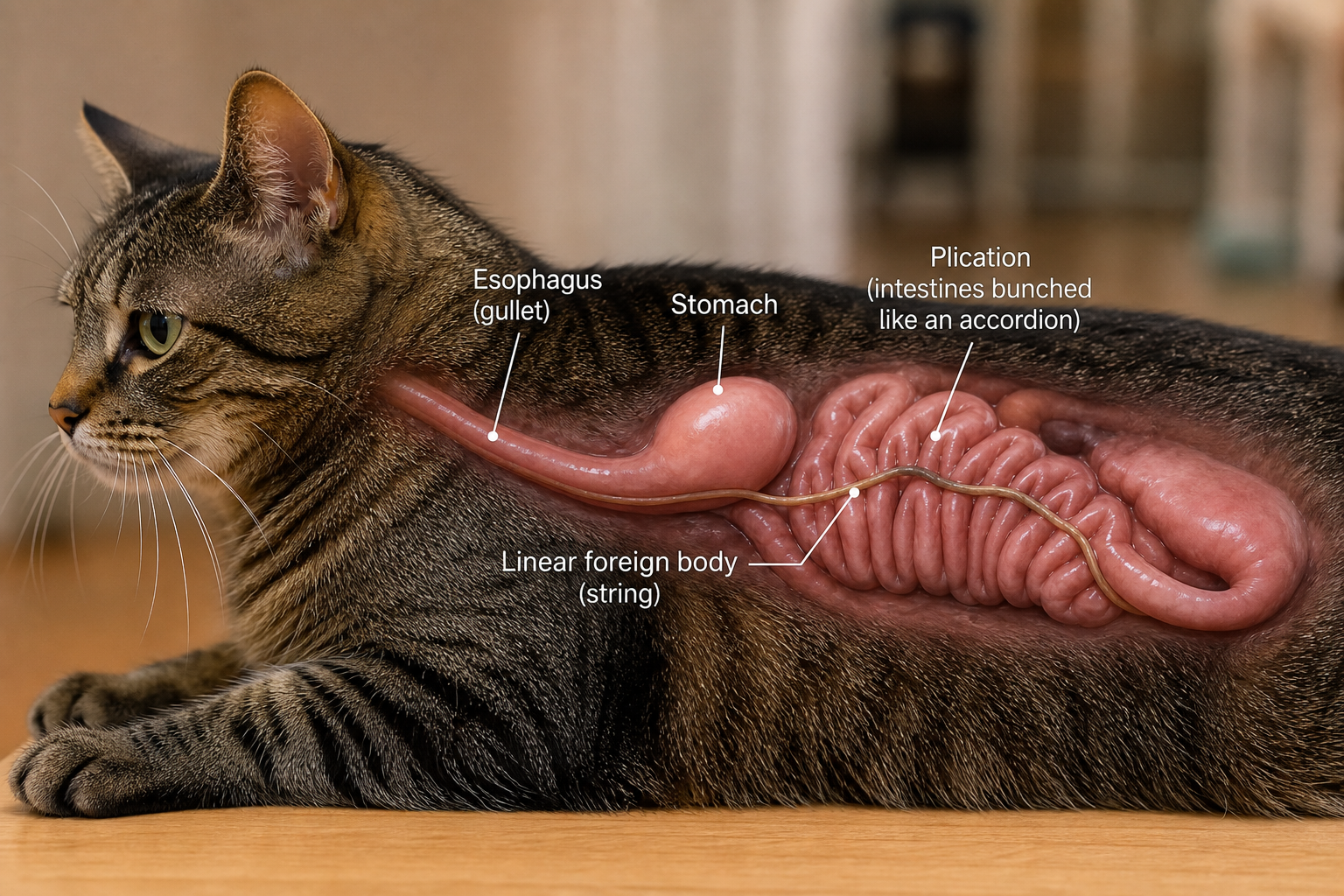
When a string is anchored, the intestines bunch up like an accordion (plication) as they try to push the string through.
Once the intestines are bunched up, the constant sawing motion of the taut string against the delicate, highly pressurized intestinal walls can slice right through the tissue. This leads to intestinal perforation, allowing bacteria, digestive fluids, and feces to leak directly into the sterile abdominal cavity. This causes a massive, life-threatening infection called peritonitis. This is why pulling the string from either end is so incredibly dangerous, you are effectively pulling a saw blade through your cat's internal organs.
Step-by-step
If you suspect or know your cat has swallowed a string, follow these steps immediately to keep them safe and prepare for the vet.
Your vet will perform a physical exam and may recommend X-rays or an ultrasound to locate the string.
Step 1: Prevent access to more string
Immediately take away any remaining string, yarn, or sewing kits. If your cat is currently chewing on a piece of string but has not swallowed it completely, gently open their mouth and remove it only if it slides out with absolutely zero resistance. If you feel even the slightest tug, stop immediately.
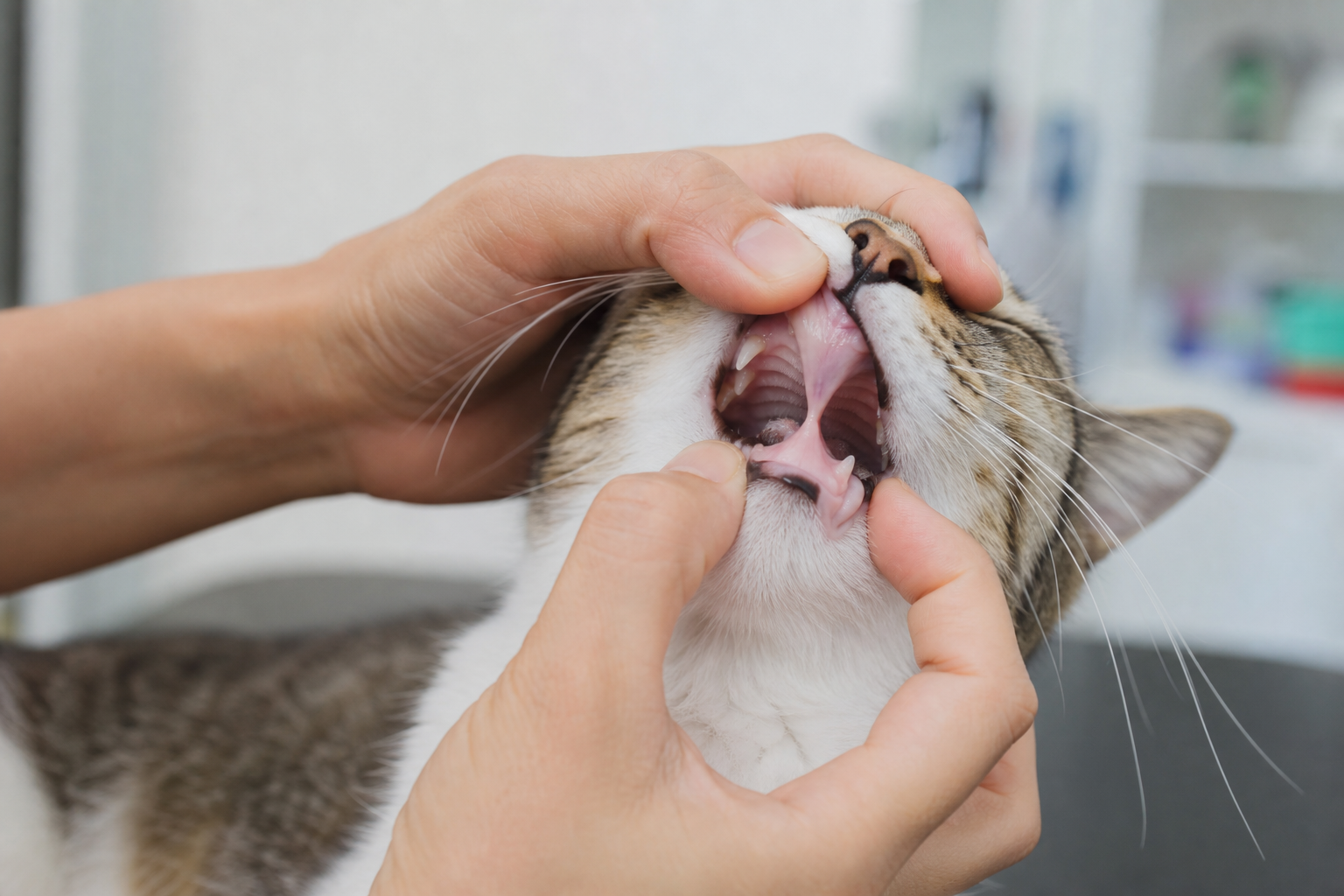
Step 2: Perform a safe mouth inspection
If your cat is cooperative, you need to check if the string is anchored under their tongue.
- Gently hold your cat's head from above, placing your thumb and index finger on either side of their upper jaw.
- Tilt their head upward slightly.
- Use your other hand to gently press down on their lower jaw to open their mouth.
- Look closely under the tongue. You are looking for a thin thread wrapped around the base of the tongue, often cutting into the flesh.
A vet will carefully check under the tongue, where swallowed strings frequently get caught and anchored.
Step 3: Check the rear end
If you suspect the string was swallowed hours or days ago, gently lift your cat's tail. If you see a piece of string protruding from their anus, do not pull it. Do not try to tape it down. If it is long and getting dirty, you can use clean scissors to snip it close to the fur, but leave enough visible so the vet can see it.
Step 4: Isolate and monitor your cat
Place your cat in a quiet, safe room (like a bathroom or bedroom) with their litter box, fresh water, and a comfortable bed. This prevents them from hiding under heavy furniture where you cannot monitor them or access them quickly when it is time to leave for the clinic.
Step 5: Call your vet or an emergency clinic
Call your primary care veterinarian or the nearest emergency veterinary hospital. Tell them exactly what kind of string was swallowed (e.g., sewing thread with a needle, stretchy ribbon, dental floss), how long ago it happened, and whether your cat is showing any physical symptoms.
Your vet will perform a physical exam and may recommend X-rays or an ultrasound to locate the string.
Signs something's wrong
Sometimes, owners do not catch their cat in the act of swallowing string. You might only suspect it because your sewing kit is messy or a package ribbon is missing. If your cat has swallowed a linear foreign body and it is starting to cause damage, you will notice very specific clinical signs.
Keep a close eye out for these red flags:
- Repeated vomiting: This is the most common sign. Your cat may vomit food, bile, or even water. They will be unable to keep anything down.
- Loss of appetite (anorexia): A cat with an intestinal blockage will refuse to eat their favorite wet food or treats.
- Lethargy and hiding: Your cat may look weak, sleep excessively, or hide in dark, unusual places.
- Abdominal pain: If you try to pick up your cat or touch their belly, they may growl, hiss, bite, or tense up their abdominal muscles.
- Hunched posture: A cat in pain will often sit hunched over with their paws tucked tightly under their chest, head hanging low.
- Dehydration: Their gums may feel dry or tacky to the touch rather than wet and slippery.
- Straining to defecate: They may visit the litter box frequently, straining without producing any stool, or passing small amounts of liquid diarrhea.
When to call your vet
This is not a situation where you should "wait and see" at home. You should call your vet immediately if:
- You saw your cat swallow any amount of thread, yarn, dental floss, or ribbon.
- You see string protruding from your cat's mouth or anus.
- Your cat is showing any of the symptoms listed above (vomiting, lethargy, abdominal pain).
- You suspect your cat swallowed a needle along with sewing thread (this is a double emergency, as the needle can easily pierce the stomach or esophagus).
If the ingestion happened within the last 1 to 2 hours, your vet may be able to safely induce vomiting under controlled medical supervision, or use an endoscope (a tiny camera with a grabbing tool) to retrieve the string from the stomach before it ever enters the intestines. This is a quick, non-invasive procedure that saves your cat from major surgery and saves you thousands of dollars in veterinary bills.
With prompt veterinary care, most cats make a full and comfortable recovery after string removal.
Common mistakes
When owners panic, they often make well-intentioned mistakes that can drastically worsen their cat's prognosis. Avoid these critical errors:
- Pulling the string: This cannot be overstated. Even if the string slides out easily at first, it can suddenly snag deep inside, and a single tug can slice through the intestines.
- Using home remedies to induce vomiting: Never give your cat hydrogen peroxide, salt water, or mustard to make them throw up. Hydrogen peroxide causes severe, necrotizing gastritis (tissue death in the stomach lining) in cats and can be fatal.
- Giving laxatives or petroleum jelly: Do not try to "grease" the tract with butter, mineral oil, or hairball remedies. These will not help a string that is anchored under the tongue or already causing plication, and they can cause your cat to inhale oil into their lungs, leading to deadly aspiration pneumonia.
- Waiting for the string to pass: The longer a linear foreign body remains in the digestive tract, the more damage it does. What could have been a simple endoscopic retrieval on day one can easily turn into a complex, multi-site intestinal resection surgery on day three.
What good looks like
If you act quickly, the outlook for your cat is incredibly bright. When caught early, many cats have the string successfully removed via endoscopy or minor surgery and are back to their normal, playful selves within a few days.
If your cat does require surgery (an enterotomy to open the intestine and remove the string, or a resection and anastomosis to remove a damaged section of the intestine), they will typically stay in the hospital for 24 to 72 hours for pain management, intravenous fluids, and monitoring.
Once they come home, good recovery looks like:
- Strict rest: Keeping your cat in a small room or crate to prevent jumping and running, which could tear their abdominal stitches.
- An Elizabethan collar (cone): Keeping the cone on at all times to prevent them from licking or chewing at their incision.
- Bland diet: Feeding small, frequent meals of highly digestible veterinary recovery food or plain boiled chicken breast as directed by your vet.
- Pain control: Administering all prescribed pain medications and antibiotics exactly as scheduled.
Within a week or two, the incision will heal, their appetite will return with a vengeance, and you will have your happy, purring companion back. You did the absolute right thing by stopping, researching, and protecting your cat from a dangerous mistake. By keeping your cool and calling your vet, you are giving your cat the very best chance at a fast, safe recovery.
Living context by region
This guide is written for multi-region English readers (US/UK/AU/NZ/CA/EU and more). Where climate, products, or vet access differ, prefer local veterinary advice and local product labels. Use metric first; keep °F/lb in mind for North American homes.
When to call your vet
-
Signs are getting worse over hours, not better
-
Pain, persistent vomiting/diarrhea, or neurological signs
-
You needed force or guesswork to keep going at home
Common mistakes
-
Waiting because the animal 'still looks okay' while prey species hide pain
-
Changing five variables at once so you cannot tell what helped
-
Copying drug doses from social media
-
Skipping species-appropriate husbandry while buying more gadgets
FAQ
How urgent is Cat Swallowed String? Don’t Pull. Read This First.?
Can I wait and see overnight?
Do home remedies replace a vet?
What should I bring to the vet?
My highlights & notes
This article is for general education and is not a substitute for professional veterinary advice. If your pet is unwell, please consult a veterinarian.
Worried about your pet?
Peqaboo’s AI helps you track symptoms, understand lab reports, and know when to see a vet.
Get the Peqaboo app