

Target Training for Birds: The Foundation Skill Behind Every Trick
Target training teaches your bird to touch a stick for a reward, giving you a force-free way to guide it into carriers, onto scales and through tricks. Here is the simple step-by-step method and how to turn it into real-life skills.

Quick answer

Target Training for Birds: The Foundation Skill Behind Every Trick
Target training teaches your bird to touch a small stick (the target) with its beak for a reward. It is the single most useful foundation skill in bird training: once your bird follows a target, you can guide it in and out of a carrier, onto a scale, through tricks, and away from trouble, all without force. It is gentle, quick to start, and works for almost every bird.
- The target is just a stick, a chopstick, a dowel or a purpose-made target rod. The tip is what your bird touches.
- Every touch earns an instant reward, so your bird learns that following the stick pays.
- Target training is force-free and works for shy birds, because the bird always chooses to move toward the target.
- Once established, it becomes the "steering wheel" for stationing, crate training, scales and trick training.
- Species
- bird
- Category
- training
- Risk level
- low
- Content focus
- practical owner decisions + mechanism
- When to escalate
- same-day if pain, not eating, breathing issues, or rapid decline
Decide in 60 seconds
| Situation | Do now |
|---|---|
| Mild / stable at home | Follow steps in this guide and monitor for 12–24 hours |
| Not eating, hiding, or clear pain | Same-day vet (species-savvy if exotic) |
| Breathing hard, collapse, continuous distress | Emergency vet now |
| You are unsure after reading | Call a clinic with your notes rather than waiting days |
What you need
You need three things: a target (any clean, safe stick with a distinct tip), a reward your bird loves and gets only in training, and optionally a "marker" (a short word like "yes" or a clicker) to mark the exact instant of the correct touch. Keep sessions short, a few minutes at most, and pick a calm time when your bird is a little hungry and attentive.
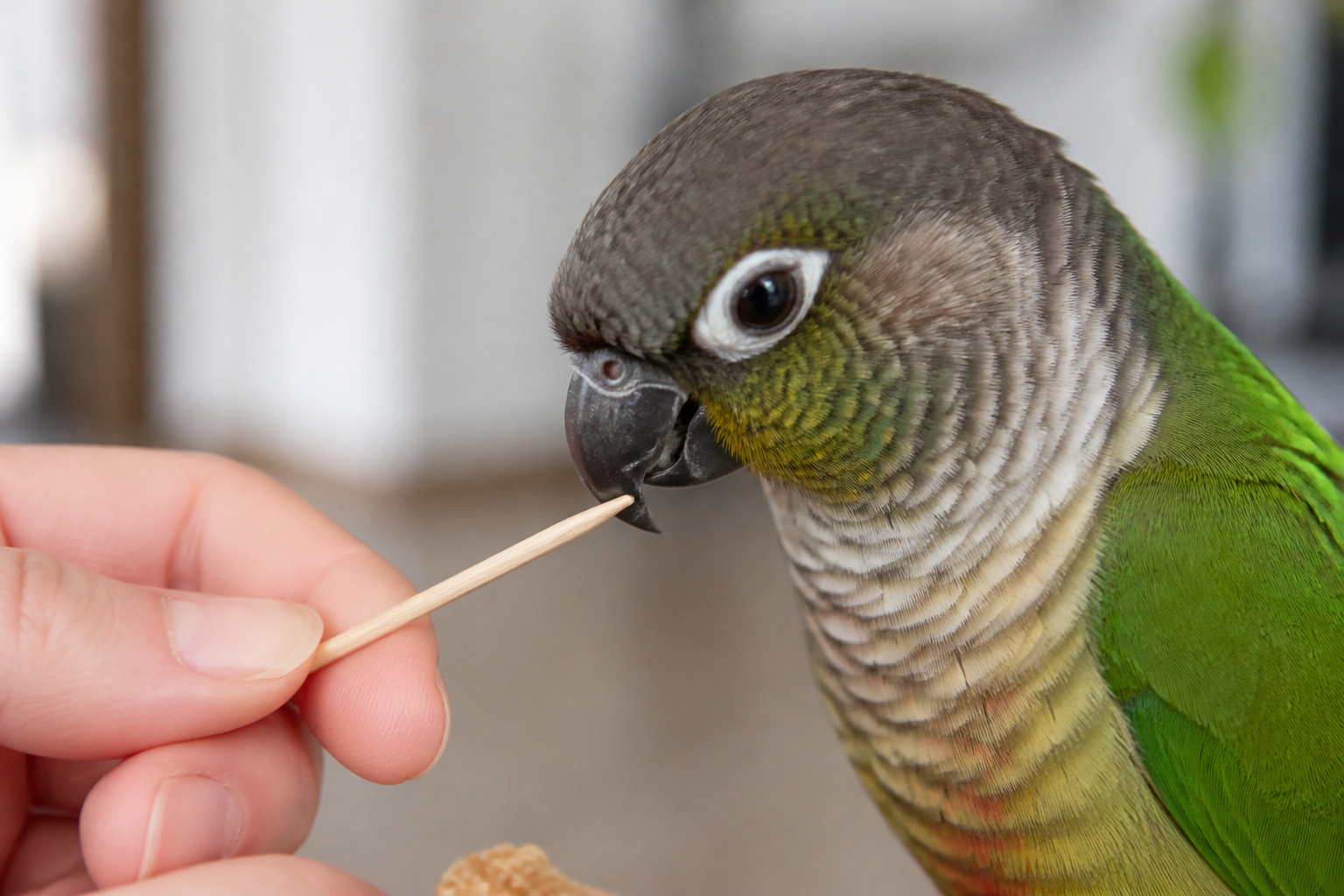
Mark and reward the instant the beak touches the tip; timing is everything.
Teach the touch, step by step
- Present the target tip near the beak. Hold it a centimetre or two from your bird, not touching. Most birds investigate a new object with the beak.
- Mark and reward the touch. The instant the beak contacts the tip, say your marker word (or click) and give the reward. Timing is everything.
- Repeat until it is deliberate. After several reps your bird stops investigating by accident and starts touching on purpose to earn the treat.
- Move the target a little. Present it slightly to one side, then a step away, so your bird moves toward it to touch. Now you are steering.
- Add distance and direction. Lead your bird along a perch, onto a scale, or a short way toward an open carrier, always rewarding the touch.
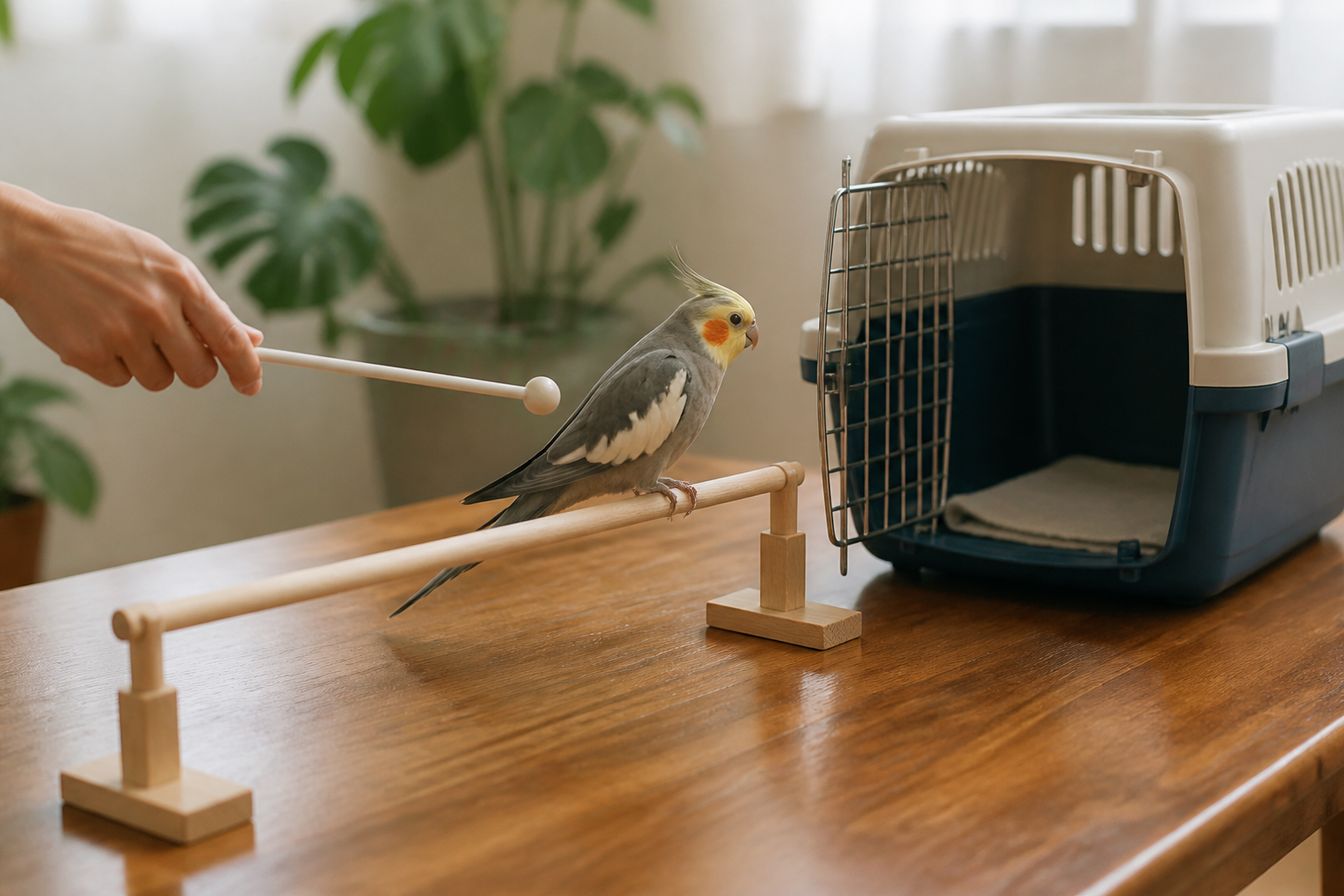
A solid target turns carrier and scale training into calm, force-free routines.
Turning the target into real-life skills
Because the target reliably moves your bird, it unlocks the practical stuff. Guide a nervous bird onto a gram scale for weekly weigh-ins. Lead a reluctant bird calmly into its travel carrier before a vet visit, so transport is not a wrestling match. Teach it to "station" on a spot while you clean the cage. Later, the same touch builds turns, wave, and other tricks. Every one of these is safer and kinder than herding or grabbing.
Keep the momentum
Practise in tiny, frequent sessions and always end while your bird is keen. Once the target is solid indoors, you can use it anywhere calm. It is the tool that makes almost every other lesson easier.
Living context by region
This guide is written for multi-region English readers (US/UK/AU/NZ/CA/EU and more). Where climate, products, or vet access differ, prefer local veterinary advice and local product labels. Use metric first; keep °F/lb in mind for North American homes.
When to call your vet
-
Signs are getting worse over hours, not better
-
Pain, persistent vomiting/diarrhea, or neurological signs
-
You needed force or guesswork to keep going at home
Common mistakes
-
Waiting because the animal 'still looks okay' while prey species hide pain
-
Changing five variables at once so you cannot tell what helped
-
Copying drug doses from social media
-
Skipping species-appropriate husbandry while buying more gadgets
FAQ
What age or species can start target training?
Do I need a clicker?
My bird bites the target instead of touching it. Is that a problem?
How is this different from step up?
My highlights & notes
This article is for general education and is not a substitute for professional veterinary advice. If your pet is unwell, please consult a veterinarian.
Worried about your pet?
Peqaboo’s AI helps you track symptoms, understand lab reports, and know when to see a vet.
Get the Peqaboo app