

Teaching Your Bird to Step Up: The First Trust-Building Cue
Step up lets you move your bird safely without chasing or grabbing, and it is the foundation of every other skill. Learn a calm, reward-based method that builds trust, avoids force, and stops the fear that leads to biting.

Quick answer

Teaching Your Bird to Step Up: The First Trust-Building Cue
"Step up" is teaching your bird to climb calmly onto your finger or a hand-held perch on a simple cue. It is the single most useful thing you can teach, because it lets you move your bird safely without chasing or grabbing. Work in short, calm sessions, reward every small win, and never force it. A bird that chooses to step up trusts you, and trust is what prevents biting.
- Step up is the foundation cue: it makes vet trips, cage changes and out-of-cage time safe and stress-free.
- Rewards win faster than pressure. A favourite treat your bird only gets during training is your best tool.
- Never push your hand into a bird's chest to force the step. Forcing teaches fear, and fear teaches biting.
- Keep sessions to a few minutes, once or twice a day, and always end on a success.
- Species
- bird
- Category
- training
- Risk level
- low
- Content focus
- practical owner decisions + mechanism
- When to escalate
- same-day if pain, not eating, breathing issues, or rapid decline
Decide in 60 seconds
| Situation | Do now |
|---|---|
| Mild / stable at home | Follow steps in this guide and monitor for 12–24 hours |
| Not eating, hiding, or clear pain | Same-day vet (species-savvy if exotic) |
| Breathing hard, collapse, continuous distress | Emergency vet now |
| You are unsure after reading | Call a clinic with your notes rather than waiting days |
Before you start: read the bird
Pick a calm time of day, ideally when your bird is a little food-motivated but not frantic. Find the treat your bird loves most (a piece of millet for a budgie or cockatiel, a sunflower or safflower seed, a sliver of nut for a bigger parrot) and reserve it strictly for training. Watch body language: relaxed feathers and interest mean go; pinned eyes, a raised foot, an open beak or leaning away mean slow down. A bird that is telling you to back off will bite if you push on.

Let your bird take treats from your fingers first so your hand signals safety, not threat.
Step-by-step from outside the cage
Start with a settled, tame-ish bird on a perch or play stand rather than deep in the cage, where many birds are territorial.
- Offer the treat first. Let your bird take the treat from your fingers a few times so your hand means good things.
- Present your finger (or a perch). Hold a steady finger just above the feet, gently against the lower chest, so stepping up is the easy path to the treat held just beyond.
- Say the cue once. A calm, consistent "step up" as the bird shifts its weight forward.
- Reward the instant a foot lands. Even one foot on your finger earns the treat and warm praise at first.
- Build to both feet, then a lift. Over sessions, ask for both feet, then a short lift, then a little carry.
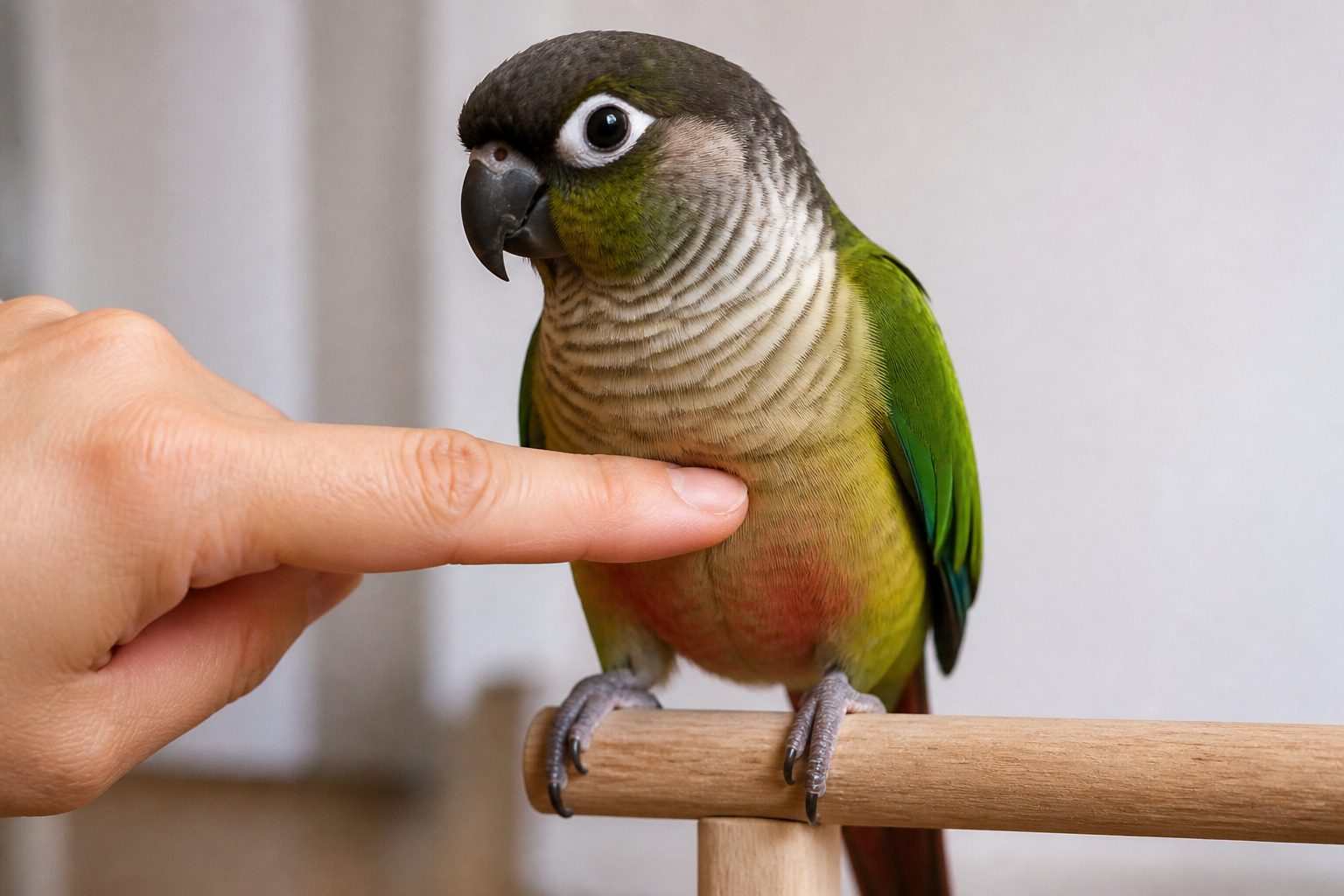
A still finger just above the feet makes stepping up the easy, natural choice.
If your bird bites instead of stepping
Biting almost always means the bird felt cornered, unsteady or pushed too fast. Do not jerk your hand away (that teaches your bird that biting works and makes it a fun game), and do not shout or tap the beak. Instead, stay calm, slow right down, and go back a step to plain treat-taking for a session or two. Rebuild the good association before asking for the foot again.
Keep it consistent
Everyone in the home should use the same cue word and the same gentle method. Practise a little every day, always ending while your bird is still keen, and soon step up becomes an automatic, happy response rather than a negotiation.
Living context by region
This guide is written for multi-region English readers (US/UK/AU/NZ/CA/EU and more). Where climate, products, or vet access differ, prefer local veterinary advice and local product labels. Use metric first; keep °F/lb in mind for North American homes.
When to call your vet
-
Signs are getting worse over hours, not better
-
Pain, persistent vomiting/diarrhea, or neurological signs
-
You needed force or guesswork to keep going at home
Common mistakes
-
Waiting because the animal 'still looks okay' while prey species hide pain
-
Changing five variables at once so you cannot tell what helped
-
Copying drug doses from social media
-
Skipping species-appropriate husbandry while buying more gadgets
FAQ
How long until my bird steps up reliably?
Should I train inside or outside the cage?
My bird uses its beak on my finger before stepping up. Is that biting?
What treat works best?
My highlights & notes
This article is for general education and is not a substitute for professional veterinary advice. If your pet is unwell, please consult a veterinarian.
Worried about your pet?
Peqaboo’s AI helps you track symptoms, understand lab reports, and know when to see a vet.
Get the Peqaboo app