

Foraging for Birds: Turning Mealtime Into Mental Enrichment
Wild birds spend hours a day finding food; a bowl handed on a plate leaves a pet bird bored. Foraging makes your bird work for meals, easing boredom, plucking and screaming. Here is how to start simply and build up.

Quick answer

Foraging for Birds: Turning Mealtime Into Mental Enrichment
Foraging means making your bird work to find and get at its food instead of eating from an open bowl. In the wild, birds spend much of the day searching for meals, so a full bowl handed over in seconds leaves a smart pet bird bored , and boredom feeds feather-plucking, screaming and other problem behaviours. Start easy so your bird succeeds, then gradually make it harder. Foraging is one of the simplest, cheapest ways to enrich a bird's day, and most birds take to it quickly.
- Wild birds forage for hours daily; an easy bowl leaves a pet bird under-stimulated.
- Foraging helps prevent and reduce boredom-driven plucking, screaming and stereotypies.
- Start easy , food half-covered , so your bird learns "working = reward" before it gets hard.
- Never let a bird go hungry because it cannot solve a feeder; always ensure it is actually eating.
- Species
- bird
- Category
- behavior
- Risk level
- low
- Content focus
- practical owner decisions + mechanism
- When to escalate
- same-day if pain, not eating, breathing issues, or rapid decline
Decide in 60 seconds
| Situation | Do now |
|---|---|
| Mild / stable at home | Follow steps in this guide and monitor for 12–24 hours |
| Not eating, hiding, or clear pain | Same-day vet (species-savvy if exotic) |
| Breathing hard, collapse, continuous distress | Emergency vet now |
| You are unsure after reading | Call a clinic with your notes rather than waiting days |
Why foraging matters
Birds are intelligent, active animals built to spend their days searching, manipulating and problem-solving for food. A pet bird that gets a full bowl handed to it has that entire natural job removed, leaving hours of empty time. That vacuum is where feather-destructive behaviour, excessive screaming and repetitive pacing often grow. Foraging gives the brain and beak a job again , it is enrichment disguised as dinner.
Start ridiculously easy
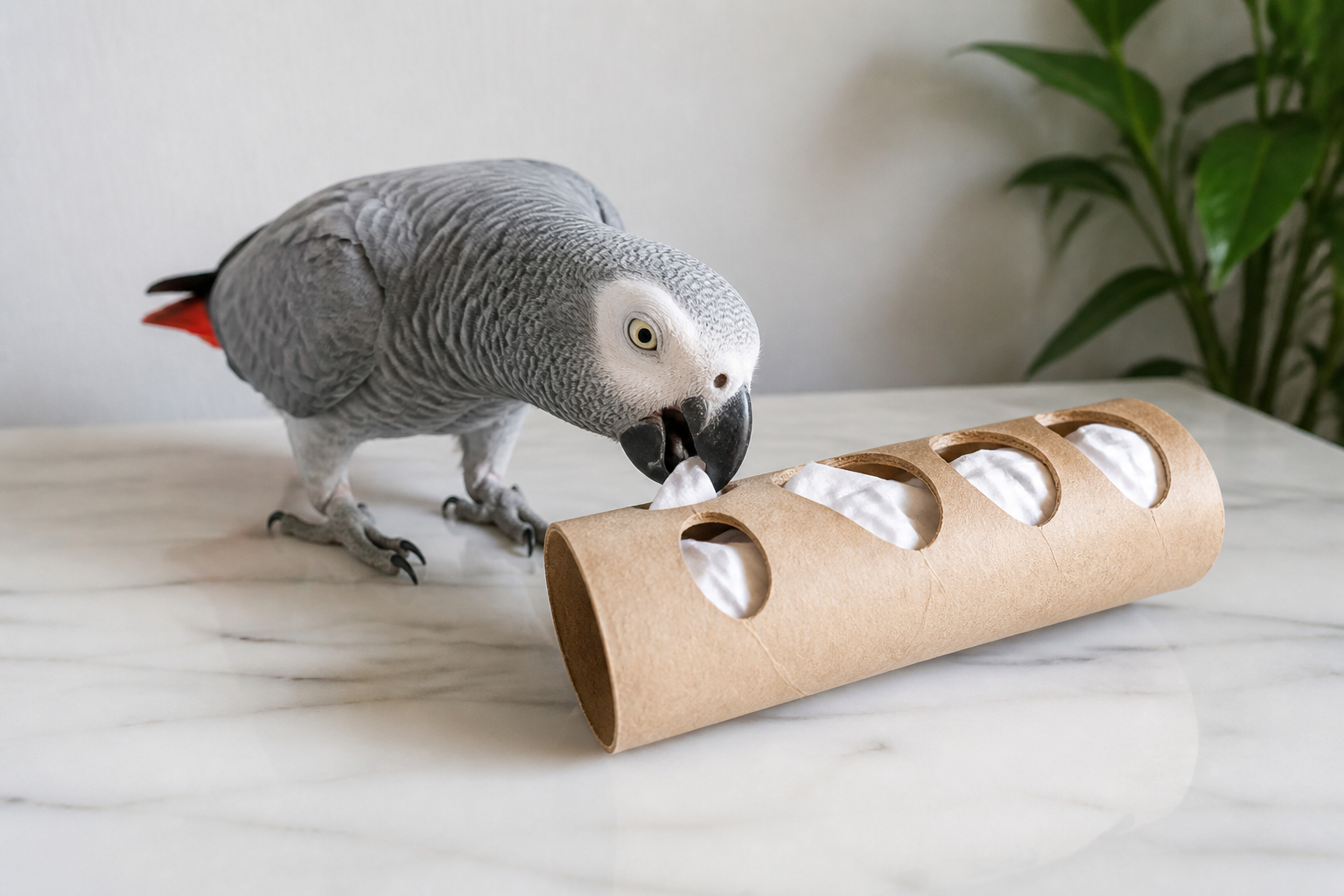
The biggest mistake is making it too hard too soon, so the bird gives up. Begin with food your bird can clearly see and almost reach: sprinkle treats over a piece of paper on top of the bowl, or half-cover the bowl. The goal at this stage is simply teaching "if I work a little, food appears". Only once your bird confidently uncovers food do you add difficulty.
You do not need fancy gear , treats wrapped in plain paper or hidden in a cardboard tube work beautifully.
Build up the challenge
As your bird gets the hang of it, raise the difficulty step by step: wrap treats in plain paper twists, tuck food into cardboard tubes, hide portions in several spots around the cage, then move on to shop-bought puzzle feeders and foraging wheels. Rotate the toys and hiding spots to keep it novel , a foraging setup that never changes soon gets boring too.
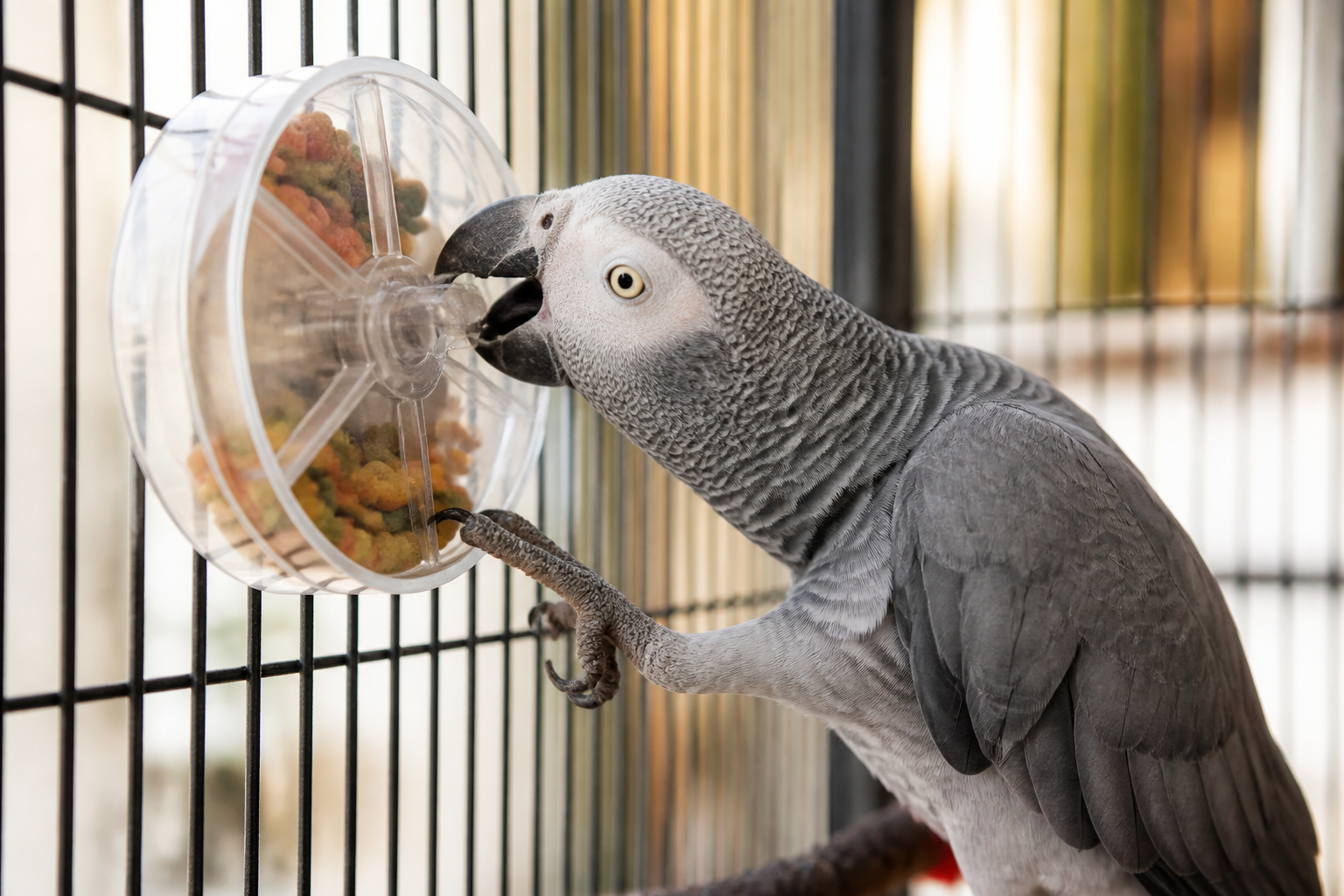
A puzzle feeder makes your bird work for food the way it would in the wild , the goal is effort, not just eating.
Keep it safe
Use only bird-safe materials: plain undyed paper, plain cardboard, and toys made for birds. Avoid glossy printed paper, staples, small parts that could be swallowed, string or fibres that can tangle around toes, and anything mouldy. Watch a new foraging toy the first few times to be sure your bird is getting food out and not just frustrated or ignoring its meals.
Make it part of every day
Once your bird is a confident forager, build it into normal routine: serve part of the daily diet through foraging rather than a bowl, scatter-feed some pellets, and set up a fresh foraging challenge before you leave the house so your bird has a job while you are out. A few minutes of setup buys hours of healthy occupation.
Living context by region
This guide is written for multi-region English readers (US/UK/AU/NZ/CA/EU and more). Where climate, products, or vet access differ, prefer local veterinary advice and local product labels. Use metric first; keep °F/lb in mind for North American homes.
When to call your vet
-
Signs are getting worse over hours, not better
-
Pain, persistent vomiting/diarrhea, or neurological signs
-
You needed force or guesswork to keep going at home
Common mistakes
-
Waiting because the animal 'still looks okay' while prey species hide pain
-
Changing five variables at once so you cannot tell what helped
-
Copying drug doses from social media
-
Skipping species-appropriate husbandry while buying more gadgets
FAQ
Will foraging stop my bird plucking or screaming?
How much of the diet should come from foraging?
My bird destroys the foraging toy instead of eating , is that bad?
Can I forage-feed a nervous or older bird?
My highlights & notes
This article is for general education and is not a substitute for professional veterinary advice. If your pet is unwell, please consult a veterinarian.
Worried about your pet?
Peqaboo’s AI helps you track symptoms, understand lab reports, and know when to see a vet.
Get the Peqaboo app