

Why Your Bird Turns Into a Monster Near Its Cage (Cage Territoriality)
A bird that is sweet on your shoulder but lunges and bites the second you go near its cage is not broken , it is defending territory. Here is why cage aggression happens and how to handle it without wrecking trust.

Quick answer

Why Your Bird Turns Into a Monster Near Its Cage (Cage Territoriality)
If your bird cuddles happily away from its cage but turns into a lunging, biting terror when you reach in or come near it, that is cage territoriality , a normal instinct to defend its home base, not spite or a personality flaw. The fix is to stop fighting over the cage: use a hand-held perch instead of your bare hand, interact on neutral ground away from the cage, and rebuild positive associations with your approach. Bites that break skin, or a sudden new aggression, are worth a vet check to rule out pain or hormones.
- Cage aggression is territorial defence , the same bird is often gentle away from the cage.
- Reaching a bare hand into a defended cage teaches the bird that biting makes hands retreat.
- A hand-held perch ("step-up stick") lets you move the bird without a territory battle.
- A sudden change from friendly to aggressive can be hormonal or painful , worth a vet check.
- Species
- bird
- Category
- behavior
- Risk level
- medium
- Content focus
- practical owner decisions + mechanism
- When to escalate
- same-day if pain, not eating, breathing issues, or rapid decline
Decide in 60 seconds
| Situation | Do now |
|---|---|
| Mild / stable at home | Follow steps in this guide and monitor for 12–24 hours |
| Not eating, hiding, or clear pain | Same-day vet (species-savvy if exotic) |
| Breathing hard, collapse, continuous distress | Emergency vet now |
| You are unsure after reading | Call a clinic with your notes rather than waiting days |
Why the cage brings out the worst
In the wild, a nest or roosting cavity is worth defending hard , it is safety and, in season, breeding real estate. Your bird's cage is that core territory. Many birds are relaxed out on a stand or your shoulder but flip to defensive the instant you invade the cage or its immediate surroundings. Hormonal birds and those with a favourite cage "mate" (a person, mirror or hut) defend even more fiercely.

What makes it worse
The most common mistake is a battle of hands. When you push a bare hand in and pull back after a bite, the bird learns that biting works , hands retreat. Grabbing, cornering or "toughing it out" raises fear and aggression together. So does a cage packed with nesty huts and hidey-holes, or a cage jammed against a wall where the bird feels forced to make a stand.
Use a perch, not your hand
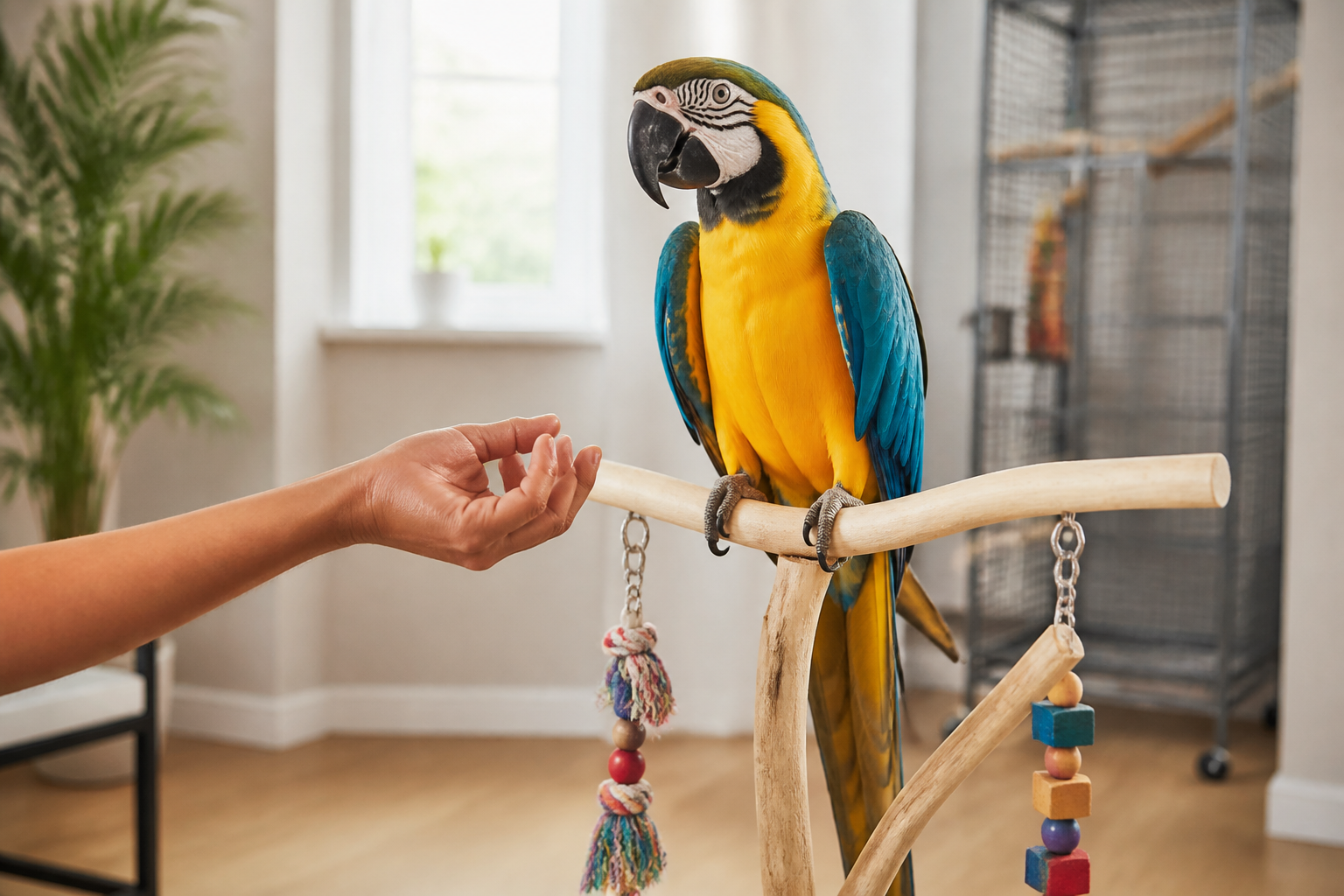
The single most useful tool is a hand-held perch. Teach step-up onto a stick away from the cage first, then use that stick to invite your bird out of the cage. You get the bird moved without shoving a hand into contested space, and the bird gets a calm, repeatable routine instead of a fight.
A hand-held perch lets a cage-defensive bird come out without you reaching into its territory.
Interact on neutral ground
Birds are usually far friendlier away from the cage. Move training, cuddles and treats to a play stand, a T-perch or another room where the bird has no territory to defend. Once your bird is out and relaxed on neutral ground, handling is easier and you can rebuild positive feelings before returning it home.
On neutral ground away from the cage, the same bird is usually far friendlier and easier to handle.
Rebuild good feelings about your approach
Change the pattern so your hand near the cage predicts good things, not conflict. Drop a favourite treat through the bars as you pass, talk warmly, and avoid unnecessary reaching in. Do cleaning and food changes when the bird is out or occupied. Reducing nest triggers , removing huts, cutting long light hours, and pulling the cage slightly off the wall so it feels less like a den , lowers the drive to defend.
Living context by region
This guide is written for multi-region English readers (US/UK/AU/NZ/CA/EU and more). Where climate, products, or vet access differ, prefer local veterinary advice and local product labels. Use metric first; keep °F/lb in mind for North American homes.
When to call your vet
-
Signs are getting worse over hours, not better
-
Pain, persistent vomiting/diarrhea, or neurological signs
-
You needed force or guesswork to keep going at home
Common mistakes
-
Waiting because the animal 'still looks okay' while prey species hide pain
-
Changing five variables at once so you cannot tell what helped
-
Copying drug doses from social media
-
Skipping species-appropriate husbandry while buying more gadgets
FAQ
Should I punish my bird for cage biting?
Will rearranging or moving the cage help?
My bird only guards the cage during certain months , why?
Is it safe to just leave the cage door open all the time?
My highlights & notes
This article is for general education and is not a substitute for professional veterinary advice. If your pet is unwell, please consult a veterinarian.
Worried about your pet?
Peqaboo’s AI helps you track symptoms, understand lab reports, and know when to see a vet.
Get the Peqaboo app