

How to Bond With Your Bird: Earning Trust and Becoming a Flock Member
Bonding with a bird is not about forcing cuddles , it is about becoming a safe, predictable flock member your bird chooses to trust. This step-by-step guide moves from simply sharing space to hand taming, step-up and daily connection, always at your bird's own pace.

Quick answer

How to Bond With Your Bird: Earning Trust and Becoming a Flock Member
Birds bond through trust, not treats alone, and trust is built by being calm, predictable and never forcing contact. Start by simply existing near your bird without demands, let it approach food from your hand on its own terms, then build up to step-up training. Rushed grabbing or chasing sets you back weeks. For most birds the whole process takes days to months depending on species and history , a hand-raised budgie may warm up in a week; a rehomed parrot may take a season.
- Birds are prey animals , sudden movement, looming hands and direct staring read as "predator".
- Trust is the bird's choice; your job is to be safe and consistent enough that it chooses you.
- Food shared from your hand is the single fastest bridge , find your bird's favourite treat.
- Never grab, chase or "flood" a scared bird into contact; fear undoes bonding fast.
- Species
- bird
- Category
- behavior
- Risk level
- low
- Content focus
- practical owner decisions + mechanism
- When to escalate
- same-day if pain, not eating, breathing issues, or rapid decline
Decide in 60 seconds
| Situation | Do now |
|---|---|
| Mild / stable at home | Follow steps in this guide and monitor for 12–24 hours |
| Not eating, hiding, or clear pain | Same-day vet (species-savvy if exotic) |
| Breathing hard, collapse, continuous distress | Emergency vet now |
| You are unsure after reading | Call a clinic with your notes rather than waiting days |
Step 1: Share space and let the cage settle
For a new bird, do nothing demanding for the first days. Place the cage in a calm, social part of the home , not isolated, not in a busy doorway , at roughly chest height so you are not looming over it. Talk softly, move slowly, and let your bird watch normal household life. You are proving you are safe before you ever ask for anything.
Step 2: Build positive associations with food
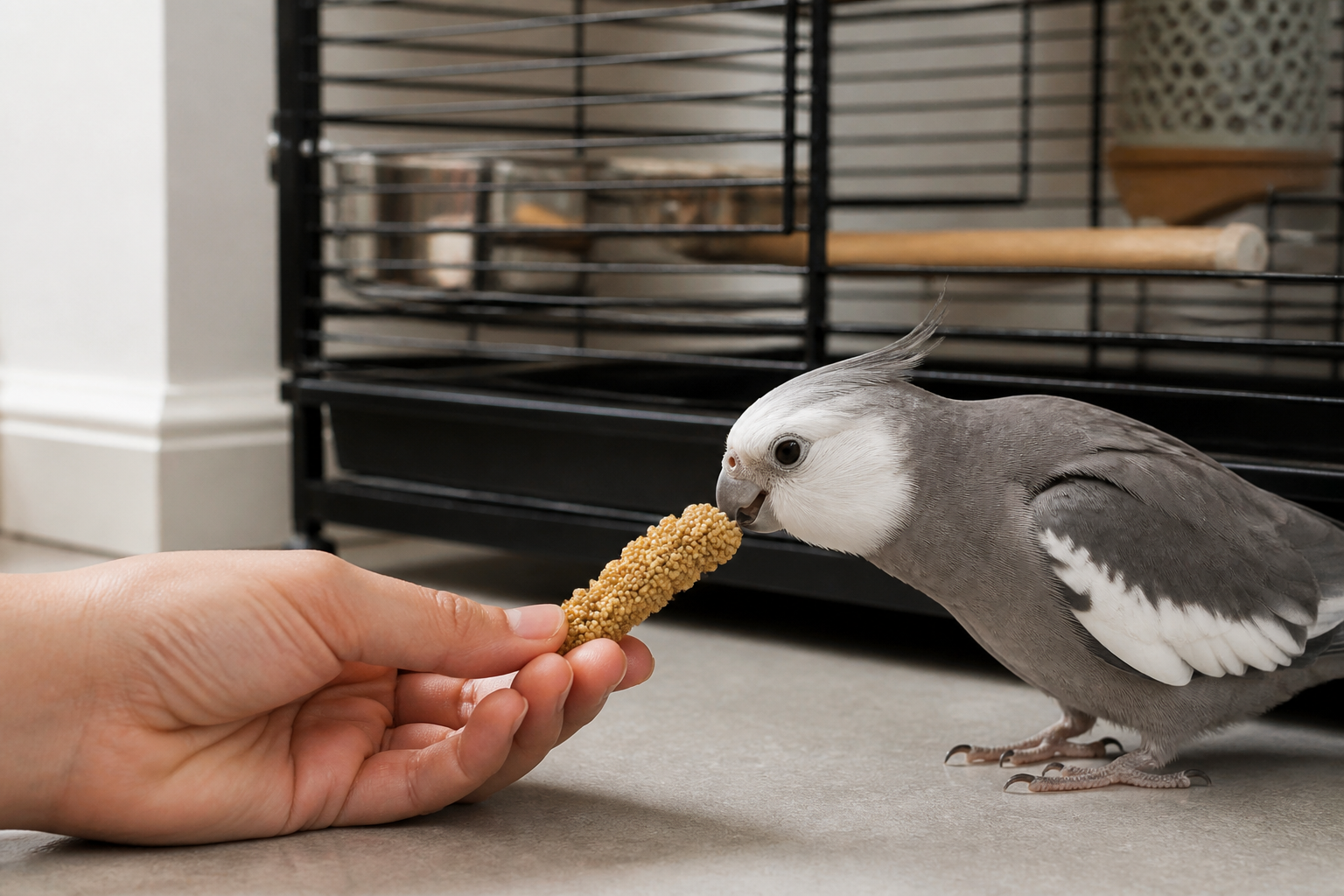
Once your bird eats, preens and moves normally in your presence, start linking you with good things. Offer a favourite treat , millet spray, a piece of the right fruit, a sunflower seed , first through the bars, then from a still open hand just inside the cage. Let the bird choose to come; do not push your hand toward it.
Offering a favourite treat from a still hand lets the bird set the pace , trust is the bird's decision, not yours.
Step 3: Teach "step up"
When your bird calmly takes food from your hand, you can introduce step-up. Present a steady finger or perch low against the bird's chest, just above its feet, and pair it with a cue word and a reward. Keep sessions short , a few minutes, ending on a win. Never jab the hand upward or chase the bird around the cage.
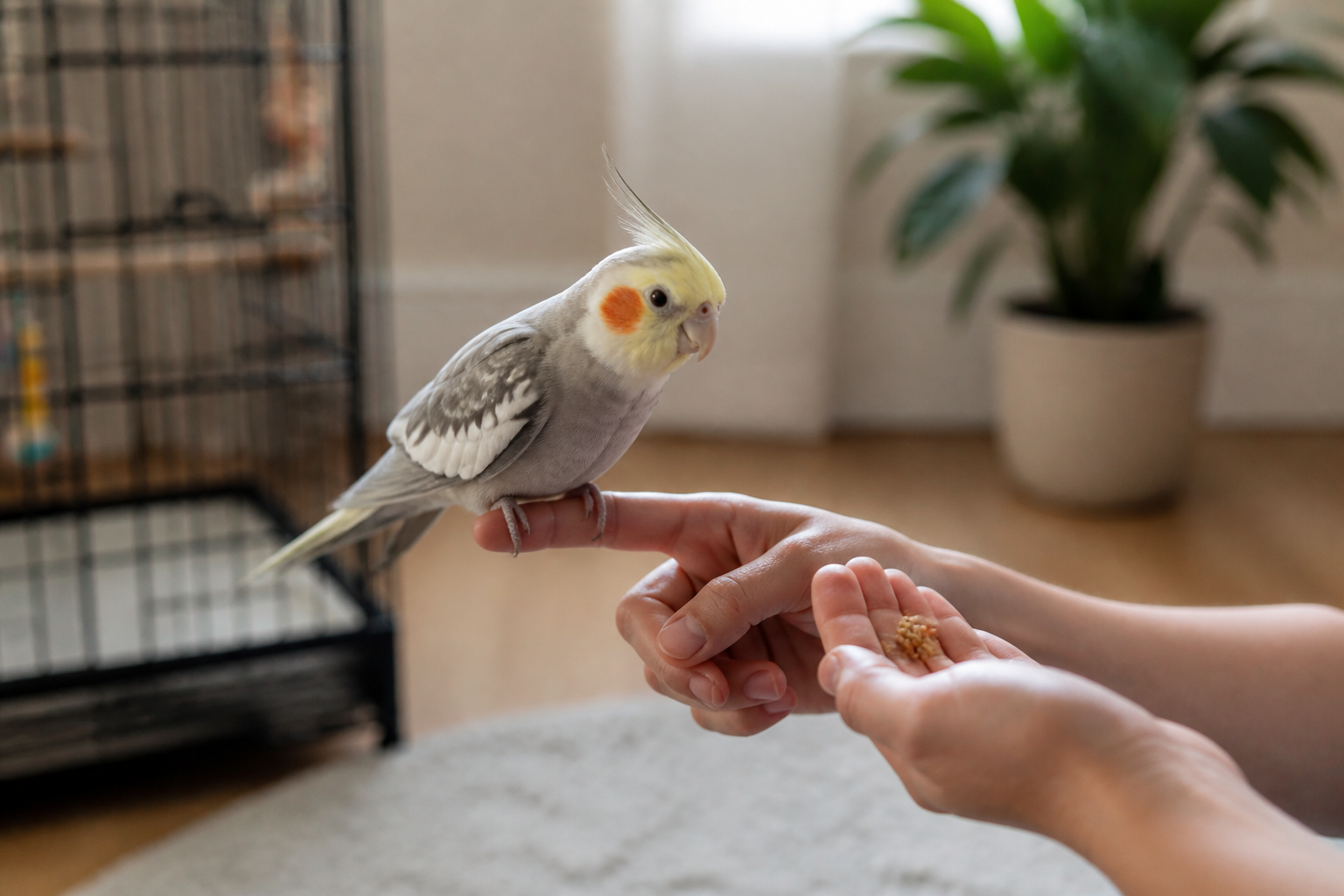
A confident, low "step up" invitation with a reward turns handling into something the bird chooses.
Step 4: Read body language and respect "no"
Learning to read your bird prevents most bites and setbacks. Relaxed birds preen, fluff briefly, grind their beak and sit on one foot. A bird that leans away, pins its eyes, holds feathers tight, hisses or lunges is saying "not now". Backing off when your bird says no is exactly what builds trust , it learns you listen.
Step 5: Make connection a daily habit
Bonds are maintained, not won once. Build short, positive interactions into every day: talking during breakfast, foraging games, shared quiet time, and training a fun trick. Consistency from everyone in the household matters , a bird that trusts one person and fears the rest is under more stress than one with a calm, predictable flock.
Living context by region
This guide is written for multi-region English readers (US/UK/AU/NZ/CA/EU and more). Where climate, products, or vet access differ, prefer local veterinary advice and local product labels. Use metric first; keep °F/lb in mind for North American homes.
When to call your vet
-
Signs are getting worse over hours, not better
-
Pain, persistent vomiting/diarrhea, or neurological signs
-
You needed force or guesswork to keep going at home
Common mistakes
-
Waiting because the animal 'still looks okay' while prey species hide pain
-
Changing five variables at once so you cannot tell what helped
-
Copying drug doses from social media
-
Skipping species-appropriate husbandry while buying more gadgets
FAQ
How long does it take to bond with a bird?
Should I let my bird out before it is tame?
My bird only bonds with one person , is that a problem?
Are treats bribery , will my bird only like me for food?
My highlights & notes
This article is for general education and is not a substitute for professional veterinary advice. If your pet is unwell, please consult a veterinarian.
Worried about your pet?
Peqaboo’s AI helps you track symptoms, understand lab reports, and know when to see a vet.
Get the Peqaboo app