Ball Python Care: A Complete Beginner Hub
Ball pythons are calm, hardy snakes and a popular first pet. This hub covers the heat gradient and secure hides they need, humidity for clean sheds, a simple frozen-thawed feeding routine, the enclosure and heating debates keepers actually have, gentle handling, and the health signs that warrant a reptile vet.

Quick answer
Ball pythons are one of the best beginner snakes: docile, slow-moving, a manageable adult size, and content to eat only every week or two. Get four things right and the rest falls into place — a secure enclosure with a genuine warm-to-cool temperature gradient, two snug hides, humidity in the right band, and clean water. Feed appropriately sized frozen-thawed rodents and handle gently once your snake has settled in. Everything below is detail on those pillars, plus the honest trade-offs experienced keepers actually argue about.

Ball pythons are calm, hardy snakes and a popular first pet.
- Adult length
- 1–1.5 m (females larger)
- Lifespan
- 20–30+ years
- Warm side surface
- 31–32°C
- Cool side
- 25–26°C
- Humidity
- 55–65% (higher in shed)
- Feeding
- every 7–14 days
- Care level
- Beginner-friendly
Is a ball python right for you?
Before the shopping list, a reality check. A ball python you buy as a hatchling may still be with you when you are twenty or thirty years older — they routinely outlive dogs, and 30-plus years is well documented in captivity. That longevity is the single most underestimated part of keeping one.
They are also famous for going off food. A healthy adult can refuse meals for weeks or even a few months, particularly through the cooler, drier part of the year, and first-time keepers often panic when nothing is actually wrong. If a snake that fasts calmly while holding its weight would stress you out, that is worth knowing now rather than later.
Finally, always buy captive-bred. Captive-bred ball pythons are hardy, feed reliably, and carry far fewer parasites than wild-caught imports, which are often dehydrated, mite-ridden and reluctant to eat. A reputable breeder or a well-run reptile shop that can tell you the hatch date and feeding history is worth paying a little more for.
Housing: which enclosure, and how big
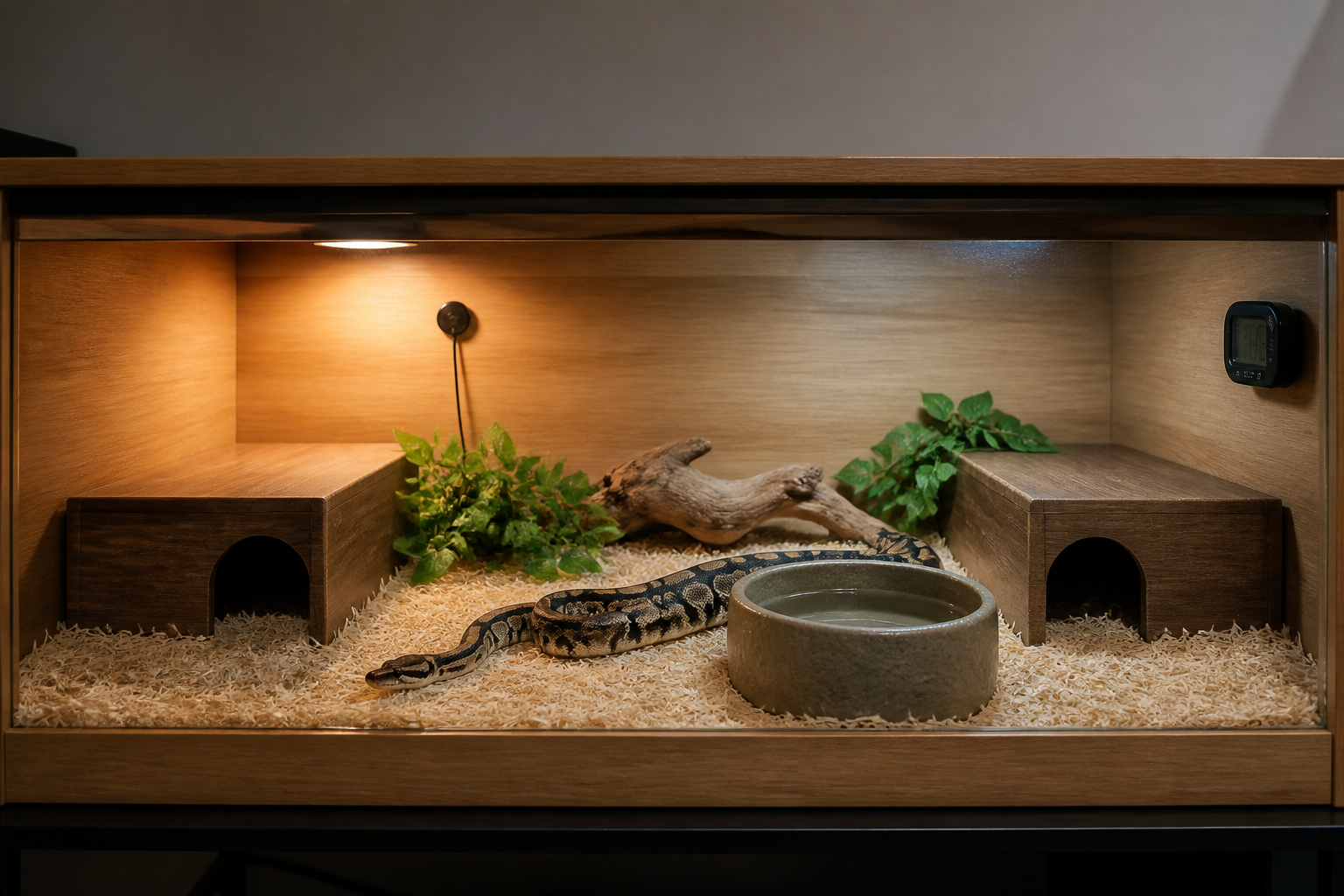
An adult does well in a floor space around 90–120 cm long. Hatchlings can feel exposed in a huge space, so many keepers either start small and upgrade, or use a large enclosure from the start with plenty of clutter (hides, plants, branches) to break up the open floor. Height matters little — these are ground-dwelling snakes — but security matters enormously. A ball python will push at every seam, so a locking or clip-down lid is non-negotiable.
Here the hobby genuinely splits into camps, and both work:
| Enclosure style | Best for | Trade-offs |
|---|---|---|
| PVC / plastic vivarium | Most keepers; holds heat and humidity well | Mid-range cost, less "display" glass |
| Glass terrarium (mesh top) | Display, planted setups | Loses humidity fast; may need a covered top |
| Wooden vivarium | UK-style builds, good insulation | Heavy, needs sealing against moisture |
| Rack / tub system | Keepers with several snakes, breeders | Minimal enrichment; efficient not decorative |
The rack-versus-vivarium argument is the classic one. Rack (tub) systems keepers prioritise stable heat and humidity and a snake that feels secure in a small, dark space; display-vivarium keepers prioritise enrichment, naturalistic planting and simply enjoying the animal. A single pet snake in a well-furnished vivarium with enough hides is perfectly happy — the key in either camp is enough cover, not the label on the box.
Cost for a suitable adult setup runs roughly US$150–400 / £120–350 / A$250–500 / HK$1,200–3,000, depending on whether you buy PVC, glass or second-hand.

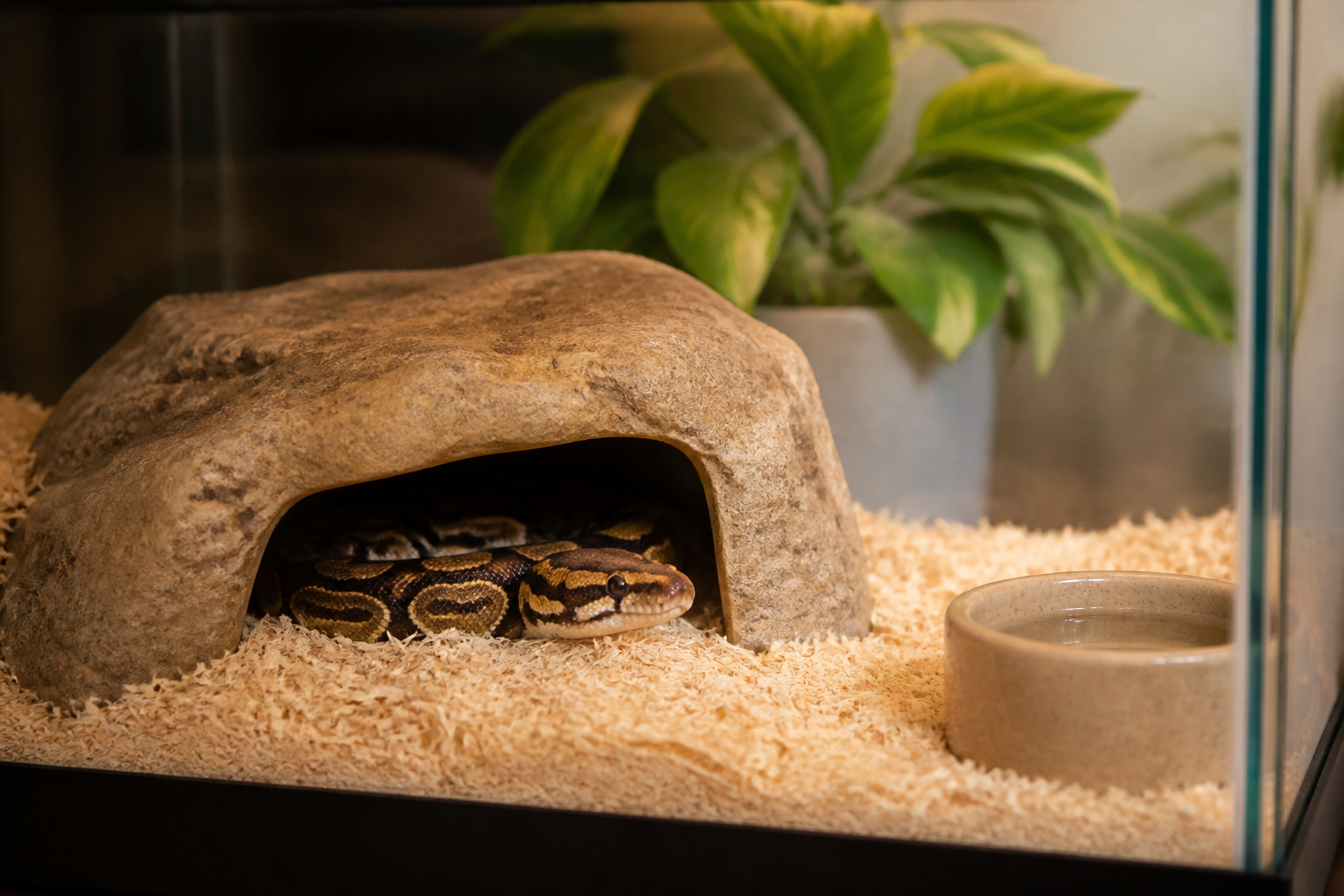
A warm hide and a cool hide let a ball python choose its temperature while always feeling covered.
The heat gradient, and how to power it
The single most important husbandry number is the gradient: a warm end around 31–32°C at the surface where the snake basks, and a cool end around 25–26°C, so it can thermoregulate by simply moving. Every heat source must run through a thermostat — this is not optional. An unregulated heat mat or bulb can and does cause serious burns.
How you deliver that heat is the second great debate:
| Heat source | How it works | Notes |
|---|---|---|
| Heat mat (under-tank) | Belly heat through the floor | Long the US default; must be on a thermostat, gives no air warmth |
| Overhead basking bulb | Radiant heat + light from above | UK/EU-favoured, more natural "sun" model; off at night |
| Deep heat projector (DHP) | Radiant heat, no visible light | Warms air and surfaces day or night; increasingly popular |
| Ceramic heat emitter (CHE) | Infrared heat, no light | Good for night heat; needs a ceramic fixture and guard |
Regionally, North American keepers have traditionally used under-tank heat mats, while a strong UK/European school argues that snakes evolved to take heat from above (the sun) and favours overhead radiant sources like a DHP or guarded bulb. Both keep a snake healthy when thermostatically controlled. What matters is measuring the actual surface temperature with a probe or infrared thermometer, not trusting a dial.
UVB and lighting
For years ball pythons were kept in the dark with no UV at all, and many lived long lives. The modern consensus has shifted: a low-level UVB source (a low-percentage tube, correctly distanced) is increasingly recommended because it supports vitamin D3 and calcium metabolism and better matches how the animal evolved. It is not strictly mandatory the way heat is, but it is a reasonable upgrade. If you add UVB, give the snake shade and hides so it can dose itself, and keep a regular day-night light cycle (roughly 12 hours) rather than leaving lights on around the clock.
Humidity, substrate and water
Aim for humidity around 55–65%, rising to 70% or more during a shed. The right substrate helps you hold it. Here too there are two schools:
- Simple / clinical: paper towel, newspaper or aspen. Cheap, hygienic, easy to spot-clean, and the standard in rack systems. Downside: it does little for humidity or enrichment.
- Naturalistic / bioactive: a deep organic mix (coconut fibre, cypress mulch, soil blends) with live plants and clean-up crew (springtails, isopods) that break down waste. Holds humidity beautifully and looks superb, but costs more and takes knowledge to set up and keep balanced.
Climate decides how hard you have to work. In humid Hong Kong, Taiwan or Singapore summers, enclosures often sit too wet, and the fix is more ventilation, not more misting — chronic damp plus poor airflow invites scale rot and respiratory infection. In an air-conditioned or centrally heated room, the air is dry and you will lean on a larger water bowl, a partly covered top, and occasional misting.
Always provide a sturdy water bowl big enough for the snake to soak in, and keep it scrupulously clean — snakes often defecate in it.
Feeding
Feed a frozen-thawed rodent roughly as wide as the snake's thickest part, offered every 7–14 days. Thaw fully to a warm (not hot) temperature — a sealed bag in warm water works well — and never microwave prey. Offer with long tongs so your fingers never smell like dinner.
A rough schedule by size:
| Life stage | Prey size | Frequency |
|---|---|---|
| Hatchling | Pinky / fuzzy mouse | Every 5–7 days |
| Juvenile | Hopper to small adult mouse | Every 7 days |
| Sub-adult | Small rat | Every 10–14 days |
| Adult | Medium rat | Every 14 days |
Two feeding debates worth knowing. Frozen-thawed versus live: frozen-thawed is safer (a live rodent can bite and injure a snake) and is the mainstream recommendation; in the UK and parts of Europe feeding live vertebrate prey where a humane alternative exists is also legally and ethically discouraged. Live feeding is only justified for the rare snake that stubbornly refuses F/T, and even then experienced keepers work hard to convert it. Power feeding (deliberately over-feeding to grow a snake fast) is popular in some breeding circles but is widely criticised for the same reason it works — it stresses the animal and drives obesity. For a pet, measured feeding and a stable weight is the goal.
Handling and taming
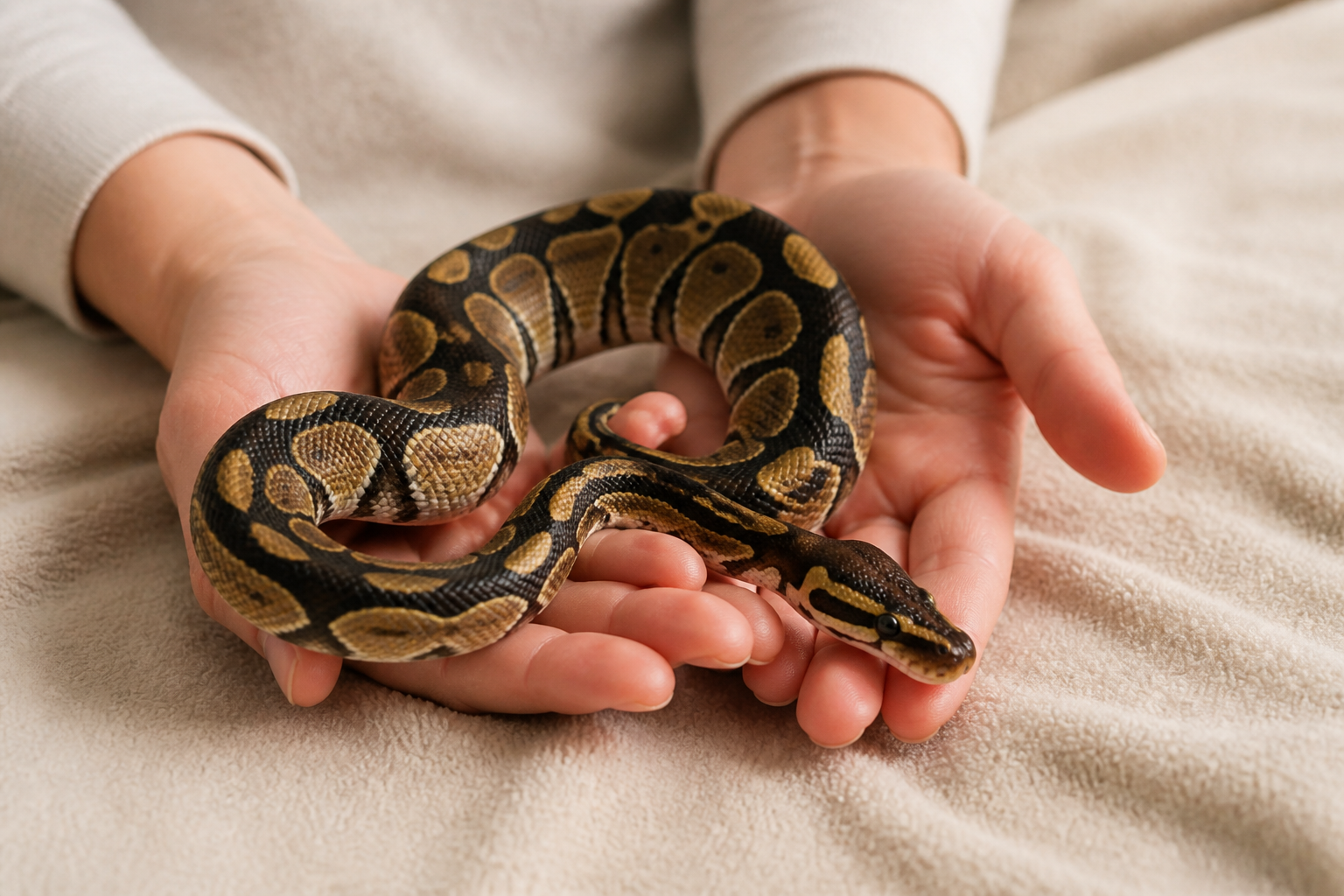
Let a new snake settle for a week or two before handling, and skip handling for about 48 hours after a meal to avoid regurgitation. Support the body from underneath and let the snake flow through your hands rather than gripping or restraining it — ball pythons feel secure with support and threatened by a tight hold. Keep early sessions to a few minutes and build up. Avoid handling when the eyes cloud over blue-grey before a shed: vision drops and the snake is more defensive and easily startled.

Support the body from underneath and let the snake move through your hands rather than gripping it.
Shedding
A healthy snake sheds in one complete piece, eye caps and tail tip included. In the days before, the skin dulls, the belly pinks slightly and the eyes go milky blue before clearing again a few days ahead of the shed. Raising humidity during this window is the single best thing you can do. Retained shed — especially over the eyes or on the tail tip, where a stuck ring can cut off circulation — almost always traces back to humidity being too low.
Health and warning signs
A healthy ball python has clear eyes, a firm rounded body, clean nostrils, a clean vent, and sheds in one piece. Respiratory infections and stuck shed are the two most common problems and usually trace back to temperature or humidity being off.
| Sign | Likely meaning |
|---|---|
| Open-mouth breathing, wheezing, nose bubbles | Respiratory infection — vet |
| Retained shed over eyes / tail | Humidity too low |
| Constant soaking | Mites or enclosure too hot |
| Refusing food + weight loss | Husbandry problem or illness |
| Swollen or discoloured belly | Scale rot or internal issue — vet |