

Megaesophagus
Also known as: Esophageal weakness, Esophageal hypomotility, Idiopathic megaesophagus, Congenital megaesophagus
In short
Megaesophagus is a serious condition where the esophagus loses its muscle tone and dilates, preventing food and water from reaching the stomach. This leads to passive regurgitation and a high risk of life-threatening aspiration pneumonia.
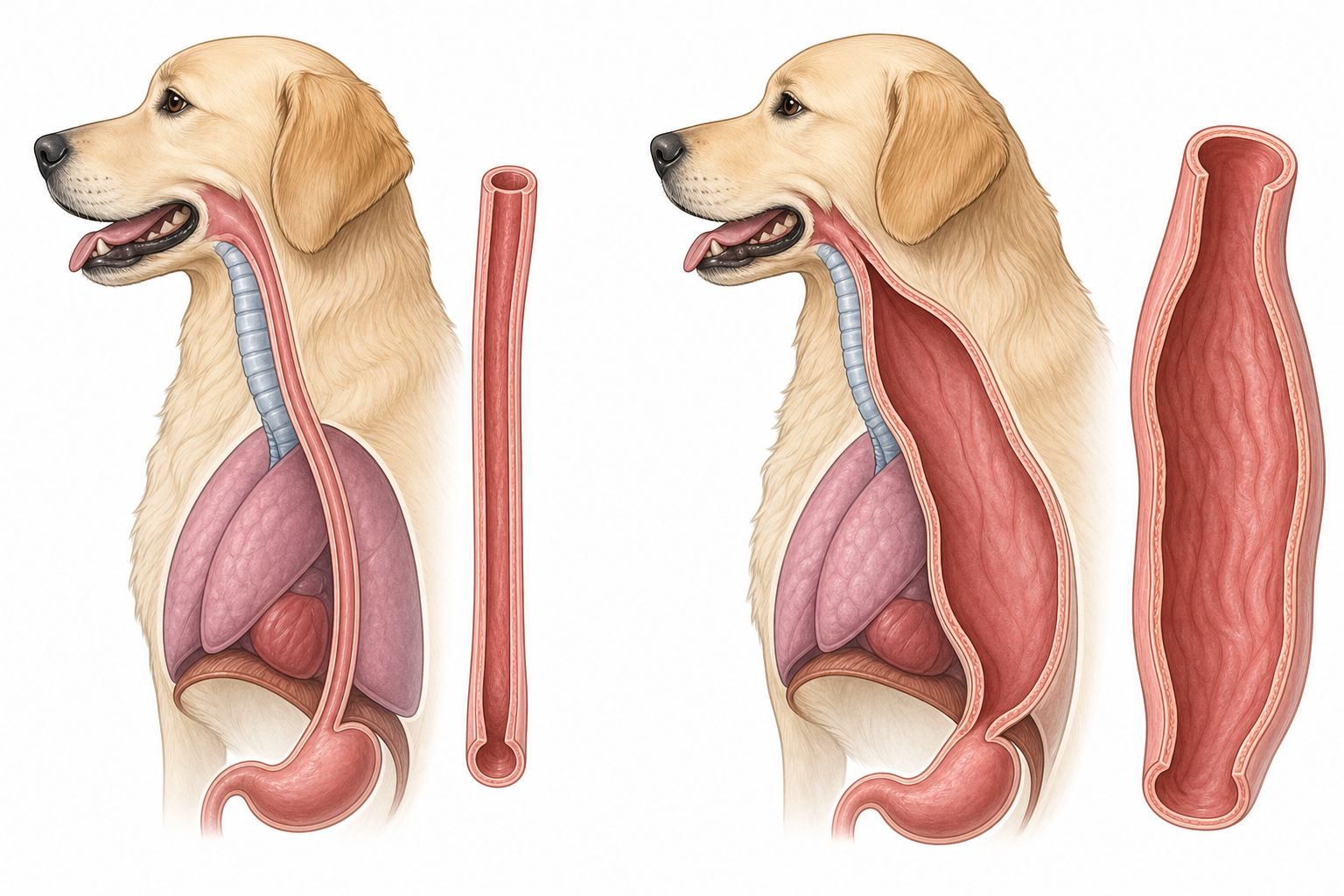
TL;DR. Megaesophagus is a serious condition where the esophagus loses its muscle tone and dilates, preventing food and water from reaching the stomach and causing passive regurgitation and a high risk of life-threatening aspiration pneumonia.
A normal esophagus (top) compared to a dilated megaesophagus (bottom) where food pools instead of entering the stomach.
What is it?
Megaesophagus is a structural and functional disorder of the upper digestive tract. Under normal conditions, the esophagus acts as an active muscular tube. When your pet swallows food or water, the muscles of the esophagus contract in coordinated, wave-like motions called peristalsis. This process actively pushes the swallowed material down into the stomach, where digestion begins.
In pets with megaesophagus, this muscular transit system fails. The esophagus loses its muscle tone and ability to contract (a state known as hypomotility). As a result, the tube stretches out and becomes abnormally dilated. Instead of moving downward, food, water, and saliva pool inside the limp esophagus. This pooled material cannot reach the stomach, leaving the animal unable to absorb vital nutrients and water.
Because the food is trapped in the esophagus, it is eventually cast back up through a passive process called regurgitation. Unlike vomiting, which is an active process involving abdominal retching and muscle contractions, regurgitation happens silently and often without warning. The trapped, undigested food simply spills back out of the mouth. This creates a severe risk: because the pet's normal swallowing reflexes are compromised, this pooled material can easily be inhaled into the trachea and lungs, leading to a dangerous and often fatal lung infection known as aspiration pneumonia.
Causes & risk factors
Megaesophagus can be classified as either congenital (present from birth) or acquired (developing later in life). While it can affect both dogs and cats, it is significantly more common in dogs.
For adult pets that develop the condition, the vast majority of cases are classified as idiopathic, meaning that despite thorough medical testing, no underlying cause can be identified. A leading veterinary internal medicine reference notes:
"Acquired megaesophagus can develop in association with a number of primary diseases in dogs and cats, but most adult-onset cases are idiopathic."
When an underlying cause is identified, the most common culprit is myasthenia gravis. This is an autoimmune disorder that disrupts the communication between nerves and muscles, leading to widespread muscle weakness, including the muscles of the esophagus. Other potential causes of acquired megaesophagus include:
- Hypoadrenocorticism (Addison's disease): A hormonal imbalance that affects muscle function and electrolyte levels.
- Toxins: Poisoning from heavy metals such as lead or thallium.
- Systemic autoimmune diseases: Conditions like systemic lupus erythematosus.
- Esophageal blockages or damage: Esophageal tumors (neoplasia) or severe inflammation of the esophageal lining (esophagitis).
- Muscle disorders: Inflammatory myopathies that directly weaken muscle tissue.
Certain breeds are genetically predisposed to developing megaesophagus. In dogs, these include the Golden Retriever, Irish Setter, Miniature Schnauzer, Great Dane, Dalmatian, Chinese Shar-Pei, Labrador Retriever, German Shepherd Dog, and Collie. In cats, the Somali and Abyssinian breeds are known to have a higher risk.
Signs to watch for
The symptoms of megaesophagus stem directly from the physical inability to move food into the stomach and the secondary complications that arise in the respiratory tract.
- Regurgitation (Cardinal): The effortless, passive casting up of undigested food, saliva, or water. This is the hallmark sign of the disease and can happen minutes to hours after eating.
- Weight loss (Common): Because food is regurgitated before it can reach the stomach to be digested, pets quickly lose weight.
- Coughing (Common): A persistent, wet cough is a primary indicator that food or liquid has entered the lungs, signaling the onset of aspiration pneumonia.
- Emaciation (Common): Severe muscle wasting and malnutrition occur as the condition progresses.
- Aspiration pneumonia (Common): A life-threatening lung infection caused by inhaling regurgitated material, characterized by labored breathing and lethargy.
- Fever (Occasional): Typically develops when aspiration pneumonia has set in, indicating an active infection.

A Bailey Chair keeps the pet upright during and after meals, allowing gravity to guide food to the stomach.
It is vital for owners to distinguish between vomiting and regurgitation. Vomiting is preceded by nausea, drooling, lip-licking, and forceful abdominal contractions. Regurgitation, on the other hand, is a sudden, passive event where food or liquid simply slips out of the throat, often shaped like a tube or coated in slimy mucus.
How vets diagnose it
Diagnosing megaesophagus requires a combination of imaging to visualize the esophagus and laboratory tests to search for underlying causes.
Your vet will start with plain survey radiographs (X-rays) of the chest. In a healthy pet, the esophagus is invisible on standard X-rays because it is collapsed and empty. In a pet with megaesophagus, the X-rays will often reveal a large, air- or fluid-filled tube running through the chest cavity. According to a leading veterinary internal medicine reference:
"Plain survey radiographs are often diagnostic, but contrast radiography may be useful to confirm the diagnosis and evaluate motility."
If standard X-rays are inconclusive, your vet may perform contrast radiography (a barium swallow study). The pet swallows a liquid contrast agent that coats the inside of the esophagus, making its shape and size highly visible on X-rays. To evaluate the esophagus in real-time, your vet may use fluoroscopy, which is essentially a moving X-ray video that allows them to watch the swallowing process and directly observe the lack of muscular contractions (hypomotility).
An endoscopy may also be performed. This involves passing a small camera down the pet's throat to visually inspect the lining of the esophagus. This test is highly useful for identifying secondary esophagitis (severe inflammation and ulceration caused by sitting acid and food), as well as ruling out physical blockages or tumors.
Finally, because myasthenia gravis is the most common known cause of acquired megaesophagus, your vet should run an acetylcholine receptor antibody assay. This specialized blood test is the gold standard for diagnosing myasthenia gravis and is crucial for determining the correct treatment plan.
Treatment options
Managing megaesophagus requires a dual approach: strict nutritional management and targeted medical therapy. There is no surgical cure for generalized esophageal weakness, so treatment focuses on using gravity to help food reach the stomach and managing secondary complications.
Nutritional and Physical Management
The most critical component of therapy is gravity-assisted feeding. Because the esophagus cannot contract, the pet must be held in an upright, vertical position during feeding and for 20 to 30 minutes afterward. This allows gravity to pull the food down into the stomach.
A leading veterinary internal medicine reference outlines this standard of care:
"Affected animals should be fed small amounts of high-calorie diet at frequent intervals from an elevated position to allow gravity to assist passage into the stomach. The 'Bailey Chair' is an example of a positioning device that may be useful."
The consistency of the food must be tailored to the individual pet. Some pets do best with a liquid slurry, while others do better with solid food rolled into small, easily swallowed meatballs.
Medical Therapies
Medications are prescribed based on the underlying cause and to protect the delicate lining of the esophagus.
- Anticholinesterase Agents (First-Line): If the pet is diagnosed with myasthenia gravis, medications like pyridostigmine are prescribed. This drug helps restore communication between nerves and muscles, which can significantly improve esophageal motility. However, other immunosuppressive options have limitations; as noted in veterinary literature, "Mycophenolate mofetil, a new immunosuppressant drug, does not improve clinical outcome when added to pyridostigmine therapy in dogs with acquired myasthenia gravis."
- Gastroprotectants (First-Line): Because regurgitated material often contains stomach acid that damages the esophagus, gastroprotectants like sucralfate are used to coat and heal ulcers.
- Acid Reducers (First-Line): Proton pump inhibitors such as omeprazole, or H2-receptor antagonists like famotidine, ranitidine, or cimetidine, are prescribed to lower stomach acid levels, reducing the risk of severe esophagitis.
- Immunosuppressants (Second-Line): If the megaesophagus is secondary to an autoimmune disease like lupus or immune-mediated myositis, corticosteroids (such as glucocorticoids) or stronger immunosuppressants like azathioprine may be used.
- Prokinetic Agents: Medications like cisapride or metoclopramide may be used to help stimulate movement in the gastrointestinal tract, though their ability to stimulate the esophagus itself is limited.
Prognosis
The prognosis for pets with megaesophagus is generally guarded to poor. This is not because the esophageal dilation itself is immediately fatal, but because of the high risk of recurrent, severe complications.
The primary cause of death or euthanasia in these pets is aspiration pneumonia or progressive emaciation from malnutrition. Managing a pet with megaesophagus requires an extraordinary commitment of time, effort, and financial resources. For dedicated owners who can strictly adhere to elevated feeding protocols and recognize the early signs of pneumonia, some pets can maintain a reasonable quality of life for months or even years. However, the risk of sudden, life-threatening respiratory infection remains a constant threat.
Prevention
Because the majority of megaesophagus cases are either congenital or idiopathic, there are no established prevention methods. For breeds known to be predisposed to the condition, responsible breeding practices are essential. Dogs or cats that have produced offspring with congenital megaesophagus, or those diagnosed with the condition themselves, should not be bred.
When to call your vet
If your pet has been diagnosed with megaesophagus, you must monitor them constantly for signs of respiratory distress. Aspiration pneumonia can develop rapidly and is a life-threatening medical emergency.
Contact your veterinarian immediately or seek emergency care if you notice:
- A new or worsening cough
- Rapid, shallow, or labored breathing
- Fever or extreme lethargy
- Nasal discharge (especially if it contains food particles)
- A complete refusal to eat or sudden inability to keep liquids down
For specific breeds
If you own a breed highly predisposed to megaesophagus, such as a Miniature Schnauzer, Great Dane, German Shepherd, Golden Retriever, Irish Setter, Dalmatian, Chinese Shar-Pei, Labrador Retriever, or Collie, or a cat of the Somali or Abyssinian breed, be highly vigilant. Any unexplained regurgitation or chronic coughing in these breeds warrants immediate veterinary evaluation. Early diagnosis and the rapid implementation of elevated feeding can prevent the onset of severe aspiration pneumonia.
Sources
- Small Animal Critical Care Medicine, 2nd Edition, p. 695
- Small Animal Critical Care Medicine, 2nd Edition, p. 696
- Small Animal Critical Care Medicine, 2nd Edition, p. 706
My highlights & notes
Signs & symptoms
Breeds at higher risk
How it is diagnosed
- Acetylcholine receptor antibody assayGold standard
- Contrast radiography
- Endoscopy
- Fluoroscopy
- Plain survey radiographs
Treatment approaches
Treatment must be prescribed by a licensed veterinarian based on your pet. Specific drug doses are intentionally not shown here.
Frequently asked questions
What is Megaesophagus?
Megaesophagus is a serious condition where the esophagus loses its muscle tone and dilates, preventing food and water from reaching the stomach. This leads to passive regurgitation and a high risk of life-threatening aspiration pneumonia.
What are the symptoms of Megaesophagus?
Bringing up undigested food、Emaciation、Weight loss (getting thinner)、aspiration pneumonia、Coughing、Fever
How is Megaesophagus diagnosed?
Acetylcholine receptor antibody assay、Contrast radiography、Endoscopy、Fluoroscopy、Plain survey radiographs
How is Megaesophagus treated?
Treatment must be prescribed by a licensed veterinarian based on your pet. Specific drug doses are intentionally not shown here.
Sources
- Small Animal Critical Care Medicine, 2nd Edition (VetBooks.ir) · p. 696
- Small Animal Critical Care Medicine, 2nd Edition (VetBooks.ir) · p. 695
- Small Animal Critical Care Medicine, 2nd Edition (VetBooks.ir) · p. 696
- Small Animal Critical Care Medicine, 2nd Edition (VetBooks.ir) · p. 706
This article is for general education and is not a substitute for professional veterinary advice. If your pet is unwell, please consult a veterinarian.
Worried about your pet?
Peqaboo’s AI helps you track symptoms, understand lab reports, and know when to see a vet.
Get the Peqaboo app